
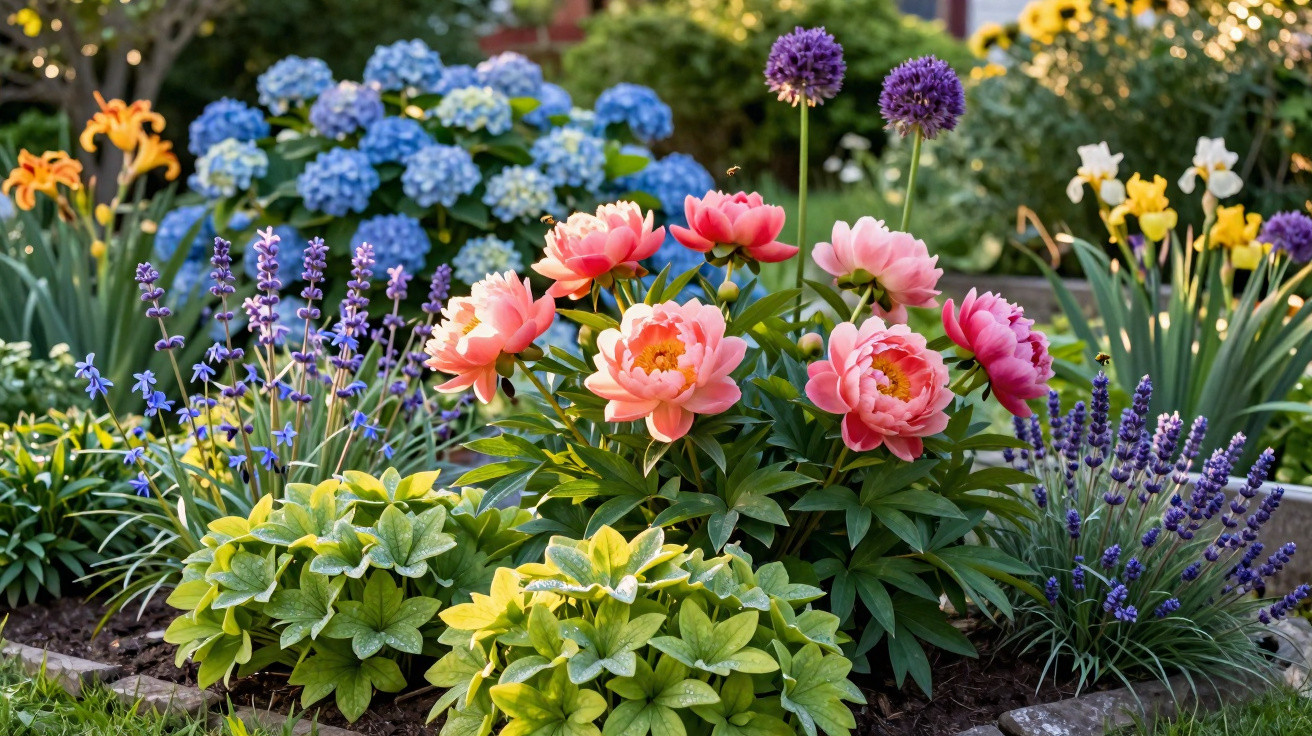
Anyone who has stood before a large peony border in May or June is unlikely to forget the sight. The lavish flower heads, delicate fragrance and rich green foliage can seem almost unreal. It becomes especially interesting when these perennials are not simply planted anywhere, but are paired deliberately with plants that support them visually and help keep them healthy.
What peonies need before companion plants move in
Before deciding what to plant alongside them, it is important to understand what peonies themselves prefer. They need plenty of light, or at least partial shade, along with deep, nutrient-rich soil that drains freely. Winter waterlogging is disastrous, as are overcrowded borders where no air can circulate around the leaves.
The reason is simple: when air is stagnant in the border and foliage does not dry quickly after rain, fungal diseases spread far more rapidly. Grey mould is particularly feared, as this fungal disease turns buds brown and can spoil entire flowers.
- Position: sunny to partially shaded, preferably open to breezes
- Soil: deep, humus-rich and free-draining, without becoming waterlogged in winter
- Spacing: leave air around every perennial and avoid dense rows
When planning a new border, plant the peonies first, then arrange the other perennials around them. This keeps the emphasis in the right place: the flowering stars take centre stage, while their companions work in the background.
The best companions: perennials that enhance the peony display
Lady's mantle as a soft carpet
Lady's mantle is a classic choice for a perennial border. The plant forms dense, rounded cushions of soft, rounded leaves. In early summer, they are covered by a haze of tiny yellowish-green flowers. This contrast makes the rounded peony blooms stand out all the more vividly.
"The gentle veil of lady's mantle flowers makes bold peony colours look as though they were lit in a professional photography studio."
It is practical, too: lady's mantle stays relatively low, scarcely crowds the peony roots and shades the soil without covering the perennials themselves. The pairing works just as well in a cut-flower arrangement as it does in the border.
Bellflowers and other perennials with nodding blooms
Bellflowers, along with similar plants bearing drooping, bell-shaped flowers, bring a sense of lightness to the planting. While peonies dominate with their large, rounded flower heads, bellflowers add plenty of smaller touches of colour between them.
Choosing the right variety matters. Tall, spreading types are better placed at the back of the border, whereas compact varieties can be planted near the peonies. They make little competition for nutrients and light, yet noticeably extend the overall flowering season.
Hydrangeas as a calm backdrop behind peonies
Where there is enough room, hydrangeas can be planted behind the peonies. These shrubs also produce weighty flower heads, but act as a calm backdrop that makes the perennials in front stand out even more. Given sufficient distance, hydrangeas offer light shade during the hottest weeks of summer without leaving peonies permanently in darkness.
As hydrangeas generally begin flowering a little later, the display passes on naturally: peonies dominate first, then the shrubs gradually take over the stage.
Planning a flowering sequence: iris, allium and daylilies
A thoughtfully designed border can provide flowers from spring well into summer. Peonies may be magnificent, but their main season is limited. Other perennials and bulbous plants can fill the gaps.
- Iris: usually flower shortly before peonies, have similar requirements and provide strong colour effects.
- Ornamental alliums (Allium): rounded flower heads, vertical accents and ideal for planting between perennials.
- Daylilies: often begin as peonies start to fade and continue through to high summer.
With their upright leaves, irises give the planting structure, whereas peonies tend to grow into broad, bushy clumps. Alliums add vertical points with their tall stems and purple spheres, creating striking sightlines alongside peony flowers. Daylilies then take over in high summer, ensuring that the border does not look empty once the peony season has passed.
Lavender as a fragrant bodyguard for peonies
Lavender is an almost ideal partner. It likes warmth, sunshine and free-draining soil, just like peonies do. Planted along the edges or in front of the perennials, lavender creates an aromatic line that does more than look attractive.
"Lavender protects the peony border with its fragrance like an invisible fence against unwelcome visitors."
Many insects and animals that nibble leaves and flowers avoid its intense scent. These include mosquitoes, flies, some insect pests and, in rural areas, even deer. Ornamental alliums reinforce this effect: the plant's slightly sulphurous note deters a range of insects without bothering the gardener.
Using protective planting effectively
Anyone adding bellflowers or other more vulnerable perennials to the border should frame them with such fragrant plants. This reduces the risk of pests multiplying in large numbers and eventually affecting the peonies as well.
| Plant | Main benefit alongside peonies |
|---|---|
| Lady's mantle | visual enhancement, ground cover, soft transitions |
| Bellflowers | delicate addition, longer flowering period in the border |
| Hydrangeas | backdrop, light summer shade |
| Ornamental alliums | vertical accents, slight protection from pests |
| Lavender | fragrant barrier, insect deterrent, structure along the border edge |
These combinations harm peonies over time
Although peonies appear robust, certain neighbours make life difficult for them. Vigorous root competitors and species that need permanently wet soil are particularly problematic. Neither suits the nature of these early-flowering perennials.
Large, spreading ornamental grasses or very expansive perennials with strong rhizomes deprive peonies of light and nutrients. Within a few years, only a handful of weak shoots may remain. Plants requiring constant moisture also create a microclimate in which fungi can thrive.
"Anyone who loves peonies avoids tight planting with spreading grasses and permanently damp companions."
The rule of thumb is that anything growing so densely that the soil beneath it is barely visible should not be planted in the immediate vicinity of peonies. An open border with clear spacing and carefully chosen companion plants is a better approach.
Practical tips: spacing and care techniques
One common mistake is filling the border completely from the outset. Peonies, however, need years to reach their eventual size. Give them sufficient room and they will reward you later with ever-larger towers of blooms.
- Plant peonies at least 60–80 centimetres apart.
- Position low-growing partners such as lavender and lady's mantle at the edge, with taller plants behind them.
- Remove wilted leaves after heavy rain so that fungi have less opportunity to take hold.
Once established, peonies prefer to be left undisturbed. Frequent division or transplanting often delays flowering for years. It is better to place new companion plants carefully into existing gaps than to interfere with the peonies themselves.
Why companion planting makes such a difference for peonies
Peonies can look good on their own in a lawn, but their potential is much clearer in a mixed perennial border. Colourful companion plants, varied growth heights and the right fragrant backdrop can turn a few perennials into a genuine focal point that neighbours stop to admire every year.
For amateur gardeners, it is worth playing consciously with contrasts: delicate clouds of flowers against large heads, upright allium stems against rounded peony clumps, and the cool purple tones of lavender against the warm pink and cream shades of the perennials. A little experimentation soon shows why professionals refer to "companion plants" rather than mere filler.
The resilience aspect is equally compelling. Fragrant barriers, airy planting distances and suitable soil companions noticeably reduce disease pressure. Instead of relying on fungicides, gardeners use plants that reinforce one another. The result is a border that not only looks spectacular in May, but flowers reliably for years – and that is precisely the appeal of well-combined peonies.

Comments
No comments yet. Be the first to comment!
Leave a Comment