
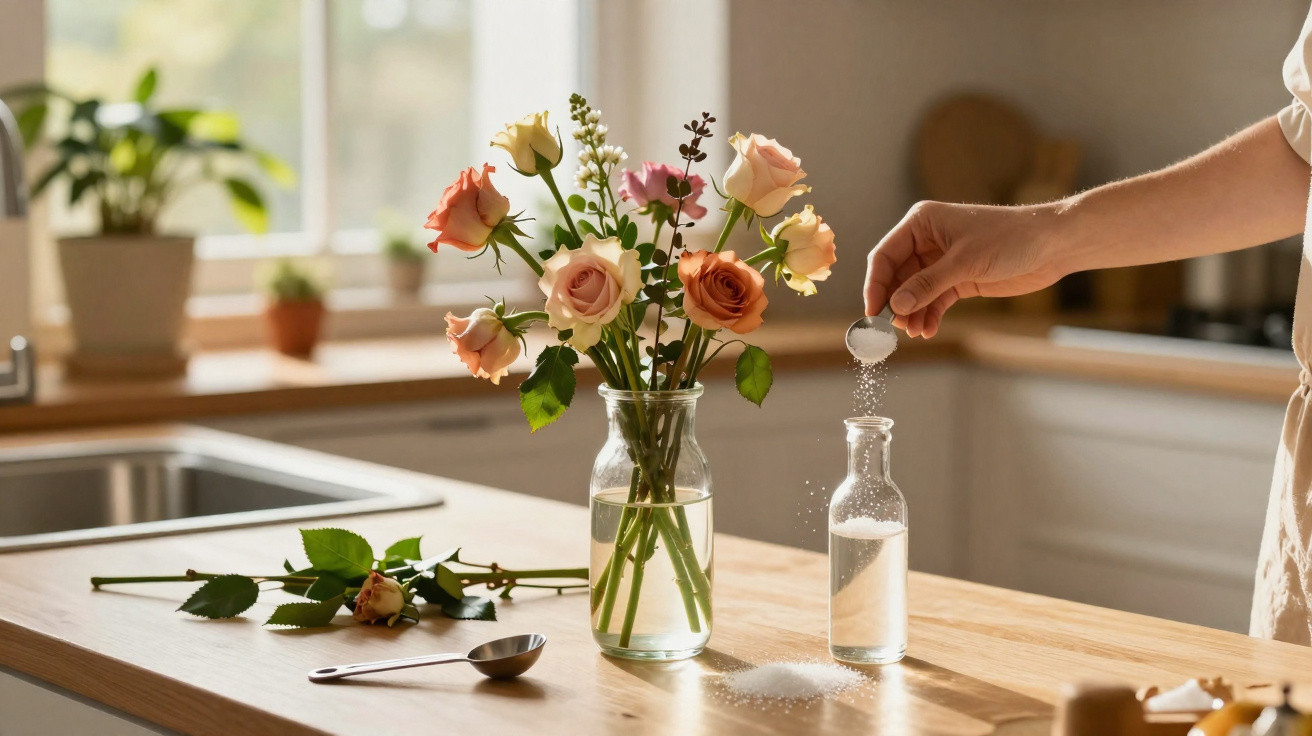
Today, the roses a friend brought round are drooping over the edge of the vase, as though they have abandoned both romance and gravity. According to one florist, they may yet be saved with a spoonful of sugar, a few drops of vinegar and several small steps that amount to first aid for flower stems.
At 7:14 a.m., the shutters rose at a small shop just off the high street. The florist picked up a bunch of weary tulips from the previous day’s display, their bent necks shaped like question marks. After washing a weighty glass vase, she tested the lukewarm tap water on her wrist and took out two ordinary-looking items: a jar of sugar and a bottle of white vinegar. The room smelled faintly of apples and rain. She cut the stems diagonally, measured out a spoonful, added the drops and waited. Before long, something subtle began to change.
How sugar and vinegar revive drooping stems
Cut flowers are more than ornaments: they are living organisms whose story has been interrupted. Sugar provides readily available energy, helping their cells remain firm and their colours stay bright. Vinegar adjusts the water conditions, discouraging bacteria from establishing themselves in the vase and blocking the stems. There is no magic involved; it is simply kitchen-table botany.
Maya, a London florist, keeps a note beside the till that reads: “Roses + sugar/vinegar: +36 hours.” It is not scientific evidence, but it is not meaningless either. She once showed me supermarket carnations that had collapsed overnight. Once they had received the mixture and a fresh cut, we placed them by the window as customers passed through the shop. Within an hour, their flower heads had lifted, as if someone had neatly straightened their collars.
Inside each stem, water travels through microscopic channels driven by tension. Slime or trapped air can obstruct that passage just as effectively as a traffic jam. Sugar gives the cells enough fuel to continue taking in water, while vinegar’s mild acidity makes the vase water less welcoming to microbes. The remedy costs pennies and can often give flowers another day or two. At breakfast, that can be the difference between a sigh and a smile.
The sugar-and-vinegar method, step by step
Begin with a clean vase filled with lukewarm water. For every litre of water, stir in 1 level teaspoon of white sugar and 3–4 drops of white vinegar. Re-cut every stem at a 45-degree angle, removing around 1–2 cm, then take off any leaves that would be submerged. Arrange the flowers with a little room around them, away from direct sunlight and hot radiators. Sugar feeds, vinegar protects - the rest is simple.
There are a few traps to avoid. Excess sugar makes the water syrupy and gives bacteria the ideal conditions to multiply, while too much vinegar may distress fragile petals. Replace cloudy water before it begins to smell unpleasant, and wash the vase instead of simply topping up old water. Realistically, few people do this every day. Even so, one change of water can revive a wilting bunch and start the clock again.
It is understandable to worry about getting it wrong when flowers carry emotional meaning. Think of the process as making tea: it is about proportions, temperature and a brief ritual. For woody stems, such as roses, let them drink a little longer in warm water before adding the mixture. Keep daffodils in a separate vase initially because their sap can affect other flowers. If cider vinegar is all you have, use fewer drops and be mindful of its scent. Your kitchen is already a laboratory; you simply may not have thought of it that way.
“You’re not reviving a corpse - you’re giving live tissue what it needs to carry on for a bit,” Maya told me, checking a line of sleepy ranunculus. “Sugar keeps the engine humming. Vinegar clears the road.”
- Ratio: 1 tsp sugar + 3–4 drops white vinegar per litre of lukewarm water.
- Cut: 45-degree angle, 1–2 cm, with a sharp knife or clean shears.
- Reset: Fresh mix and re-cut if water turns cloudy or stems slump again.
- Position: Bright room light, no direct sun, away from heat and fruit bowls.
- Exceptions: Keep daffodils separate; go gentler on delicate garden roses.
What this small flower-care ritual changes at home
We have all known the disappointment of watching a treasured bouquet fade before the week has properly begun. A spoonful of sugar and several drops of vinegar cannot stop time, but they can extend it, and sometimes that is all we want. The ritual encourages you to take another look and give something you care about a second chance before throwing it away. Care is a series of tiny choices made in quiet moments. Flowers respond to those choices, not mystically, but through straighter stems and colour that lasts as you finish your coffee. That modest rescue can also shape the rest of the day.
| Key point | Detail | Benefit for the reader |
|---|---|---|
| Recipe that works | 1 tsp sugar + 3–4 drops white vinegar per litre of warm water | A quick, inexpensive mixture made from cupboard staples |
| Timing matters | Re-cut stems and refresh water at the first sign of drooping | Adds an extra 24–48 hours of vase life in many cases |
| Know the exceptions | Keep daffodils separate; be gentle with delicate flowers; use a clean vase | Prevents common errors that reduce a bouquet’s lifespan |
FAQ
- Does the sugar-and-vinegar trick really work for all flowers? It helps most common cut flowers by nourishing cells and keeping the water clear, although especially delicate or highly woody stems may require milder ratios and additional trimming.
- Which vinegar should I use? Plain white vinegar is the best choice. Its colour is neutral, it is consistent, and it will not scent the water. When using cider vinegar, reduce the number of drops and keep the vase away from strong smells.
- How much should I add if my vase is small? Use the same proportions. For half a litre, add 1/2 tsp sugar and 1–2 drops vinegar. When unsure, use slightly less and replace the mixture the following day.
- Can I swap sugar for honey or lemonade? Honey can be used, but it may make the water cloudy more quickly. Lemonade contains both acid and sugar, but it also brings colouring and fizz. Plain granulated sugar is clean and predictable.
- Is bleach better than vinegar for the water? A very small splash of household bleach can help keep water clear, but it is easy to add too much. Vinegar is milder and, alongside sugar, provides the balance most bouquets require.


Comments
No comments yet. Be the first to comment!
Leave a Comment