
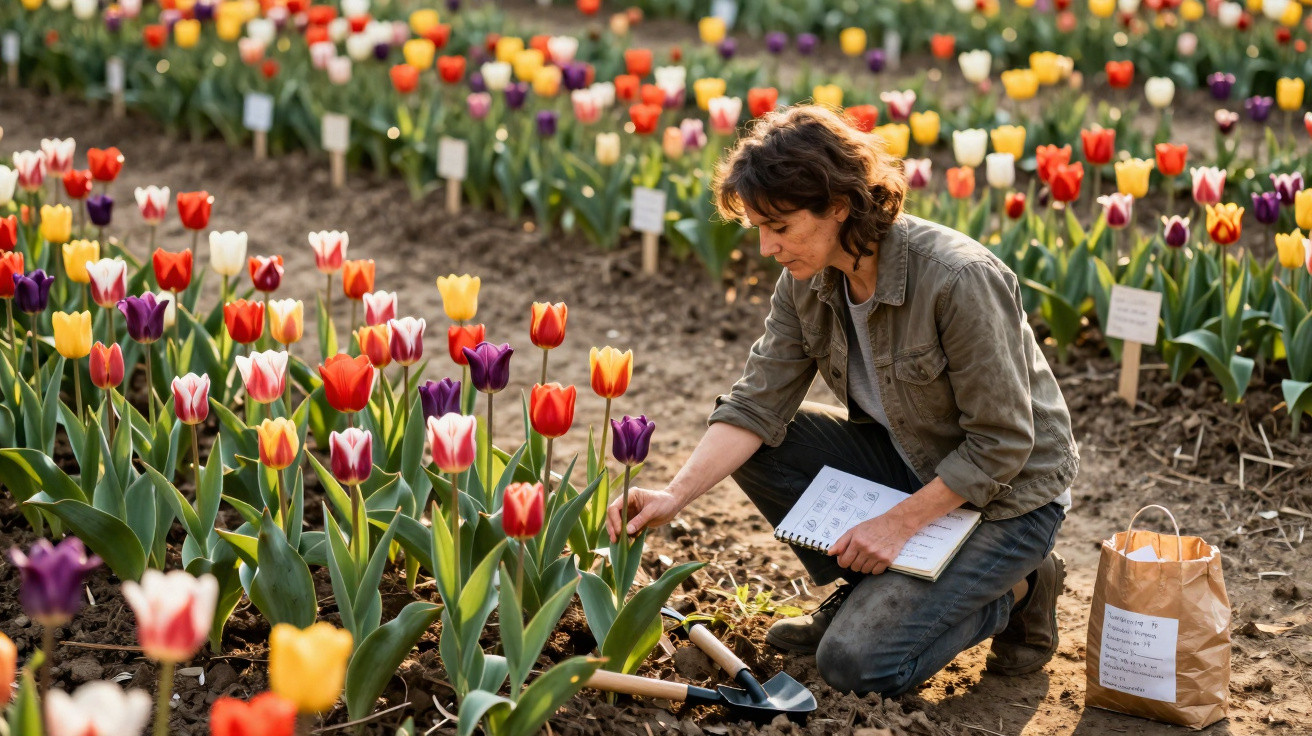
The cry came from a woman in a grey cardigan, stopped halfway along the path with a mug of tea in her hand. She was staring at a tulip that simply shouldn’t have been there. Her bed was meant to be a wash of gentle pastels. Instead, a chunky, unapologetic tulip had burst through the centre in searing orange and red, like a match flaring in the mist.
She crouched beside it, unable to decide whether to laugh or curse. Three years before, she had planted a bag of traditional pink ‘Angelique’ bulbs. This brute looked as though it had stepped out of a 17th-century Dutch painting: broad petals, unruly markings and a stem that rose above everything nearby.
Her neighbour looked over the fence. “What on earth did you feed them?” he joked. She could not answer. The explanation lay beneath the soil, in a quiet conflict gardeners seldom discuss openly. The tulip world has shifted, and it is taking people by surprise.
When tulips bloom as if they have a mind of their own
You assume you know what went into the ground. You recall the packet, its photograph and the orderly pattern of holes dug in autumn. Then spring arrives, and your tulips bloom as though they have been following an entirely different plan. The colours are wrong. Their heights vary. Some vanish without trace, while others spread like rumours.
That small jolt - the “I never ordered that” moment - is becoming remarkably familiar. Every spring, gardening forums fill with photographs of rogue tulips, unusual stripes and early flowers that collapse after one warm spell. What is promised on the label does not always withstand actual weather, real soil or the long route bulbs travel before reaching your trowel.
Beneath tidy borders, tulips are caught up in a story far larger than a pleasing April photograph. They contend with heat, disease, breeding compromises and exhausted soil. For many gardeners, the realisation only comes when a flower appears right in front of them.
Last April, a member of a British gardening forum shared a photograph under the title “They never expected this tulip bloom.” It showed a compact urban front garden with ordinary lavender, clipped box and a line of restrained white tulips. In the centre stood one tulip, half as tall again as the rest, with jagged petals streaked crimson across buttery yellow, like a flame held at its loudest point.
Comments quickly followed. Some people insisted that the bag had been wrongly packed. Others described it as a “throwback” tulip, a genetic reminder from the bulb fields. A Dutch contributor raised a more troubling possibility: patterns that appear romantic can occasionally be viral. Literally. For centuries, the tulip “breaking virus” has created painterly petal splashes while steadily weakening the plants.
Rather than being a charming oddity, that single tulip reflected industrial bulb production, viral pressure, climate strain and the unspoken risk behind every inexpensive supermarket bag of bulbs. The gardener had wanted white flowers. She received a horticultural twist in the plot.
Look beyond the petals and tulips become less straightforward. They are genetically restless plants, heavily bred for immediate impact and then sent around the globe like seasonal fireworks. Many of the most extravagant modern varieties are what professionals call “one-hit wonders” - spectacular in their first year and underwhelming by their third.
Bulb farms prioritise size and consistent flowering, sometimes at the expense of enduring vigour. Combine that with warmer winters, unpredictable January thaws and springs that move from frost to 25°C within a week, and tulips begin to act like temperamental teenagers. They sulk, grow leggy, flower too quickly or divide into feeble offsets that never properly bloom again.
When a bed erupts in unforeseen colour or dwindles into uneven bare patches, it is not random magic. Climate, breeding, viruses, storage and soil condition are all competing at once. Gardeners generally see only the outcome: an awkward, unexpected tulip bloom.
How to gently regain control of your tulip display
The first subtle solution begins in autumn, long before the surprise flowers emerge. Select fewer varieties, but choose them deliberately. Traditional species tulips and older “Darwin hybrid” varieties may look less theatrical on a packet, but they are the long-distance runners of the tulip world.
If disappearing tulips have disappointed you, follow one simple approach: use no more than three varieties in each bed and repeat them. Set the bulbs deeper than the packaging recommends - roughly three times the bulb’s height - in freely draining soil. That added depth moderates temperature fluctuations and shields bulbs from abrupt warm periods that trigger rushed flowering.
Treat it as editing instead of decorating. Choose fewer, more resilient performers. Spring brings less disorder and greater control over the sort of surprise you encounter.
A second, very practical idea is to plant for “failure zones”. Every garden has a section with heavier soil, dripping eaves or a route the dog regularly uses. Put inexpensive, experimental bags of bulbs there, where unexpected blooms cannot ruin a carefully planned colour scheme.
Keep the best viewing areas - the bed beneath the window or the border beside the front gate - uncomplicated and dependable. Choose proven varieties known to perform as perennials, and renew part of the planting each year rather than removing everything at once. Let’s be honest: nobody really does this every day, but a 20-minute session each October can make a border look “designed” without turning gardening into a full-time job.
On the first mild morning of spring, when you open the curtains and see a view that resembles the one you imagined, your future self will be grateful.
A long-standing grower in Lisse, the Netherlands, put it this way while standing among rows of trial beds with a thermos of coffee:
“People think tulips disappoint them. Most of the time, it’s us disappointing what the tulip actually is.”
The thought stays with you. Tulips are not roses or shrubs. They are more like fireworks: stored energy waiting for one powerful display. Work with that rhythm, and much of the frustration eases.
If bulbs that failed to return have caught you out before, keep this brief checklist in mind:
- Choose types that naturalise - species tulips, Darwin hybrids and some fosterianas.
- Plant deeper in well-drained spots so bulbs neither bake nor rot.
- Deadhead after flowering but allow the foliage to turn yellow naturally.
- Rotate planting positions if you have experienced viruses or unexplained streaking.
- Accept that certain elaborate doubles are “treats”, rather than lifelong companions.
What that startling tulip bloom is really telling you
That rogue tulip in your border is more than simple mischief. It is feedback. Your soil, microclimate and purchasing choices are all speaking through one loud, colourful message. If blooms are taller and flimsier than expected, the bulbs may be reaching for light or emerging too early after a mild winter.
When familiar favourites disappear but one strange survivor flourishes, it may be worth examining where your bulbs were sourced, how intensively they were driven during production, or whether viruses have gradually reduced their vigour. One unusual bloom can be lovely; an entire bed of streaked, distorted petals is a warning sign.
Most of us have experienced the moment when the garden fails to match the glossy promise on the packet. That disappointment is genuine. Yet it can also mark the point when you stop viewing tulips as disposable decorations and begin to regard them as short-season perennials with highly particular requirements.
When gardeners speak candidly away from the camera, they acknowledge that they are learning to interpret tulips as farmers interpret a wheat field. Patchy growth, stunting or odd colours suggest that something is wrong with the wider system, not only the individual plant. Perhaps the previous summer was severely dry and the bulbs could not replenish their reserves. Perhaps you removed the leaves too soon because they looked untidy beside the front path.
Rather than faulting the plant, let the surprise prompt a question: what altered between planting and flowering? Weather, watering, storage and spacing can each reshape the result. Asking this every spring is how quiet, ordinary gardens become dependably beautiful.
A cultural change is happening too. As more people post their tulip disasters online, the fixation on “perfect” beds is being replaced by a more patient and curious outlook. A disorderly clump can become a conversation starter rather than a failure.
Some gardeners now intentionally plant one “wildcard” bag each year - cheap bulbs of unknown colours - in a pot or an out-of-the-way corner. The shock then remains amusing rather than upsetting. The principal beds contain tested classics, while the surprises have space to be messy, or even ugly, without disrupting the whole garden.
One outrageously bright flower in a restrained border may still make you drop your tea. But it may also lead you towards bulbs with genuine staying power, better-draining soil or a more realistic view of a living spring display. Not a catalogue, but a story.
Tulips have always held drama in their petals. Centuries ago, they brought down economies. Now they disrupt your colour scheme. The consequences feel less serious, but the lesson is curiously alike: whenever we regard them as guaranteed, they find a way to prove that they are not.
The gardeners who appear calmly untroubled every April are often those who have accepted this. They expect some bulbs to disappear, others to behave badly, and one or two to emerge from nowhere and dominate the display. They plant with that expectation, turning surprises from problems into plot twists.
The next time a tulip blooms in a way you did not anticipate, pause before digging it up. Notice its position, its flowering time and how it differs from the packet photograph. Allow it to reveal something about your patch of ground, your decisions and perhaps even your patience.
You may still relocate it later, or you may keep it, as you would a slightly eccentric friend at the table. Either way, that startling moment on a chilly spring morning could be the nudge that quietly changes the way you garden for years.
| Key point | Detail | Benefit for the reader |
|---|---|---|
| Choose more “perennial” tulips | Favour species tulips and Darwin hybrids over ultra-spectacular but short-lived varieties | Achieve more reliable flowering over several years, with fewer disappointments |
| Plant more deeply in free-draining soil | Bury bulbs at three times their height and avoid waterlogged areas | Reduce rot, failed flowering and overly weak stems |
| Accept and direct surprises | Set aside a “wildcard” area or pots for uncertain mixes and impulse purchases | Turn unexpected flowering into enjoyment and learning rather than frustration |
FAQ
- Why did my tulips change colour from last year? Some modern tulips are genetically unstable, and stress from heat, poor soil or virus can change pigments or uncover hidden traits. If many flowers appear streaked or unhealthy, consider lifting and discarding those bulbs.
- Why don’t my tulips return as strongly every spring? Many striking varieties are bred to perform for a single season. If foliage is removed too soon or summers are very dry, bulbs cannot recharge, so they shrink and produce weak flowers - or none at all - the next year.
- Is a streaked or “broken” tulip always caused by a virus? No. Certain varieties are bred to have a broken appearance without carrying the historic tulip-breaking virus. However, if a previously solid-coloured tulip suddenly develops the pattern and the plants look weak, treat it with caution.
- Can I move tulips that have appeared in the wrong place? Yes. Mark them during flowering, then lift and move them after the foliage has died back naturally. Replant them in autumn in a more suitable location or a dedicated “experiment” bed.
- Is buying cheap mixed bags of bulbs worthwhile? They work well in pots, informal corners or for beginners, but they are a gamble when you want an exact colour scheme. For important borders, select named varieties from a reputable grower and repeat them.



Comments
No comments yet. Be the first to comment!
Leave a Comment