
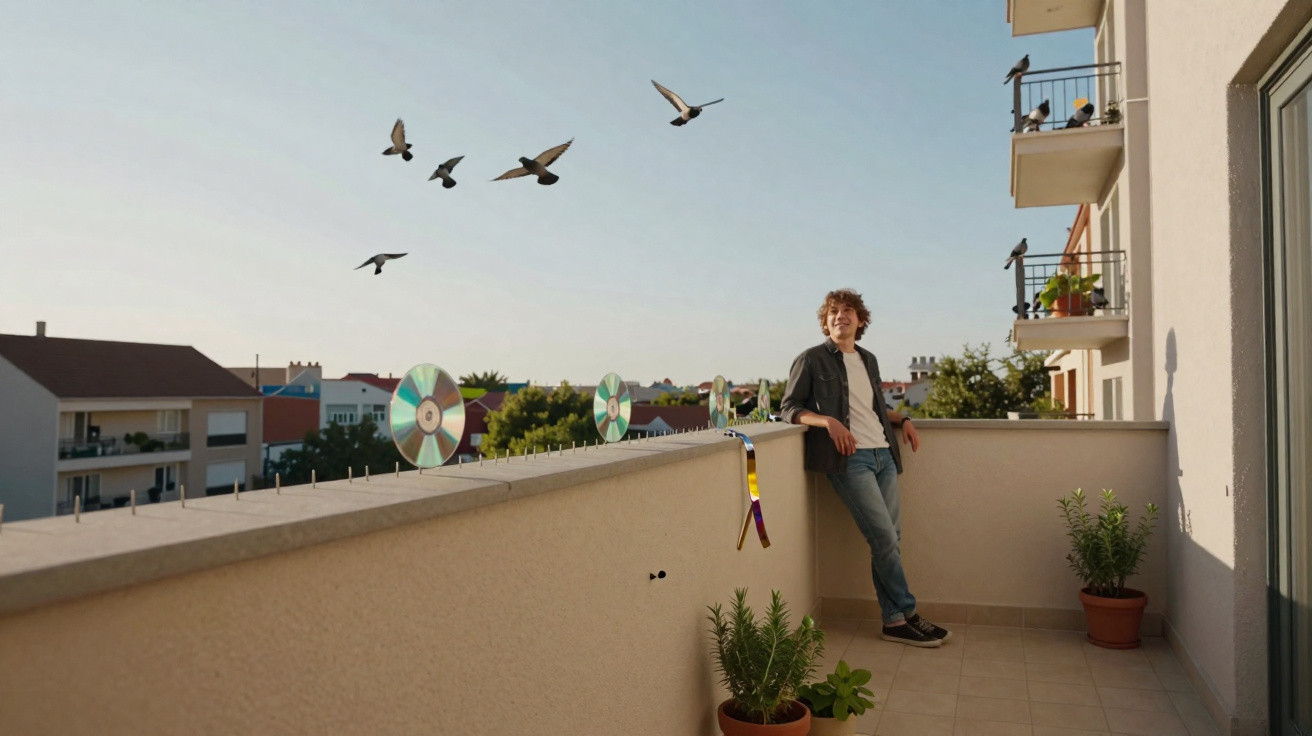
Anyone living in a city with a balcony or roof terrace will know the issue: pigeons land, nest and leave droppings behind – so it can feel as though you are cleaning every day. In the case used here as an example, one woman cleaned her terrace every week, and sometimes even more often. Only when she consistently combined several measures did the birds stay away. The approach behind it can be applied to any other balcony too.
Why pigeons are so attracted to your balcony
Before looking at practical tricks and deterrents, it is worth asking why pigeons repeatedly choose certain places. The birds are not acting out of spite; their reasons are entirely practical.
- Easy food sources: Crumbs, leftover food, bird feed and open rubbish bags are an all-you-can-eat buffet for pigeons.
- Comfortable landing places: Window ledges, railings, air-conditioning units and parapets provide ideal perches and nesting spots.
- Sheltered corners: Overhangs, the undersides of roofs, gaps and recesses resemble small caves – making them ideal for breeding.
Keeping these three factors in mind soon makes it clear why a thorough weekly clean alone rarely solves the problem. As long as the birds see an advantage in returning, they simply come back.
“The less appealing a balcony seems to pigeons, the faster they will find somewhere else.”
First step: remove food sources completely
No more open buffet for city pigeons
At first, the woman with the constantly dirty terrace made a common mistake: although she swept regularly, she kept planters containing fallen seeds and a basic bird-feeding station in place. That was precisely what kept attracting the pigeons.
Anyone seriously trying to deter pigeons needs to be consistent:
- Clear away crumbs from bread, biscuits or crisps immediately.
- Offer bird feed only in protected feeders for small birds that pigeons cannot easily access.
- Keep rubbish bags sealed and do not store them openly on a balcony or terrace.
- Clean regularly so that food remains do not stick in corners.
Feeding pigeons is prohibited in many towns and cities anyway. Anyone who ignores the rules risks a fine – and makes the issue worse for neighbours.
Second step: make surfaces uncomfortable
Pigeons avoid places where they cannot perch comfortably
The real turning point for the frustrated terrace owner came when she realised that, while railings and ledges remained comfortable places to perch, the birds would keep trying to return. So she changed the “furnishings” – not for herself, but for the pigeons.
Options that have proved effective include:
- Bird spikes: Narrow strips fitted with plastic or metal spikes, which can be attached to window ledges, air-conditioning units or railings. When certified, animal-welfare-compliant systems are used, they prevent pigeons from settling there comfortably without harming them.
- Tensioned wires or cords: Fine, slightly springy wires positioned directly above the edge of a railing. They make the landing surface unstable, and the birds quickly lose interest.
- Smooth sheets such as Perspex: Whether laid in place or screwed down, these can make many surfaces so slippery that pigeons cannot get a grip.
This is exactly the combination the woman used: she fitted wires to the railing and fixed Perspex sheets onto a broad wall surface. Within a few days, hardly any pigeons could be seen.
Third step: smells pigeons dislike
Use household remedies rather than poison
Those who do not want to carry out time-consuming installations can try smells that pigeons find unpleasant. Several of these remedies may already be in the kitchen cupboard.
- Vinegar solution: Put a mixture of water and household vinegar, at roughly a 1:1 ratio, into a spray bottle and apply it regularly to the usual landing spots.
- Strong spices: Lightly scatter pepper, curry powder or cinnamon over window ledges and balcony parapets. This needs reapplying after rain.
- Strongly scented plants: Herbs such as rosemary or peppermint, along with geraniums, may make the space less inviting to pigeons.
These methods rarely work on their own, but they can strengthen the effect of other measures. The terrace owner, for instance, sprayed vinegar solution every other day where the last landing attempts occurred – and the pigeons gradually abandoned the place altogether.
Fourth step: light, movement and uncertainty
Reflections and movement as a source of stress
Pigeons are comfortable in places that are quiet and predictable. Anything that unexpectedly glitters or moves can make them uneasy.
- Hanging reflective items: Old CDs, shiny ribbons or thin strips of aluminium foil fluttering in the wind can confuse pigeons.
- Wind chimes and small windmills: Moving elements in bright colours create visual stimuli that the birds tend to avoid.
In the example described, the woman hung several shiny ribbons from the balcony ceiling. Combined with the uncomfortable surfaces, this made the pigeons increasingly reluctant to venture onto the terrace.
Technical and structural solutions for persistent cases
Electronic devices to deter visiting birds
Anyone protecting a large roof terrace or flat roof often turns to technical aids. Devices are available that emit sounds barely audible to people but intended to disturb pigeons. Their effectiveness depends heavily on the surroundings, and other animals may also be affected.
Nets and physical barriers
Nets that close off entire areas are a considerably more robust option. They are especially suitable for courtyards, loggias or deeply covered balconies. Installation requires some planning, but they can then keep pigeons away very reliably.
| Measure | Effort | Effectiveness |
|---|---|---|
| Cleaning and removing food sources | low | essential foundation |
| Spikes / wires / Perspex | medium | very high in affected areas |
| Smell and spice remedies | low | supportive |
| Reflectors and wind-powered objects | low | good when combined |
| Nets and structural barriers | high | almost complete |
Do not overlook legal and health considerations
City pigeons may look harmless, but their droppings are not. The droppings are highly acidic, damage stone, metal and wood, and may contain pathogens. Anyone who does not protect their surfaces can ultimately face repair costs.
At the same time, Germany has clear rules: deliberately injuring or killing pigeons is prohibited. Glue traps and poison bait are not an option either. Only measures that drive the birds away without causing them direct harm are permitted.
- Do not feed them, particularly not in the same place on a regular basis.
- Use only recognised deterrent systems that do not injure animals.
- If in doubt, hire specialist companies for larger buildings.
Why combining measures creates the breakthrough
The woman who had been cleaning constantly did not achieve her aim through one magic solution, but through a strategy: no more food, uncomfortable surfaces, unpleasant smells and unsettling movement. It was only the complete package that made the pigeons give up.
Anyone wanting to protect a balcony or terrace will benefit from a similar mix. First remove the causes, then make the birds’ favourite spots deliberately unattractive. The more consistent the approach, the less often you will need to reach for a bucket and scrubbing brush afterwards.
For many people, this may initially sound like a great deal of effort. In practice, however, most of the work is needed only once – when fitting spikes, wires or nets. After that, ordinary basic maintenance is enough. That is the point at which a weekly cleaning nuisance becomes a balcony you actually enjoy spending time on again.

Comments
No comments yet. Be the first to comment!
Leave a Comment