
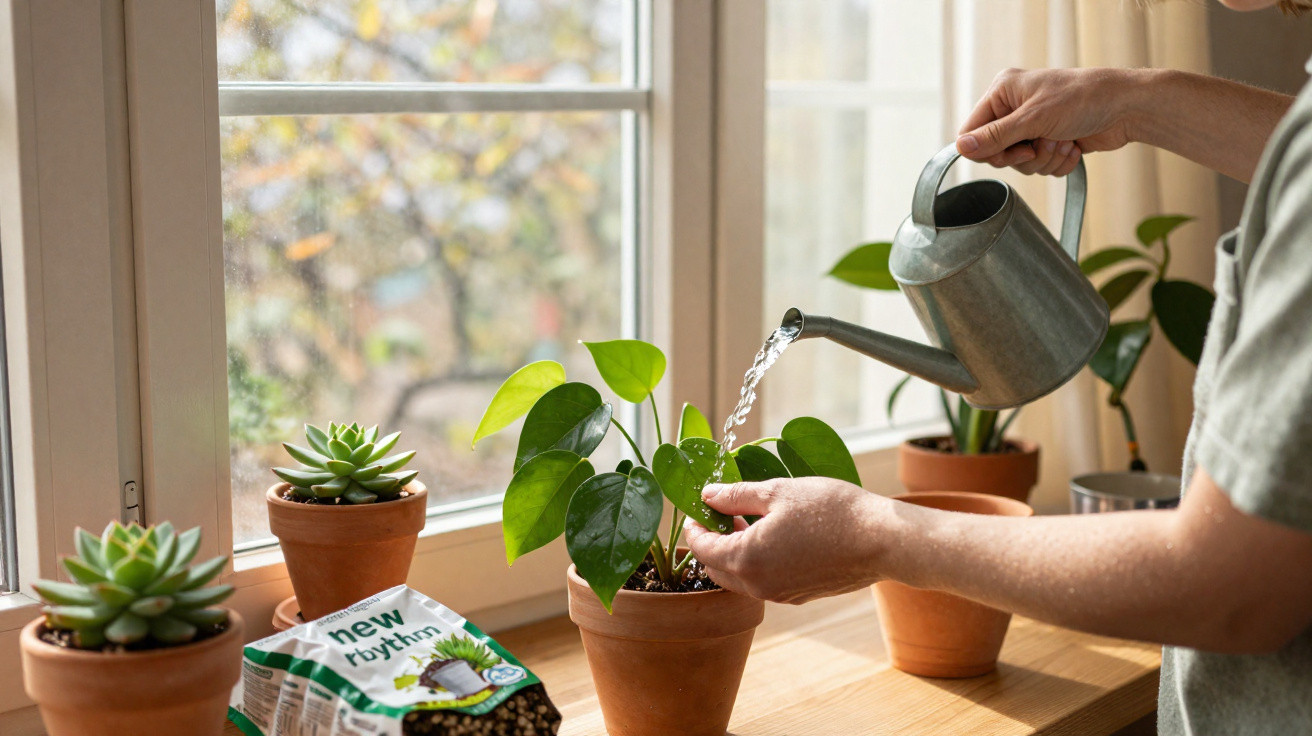
Once winter dormancy ends, the money tree begins to pick up pace in March – but making the wrong adjustments now can rob it of all its spring vigour.
Every year, many owners are puzzled by the same pattern: throughout winter, the money tree appears steady, albeit somewhat sluggish, yet it suddenly droops in March, sheds leaves or produces only weak growth. In nearly every case, care during this transitional period is the cause. For this succulent houseplant, the month marks the shift from dormancy to its growing season, when light, watering, fertiliser, pruning and potting all need a clear but careful adjustment.
Why March is a turning point for the money tree
From autumn through to late winter, the money tree – botanically Crassula ovata and also commonly known as the jade plant – slows its metabolism considerably. It barely grows, requires little water and does not need fertiliser at all. Watering only once every four weeks is often appropriate when days are short and rooms are cool.
March changes the picture: daylight hours lengthen, light becomes stronger and the compost dries out faster. Small, fresh buds begin to emerge at the tips of the shoots. This is the signal that the new season has begun.
“Anyone who blindly continues winter care in March risks either waterlogging and rot – or spring growth that is completely held back.”
The answer is not drastic action, but subtle changes: more light without scorching, more water without leaving it with “wet feet”, and a small nutrient boost without overfeeding.
More light without sun scorch: the right spring position
Light is the first major factor to address in March. A money tree thrives in a very bright spot, but after a dark winter it cannot cope with harsh full sun overnight.
Suitable locations include:
- An east-facing window with morning light
- A west-facing window with gentle evening sun
- A south-facing window with a light curtain to filter the sun
There are several typical warning signs:
- Too little light: shoots become long, thin and begin to flop downwards, giving the plant a stretched appearance.
- Too much direct sun after winter: leaves turn pale or develop brown edges and patches.
Move the pot nearer to the window gradually, advancing it a small amount each week. Turn the pot slightly every seven to ten days. This encourages an even, rounded crown rather than a plant that leans towards one side of the window.
Watering in March: a new rhythm, not a watering shock
Water is the second key consideration. Restraint was essential over winter; in March, the money tree needs a little more, though still far less than conventional houseplants.
“The rule of thumb: water only once the top two to three centimetres of compost are dry – but water thoroughly when you do.”
In practical terms, this means:
- Use a finger or a wooden stick to check that the upper layer is completely dry.
- Then water until it runs from the drainage hole at the bottom.
- Empty the saucer or decorative outer pot fully after a few minutes.
In a bright room, spring watering often works out at roughly every 10 to 15 days, or slightly more often for very small pots. Adjust the interval gradually rather than leaping from “once a month” to “twice a week”.
Reading the leaves as a warning system
The money tree makes it quite clear when it is receiving too little or too much:
- Too much water: leaves become soft and yellowish, while the base of the stem may look dark and mushy.
- Too little water: leaves shrivel slightly, appear wrinkled and draw in somewhat.
If these symptoms occur, lengthen or shorten the watering interval by a few days. A sudden major change can easily cause stress and leaf drop.
Fertiliser in March: a gentle start to the growing season
After its lean winter period, the money tree takes up nutrients readily in spring. It still does not tolerate excess, however, because fleshy succulents are sensitive to a build-up of salts in the compost.
A specialist liquid feed for cacti and succulents is a proven choice. It generally contains less nitrogen and promotes compact, sturdy growth.
“From March until autumn, healthy plants need fertiliser only every four to six weeks – and at half strength.”
Three points matter in particular:
- Never apply fertiliser to completely dry compost, as this can burn the roots.
- Do not feed severely weakened or diseased plants.
- Wait at least three to four weeks before feeding after repotting.
The best time is a few days after watering, when the compost is lightly moist. This distributes the fertiliser evenly and is kinder to the roots.
Spring pruning: shaping rather than cutting back hard
Early spring is a good time to shape a money tree. As soon as new leaves are visible, overly long or uneven shoots can be shortened.
Use the following as a pruning guide:
- Cut just above a node, where a leaf joins the stem, as this is where new growth will emerge.
- Remove no more than 20 to 30 percent of the total plant mass at one time.
- It is better to prune in two or three stages over several weeks.
A sharp, clean tool is essential. Small garden secateurs or a sharp knife wiped with alcohol significantly reduce the risk of infection.
“Targeted pruning in March creates dense, tree-like growth instead of a thinly branched, top-heavy plant.”
In many cases, the removed shoots can be used as cuttings. Leave them to dry for a few days, then place them in lightly moist, sandy compost to create new plants with little effort.
Repotting the money tree: when it genuinely needs a new pot
Spring is also the right time for repotting. Every two to four years, inspect the roots: if they are growing through the drainage hole, or if the compost remains heavy and poorly aerated, it is time to move the plant.
| Criterion | Sign that repotting is needed |
|---|---|
| Roots | Pressing against the pot wall or growing out from the bottom |
| Compost | Stays wet for a long time, appears compacted and has little remaining structure |
| Growth habit | Plant tips over easily or looks top-heavy in relation to the pot |
Choose a new pot with only a slightly larger diameter. Excess space holds unnecessary water and increases the risk of rot. Far more important is a very free-draining compost: ready-made cactus compost, or a blend of potting compost, sand and mineral components such as pumice or expanded clay.
After repotting, leave the money tree dry for several days so that any cut surfaces on the roots can dry. Water lightly only after that. Wait at least three to four weeks before the next feed, giving the plant time to settle into its new environment.
Common March mistakes – and how to avoid them
Typical care mistakes are especially common at the start of spring. Most are easy to prevent once you understand what the plant needs.
- “Spring-cleaning” shock: moving the plant, sharply increasing watering and applying a full dose of fertiliser all at once overwhelms it. Make changes gradually instead.
- Draughts at the window: a bright position directly above a frequently tilted-open window can create stress on cold nights. The money tree prefers more stable temperatures.
- Permanently wet outer pots: roots quickly rot when water stands in a decorative outer pot. Always empty saucers.
- Too little light with extra fertiliser: more nutrients without sufficient brightness lead to soft, unstable shoots.
Background: why succulents are so sensitive to water
The money tree stores water in its fleshy leaves and shoots. This reserve makes it resilient during short dry spells, but it also leaves the plant vulnerable to constant dampness. Its roots are adapted to airy compost that dries quickly. In overly wet compost, oxygen is lacking and rot-causing pathogens can thrive.
Understanding this principle makes care easier to judge: it is better to water thoroughly once and then allow the compost to dry for a long time than to keep it “slightly wet” all the time. In March, only the rhythm changes; the underlying rule remains the same.
Getting the most from the spring season
A few targeted changes in March lay the foundations for a healthy, dense money tree that stays strong throughout spring and summer. Bright but filtered light, a considered watering routine, restrained feeding and gentle pruning where needed are almost all the plant requires at this stage.
If you keep several specimens, spring offers a useful opportunity for comparison: different positions, slightly varied watering intervals or varying amounts of mineral material added to the compost will quickly reveal what works best in your own home. In this way, a supposedly “easy-care” plant becomes an engaging little project – with noticeably stronger growth when the right decisions are made in March.

Comments
No comments yet. Be the first to comment!
Leave a Comment