
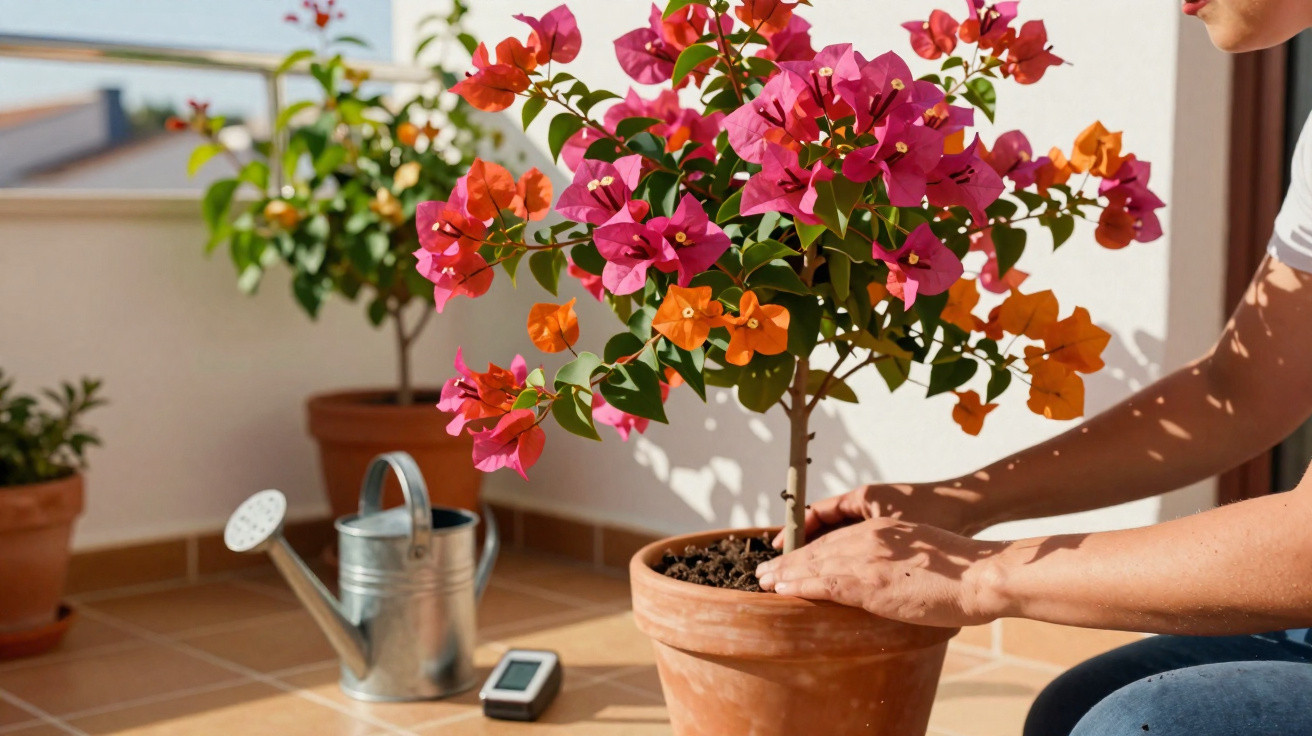
A Bougainvillea shrub on a patio or balcony brings visions of a blaze of pink, orange or white. Yet the reality is often a lush, dark-green leafy giant in a pot, with no sign of its characteristic vivid bracts. The cause is rarely the variety; it is almost always down to unsuitable habits around position, watering and fertiliser.
Why your Bougainvillea produces leaves rather than flowers
When a Bougainvillea looks healthy, grows vigorously, but fails to produce bracts, it is sending a clear message: it is too comfortable. To create its colourful display, it needs a small amount of stress to signal that it is time to reproduce.
Getting the basic conditions right comes first:
- Full sunshine: at least 6 hours of direct sun each day
- A warm position: 20–30 °C is ideal during the growing period
- Frost protection: bring the container indoors below 5 °C; damage is possible at around 0 °C
- A sheltered site: for example, beside a south- or south-west-facing wall
This plant originates from largely dry, sunny regions. There, short, heavy downpours are followed by long spells of dry soil. Reproducing this pattern helps encourage flowering later on.
“A rich-green, fast-growing Bougainvillea without flowers nearly always indicates too much water, too much fertiliser and too little deliberate stress.”
The classic mistake: excessive water and fertiliser
A common situation is easy to recognise: it is midsummer, the plant sits on the patio in blazing sunshine, and its owner worries that heat will harm it. The watering can comes out every other day, followed by a dose of general-purpose fertiliser each week. The Bougainvillea responds with long shoots and flawless leaves – but no flower buds.
Botanically, this makes perfect sense. With ample water and plenty of nitrogen, the plant concentrates on growth and foliage. It does not need to enter its reproductive phase. Its energy is directed into fresh shoots instead of bracts.
However, when the root ball is allowed to dry slightly between waterings, its strategy changes. This mild drought stress acts as a trigger, making the plant more likely to form flowers and bracts.
The controlled-dryness method for Bougainvillea
Professionals use a straightforward but consistent routine to get a reluctant Bougainvillea flowering. Before reducing watering, though, the fundamentals must be in place.
The essentials: position, compost and pot
- A fully sunny spot: avoid keeping it in permanent partial shade on the balcony
- Free-draining compost: use a loose mix, ideally blended with sand or expanded clay
- A pot with drainage holes: never grow it in a container with no outlet for water
- No standing water: empty saucers regularly
When choosing fertiliser, use less nitrogen and more potassium. A potassium-rich product supports flower formation, whereas too much nitrogen will only encourage more greenery. Stop feeding from mid-September so that the plant can prepare for rest and maturity.
How to water correctly in summer
During summer, the rule is simple: water only once the top few centimetres of compost have dried out. In practical terms:
- Push a finger 3–4 cm into the compost.
- If it feels dry, it is time to water.
- Water thoroughly until water runs out from the bottom.
- Empty the saucer after around 30 minutes.
Between waterings, allow the root area to remain slightly dry. This alternation between a dry spell and a generous soaking resembles a thunderstorm in the plant’s native habitat – and is often what finally prompts flowering.
“The plant does not need constant moisture; it needs a clear rhythm: briefly dry, then thoroughly watered.”
Watering routine in winter quarters
From November until March, move the container to a bright but relatively cool place. Temperatures of 10–15 °C are ideal, such as in a conservatory, stairwell or bright unheated room.
Growth slows considerably during this period. The compost will stay dry for longer, so water only at wider intervals and in small quantities. Winter quarters should be kept almost dry, but never completely parched for many weeks.
How to tell when it is time to water
The finger test remains the simplest check. If the top layer is still moist, wait. Only water again once it looks dry and feels dry to the touch.
Slightly limp leaves can be an early warning of insufficient water. Watering at this stage is usually still unproblematic. If leaves turn brown or curl severely, the stress has already become excessive; the plant will often recover, but it loses strength.
The aim is a moderate dry period, not extreme dehydration.
Common pitfalls that delay flowering
Several issues can undo the benefits of controlled dryness:
- Automatic irrigation: keeps the compost constantly moist, eliminating the required dry-and-wet cycle.
- A permanently full saucer: encourages root rot, weakening the plant and leaving it unlikely to flower.
- An oversized pot: the root system develops first, considerably delaying flowering.
- Pruning at the wrong time: hard pruning shortly before flowering removes the shoots that would otherwise carry bracts.
For pruning, lightly thin the plant immediately after a flowering period. Carry out more substantial pruning at the end of winter, before new growth begins.
How much stress can the plant actually tolerate?
The term “drought stress” sounds more severe than it is in everyday care. The plant should notice that water is not endlessly available without being allowed to suffer seriously. If you are unsure, proceed gradually: slowly extend the time between waterings and watch how the leaves respond.
If a Bougainvillea receives a sunny, sheltered position in high summer, free-draining compost and the correct watering rhythm, the first wave of flowers usually follows before long. With older specimens that are strongly root-bound, it may take a little time before the change in care becomes visible.
Practical measures for a more abundant floral display
Training a Bougainvillea up a wall can provide extra help: warmth stored in the masonry supports flower formation. A bright, reflective backdrop, such as a white wall or light-coloured façade, increases the available light and can improve this effect further.
Balance remains essential throughout: water deeply once rather than giving frequent small amounts, use fertiliser sparingly, provide clear winter quarters and prune with care. Gradually, the frustrating green shrub becomes what many balcony and patio owners want: a lush, colourful wall of flowers that defines the summer.
Comments
No comments yet. Be the first to comment!
Leave a Comment