
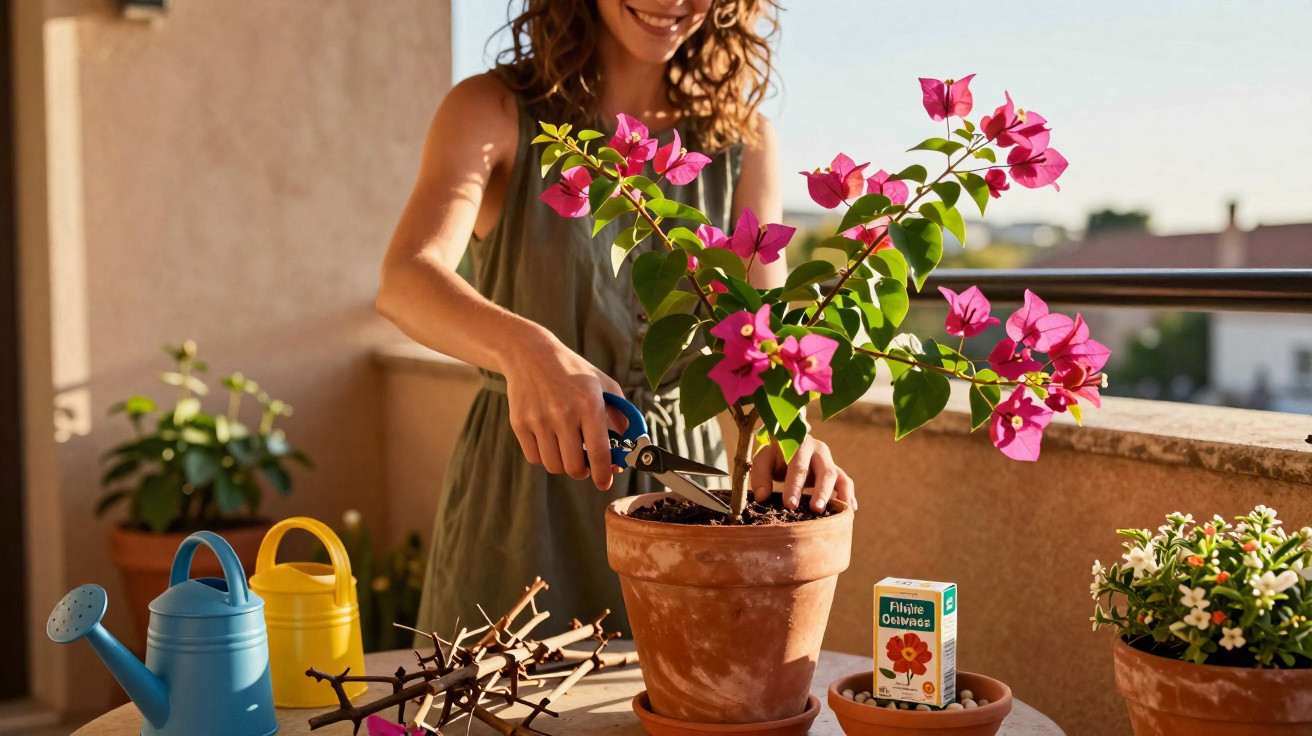
With three straightforward adjustments, this can be changed surprisingly quickly.
Anyone who has sat beneath cascading pink bougainvillea while holidaying in southern Europe expects the same spectacle at home. Yet on a balcony or patio, the reality is often disappointing: long shoots, plenty of green growth, but none of the famous papery bracts. This is rarely down to bad luck; care mistakes are usually to blame, especially after winter. The right pruning, suitable fertiliser and adjusted watering and light conditions can encourage flowering far faster than many people expect.
Why a Bougainvillea suddenly stops flowering
Bougainvilleas are not traditional houseplants. They are sun-loving plants from warm climates. In central Europe, they have to cope with short summers, wet winters and confined pots. That places the plants under stress, often causing flowering to stop completely.
"Bougainvillea only produces colour when pruning, nutrients, water and sunshine are all right together. If one of these building blocks is missing, the plant remains stuck in ‘leaf mode’."
Typical signs that something is wrong include:
- Long, thin shoots with very little branching
- Lots of leaves but no colourful bracts
- A root ball that is constantly wet or, conversely, completely dry
- A semi-shaded position, beneath trees or in a dark window recess
The good news is that, in most cases, three targeted measures are enough to steer the plant back towards flowering.
First key: prune correctly at the start of the season
One common mistake is cutting the plant back during winter, or pruning it heavily to the base because it looks untidy. This removes precisely the wood on which flowers develop.
"Bougainvillea produces its flowers mainly on the previous year's shoots. Pruning too severely unintentionally removes the entire basis for flowering."
The ideal time to prune
The best time is from late winter into very early spring, once severe frost is no longer likely. In mild areas, this is usually from late February to March; in colder locations, April is more suitable.
Experienced gardeners proceed as follows:
- Remove dry and frost-damaged shoots: Cut anything brown, hollow or brittle back to a healthy branch junction.
- Shorten excessively long growth: Reduce long, whip-like shoots by around one third to encourage branching.
- Pinch out only the tips lightly: Nip off the soft shoot tip with your fingers or secateurs. This stimulates side shoots, which will later carry the flowers.
For container-grown plants, regular shaping cuts are worthwhile. The plant is then more likely to direct its energy into compact, flower-rich shoots rather than a few metre-long climbers that merely take up space.
What to avoid when pruning
- Do not prune hard in the depths of winter.
- Do not cut the entire plant back to just a few centimetres.
- Do not use wet or unsuitable secateurs, as these can injure the plant.
Those who guide the plant gently each year instead of cutting it back brutally on a single occasion will achieve much more reliable flowering.
Second key: fertiliser for flowers rather than leafy growth
Many owners mean well but choose all-purpose fertilisers with a high nitrogen content. The result is lush green foliage and vigorous shoots, but no colour at all.
"For abundant flowering, Bougainvillea needs phosphorus and potassium above all. Too much nitrogen only pushes up foliage growth."
How to feed the plant properly
The basic rule is to feed moderately but regularly from spring until late summer, then provide little to no fertiliser in autumn and winter.
- Spring: Apply a thin layer of mature compost or well-rotted farmyard manure around the root area; use only a small amount in pots.
- April to September: Add liquid fertiliser for flowering plants to the watering can roughly every two weeks. Check the NPK ratio: low nitrogen (N), with higher phosphorus (P) and potassium (K).
- Autumn/winter: Substantially reduce feeding or stop altogether, particularly for plants kept indoors.
In pots, the growing medium should not be too old. Leaving a Bougainvillea in the same container for several years risks exhausted compost that can no longer retain water or nutrients properly. Repotting every two to three years into a free-draining, slightly sandy mix helps enormously.
Third key: balance sunshine, water and drainage
No sun means no flowers; with this species, it is as simple as that. At the same time, it does not tolerate waterlogging. This is exactly where the chances of success are decided in the German climate.
The right position for Bougainvillea
"The plant needs at least six hours of direct sunshine each day, ideally against a warm south- or west-facing wall."
A sheltered site is ideal:
- Bright and in full sun, without constant shade from trees or roof overhangs
- Warm, for example beside a house wall that stores heat
- Protected from the weather, rather than permanently exposed to draughts or heavy rain
Indoors, it is best placed directly at the sunniest window, not two metres away in the room. Glass already filters some light, and a north-facing window is usually insufficient.
Watering correctly throughout the year
Bougainvilleas cope better with short dry spells than with wet roots. Watering should be adjusted according to temperature and location.
| Season | Watering frequency in a pot (guide) | Note |
|---|---|---|
| Spring | every 3–5 days | Water only once the upper layer of compost has dried out. |
| Summer | every 1–3 days | Water more often in intense heat, but never leave water standing in the saucer. |
| Autumn | every 7–10 days | Gradually reduce watering as the flowering period comes to an end. |
| Winter (overwintered in cool conditions) | every 2–3 weeks | Keep only slightly moist; do not allow the root ball to become wet. |
When grown in the ground, a deep watering every few days in summer is enough in many regions. Between waterings, the soil surface may dry out.
Drainage is essential
Good drainage is compulsory in containers:
- Choose a pot with drainage holes.
- Add a bottom layer of expanded clay, broken terracotta or coarse gravel.
- Use an airy growing medium containing sand or perlite.
Waterlogging quickly causes root rot. Damaged roots cannot supply the plant properly, shoots become weak, and flowering fails completely.
Overwintering: this often determines the next flowering season
Bougainvilleas are sensitive to temperatures below roughly 5°C. In many areas, they therefore need moving into winter quarters.
"Anyone who overwinters the plant somewhere cool, bright and dry gives it a head start for the next round of flowering."
Suitable places include unheated conservatories, bright stairwells or frost-free garages with a window. The cooler the location, the less water the plant needs. A frequent mistake is keeping a Bougainvillea warm in the living room, watering it generously, but giving it too little light. This produces leggy, thin shoots with no flowering potential.
When can the first new flowers be expected?
Even with perfect care, the plant will not respond overnight. If pruning, feeding and a position correction begin in late winter, the first flashes of colour may appear from early summer, depending on the weather. Each year that its routine is better matched to its needs, flowering becomes more abundant and longer-lasting.
There is another point that many people do not realise: the apparent “flowers” are actually colourful bracts surrounding the small, inconspicuous blooms. This is why the plant looks so spectacular despite its true flowers remaining tiny. These bracts in particular need intense sunshine to develop their strong colour.
Anyone new to growing bougainvilleas should consider their approximate eventual size in advance. Vigorous varieties are better suited to trellises and house walls, while compact varieties are easier to manage in pots. Combined with other sun-loving plants such as oleander, lavender or Mediterranean herbs, they can quickly create a Mediterranean feel on a balcony or patio - provided Bougainvillea care consistently follows the three core principles: targeted pruning, flower-focused feeding and a position that allows sunshine and dry spells.

Comments
No comments yet. Be the first to comment!
Leave a Comment