
While beekeepers, gardeners and public authorities are increasingly affected by the Asian hornet’s spread, there are only a few weeks each year in which the situation can still be turned around. During this brief period, one vulnerable queen determines whether thousands of new hornets will emerge – and that is where anyone with a garden, balcony or shed has an opportunity to act.
Why the Asian hornet is so dangerous
Originally from East Asia, the Asian hornet (Vespa velutina) is classed as an invasive species in Europe. It is thought to have arrived in Europe in shipping containers in the early 2000s. Within a few years, it spread across large parts of France and has since reached other countries too.
The issue is that it primarily hunts honey bees, as well as wild bees and other pollinators. One hornet can kill several dozen bees a day. When an entire colony gathers outside a hive, it can devastate a whole bee population within a few weeks.
In some regions, more than 20 per cent of honey bee colony losses are already attributed directly to the Asian hornet.
Beekeeping suffers financial losses running into millions, while declining pollinator populations can also have lasting consequences for fruit and vegetable growing. This is no longer an issue solely for professional beekeepers with hundreds of colonies: amateur gardeners who depend on a healthy, stable pollinator population are affected too.
The crucial weakness: one queen alone
Unlike honey bees, for example, an Asian hornet colony has just one queen that establishes the entire nest. Without this founding queen, there can be no colony, no workers and no new queens – nothing.
This is what happens in spring:
- The queen spends the winter alone, concealed in cracks, lofts, piles of leaves or sheds.
- From roughly February to May, she leaves her shelter, severely weakened and hungry.
- Her first task is to find food, followed by a protected site for a small initial nest.
- She builds the first cells, lays the first eggs and feeds the larvae entirely on her own.
At this point, she is particularly exposed because no workers are present to protect her. If she is lost, the whole future colony is eliminated.
A queen caught in spring can prevent up to 3,000 adult hornets from emerging in autumn.
Depending on the area, one nest produces several thousand hornets and, in late summer, dozens of young queens. The following year, those queens can each establish colonies of their own. Catching a founding queen therefore does not merely halt one nest; it can potentially interrupt an entire chain reaction.
Timing is critical: only a few weeks are available
The queen’s active period begins once several sunny days in succession bring temperatures above around 12 to 14°C. The usual window runs from mid-February to late May, although this may be earlier or later depending on the region.
During this period:
- The queen flies out to forage, favouring sweet and protein-rich food sources.
- She looks for low, sheltered locations for a small first nest, such as inside sheds or beneath eaves.
- The starter nest is little bigger than a tennis ball and can easily go unnoticed.
Anyone who remains alert during these weeks can make a major difference through targeted checks and suitable traps, before the hornets become a serious late-summer problem around patios and apiaries.
Effective Asian hornet traps – and what to avoid
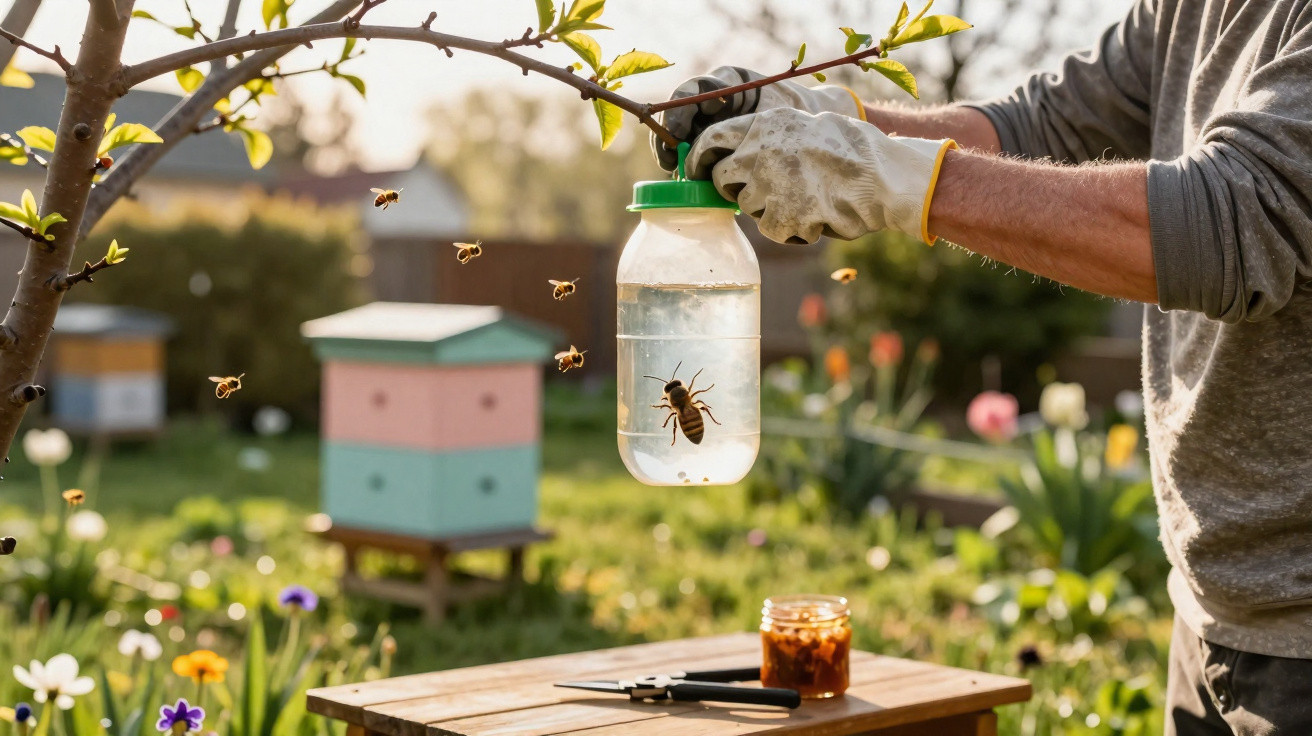
Asian hornets respond strongly to certain lures. In France, a combination of beer, syrup and slightly fermented fruit juice has proved effective. Its scent attracts hungry queens that urgently need energy in spring.
Three factors matter most:
- Location: place traps near former nests, flowering shrubs, fruit trees, apiaries or water sources, usually at a height of 0.5 to 1.5 metres.
- Regular checking: traps need frequent emptying so that excessive numbers of other insects do not accumulate.
- Selective design: the trap should be constructed so that beneficial insects have the best possible chance of escaping.
Homemade “drowning traps” made from plastic bottles filled with sugary liquid often cause more harm than good – catching bees, butterflies and other beneficial insects.
Anyone choosing to use traps should opt for models that allow unintended catches to be released, for example through controllable entry points or exit holes for smaller insects. If in doubt, it is best to speak with local beekeeping associations or conservation groups.
Every garden can become a line of defence
In spring, founding nests are still very small and easy to reach. Common locations include:
- Tool sheds, garden buildings and carports
- Nest boxes and empty birdhouses
- Eaves, pergolas and canopies
- Corners of cupboards and sheltered spots on walls and fences
- Letter boxes or cavities in roller-shutter housings
By inspecting these places regularly, you may spot nests while they are still the size of a tennis ball, or only slightly larger. At this stage, they usually contain only the queen and a few early larvae, so the risk is considerably lower than with a large primary nest in summer.
Where there is any uncertainty, take photographs, keep your distance and contact specialists. In many areas, councils, fire services or specialist pest controllers arrange removal, sometimes free of charge or with financial support.
Government plans need public involvement
France already has a publicly funded action plan against the Asian hornet, with an annual budget of millions. Local figures show that the number of nests falls measurably where councils and residents take coordinated action. Numbers increase wherever no action is taken.
The underlying approach can be applied in other countries. Individual beekeepers, or a small group of committed neighbours, can do little to slow the spread alone. Lasting results over several years only become possible when local authorities, associations and residents work together, coordinate trapping and report sightings.
| Measure | Effect |
|---|---|
| Coordinated spring trapping | Fewer founding queens and substantially fewer nests in summer |
| Systematic inspections of sheds and eaves | Earlier detection of small starter nests |
| Training for beekeepers and garden owners | Better distinction from native species and fewer false alarms |
| Central reporting points within the local authority | Faster, safer professional nest removal |
How to identify the Asian hornet safely
Many people mistake native hornets or large wasps for the Asian species. Incorrect control measures can then harm protected species. Typical identifying features of the Asian hornet include:
- A noticeably dark body, almost black-brown
- An orange area around the head
- A yellow segment towards the rear of the abdomen, resembling a broad band
- Yellow legs combined with a dark body – which is why it is called the “yellow-legged hornet” in some countries
- Usually spherical nests, often high in trees but also found in buildings
The native European hornet is lighter overall, with more yellow colouring and a less strikingly contrasting appearance. If unsure, take a clear photograph and send it to a beekeeping association or specialist service rather than reaching straight for insecticide.
What beekeepers and gardeners can do in practice
Anyone who keeps bees or has many flowering plants in their garden should make active use of spring. Useful measures include:
- Protect apiaries and flower-rich gardens with selective traps.
- Search all outbuildings and roof areas several times each month for small nests.
- If unusually high numbers of hornets appear in late summer, note the locations, as queens often overwinter nearby.
- Speak to neighbours and make them aware of the issue, so that entire streets can be involved.
Anyone who is not confident dealing with nests should not attempt to destroy them using spray or fire. Once a nest reaches a certain size, the hornets can react extremely aggressively and attack in groups. At that stage, only professionals with protective clothing and appropriate equipment should deal with it.
Risks, limits and useful supporting measures
Although targeted trapping of queens sounds highly effective, it is not a miracle solution. Traps that are not carefully monitored can damage insect ecology. Many species of wild bee and butterflies also enter sweet-baited traps. Anyone setting traps has a responsibility to inspect them.
At the same time, gardens need to remain wildlife-friendly: a variety of flowering plants, as few pesticides as possible, and areas of dead wood for wild bees. The more resilient the ecosystem, the better pollinators can recover from attacks. The Asian hornet will not disappear as a result, but losses can be limited.
Good information is the key. Anyone who understands the life cycle of the founding queen will see why these few weeks are so important: a simple trap or a careful look inside a shed can prevent thousands of hornets. For bees, gardens and people, this quiet spring period is the most important line of defence against one of Europe’s most unwelcome new animal arrivals.




Comments
No comments yet. Be the first to comment!
Leave a Comment