
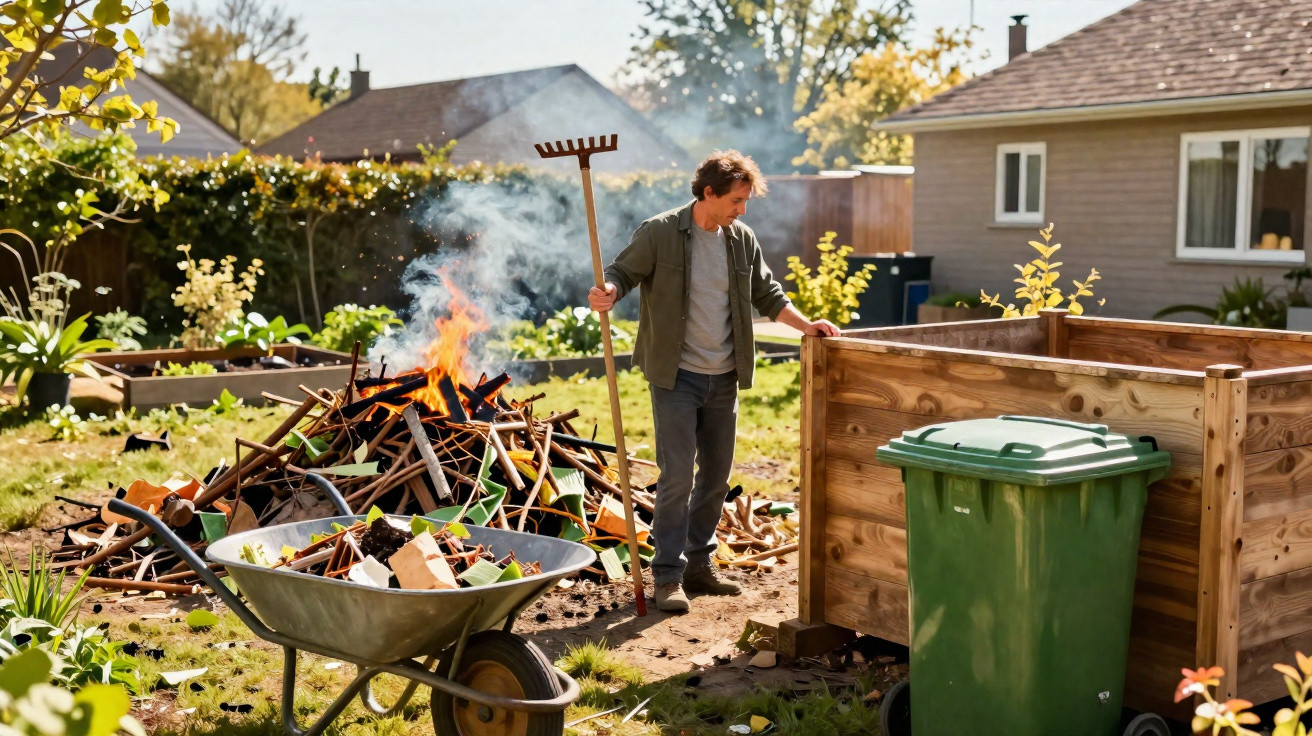
Clearing up the garden in spring often means reaching for a match rather than a wheelbarrow. Leaves, branches, shrub cuttings - everything is quickly “disposed of” in a fire: easy, convenient and seemingly tidy. Yet this very habit is being phased out in more and more federal states. Burning garden waste is no longer seen as a harmless custom; it is legally sensitive and environmentally questionable.
Garden fires only until the end of March - where it now stops
From a legal standpoint, the position is straightforward: Germany’s Circular Economy Act has, since 2015, generally prohibited the burning of garden waste nationwide. The complication is that federal states, districts and municipalities are allowed to create exceptions - and many have relied on those exceptions for years.
In many municipalities, garden fires are only permitted until 31 March, and in some places at most until mid-April - after that, legal burning is over.
A typical set of rules looks like this:
- Allowed only within a narrow spring window (often 1–31 March)
- Sometimes extended to 15 April, for example in rural areas
- Only dry, woody material permitted; no kitchen waste
- Strict time slots, such as weekdays only, and not during the midday quiet period
- From April, usually a complete ban - with clearly defined exceptions
Anyone lighting a fire outside these windows is committing an administrative offence in many districts. Depending on the area, fines can quickly run into the hundreds of euros - and in stricter cases, considerably more.
Why many federal states are tightening rules on garden fires
Pressure on local authorities to roll back exceptions has been building for years. Several factors are converging:
Air pollution right on the doorstep
What some dismiss as “a bit of smoke” can be a serious issue for neighbours with allergies or respiratory conditions. Burning leaves and green waste releases fine particulate matter, soot and, in some cases, toxic gases.
The biggest concern is where these fires typically happen: in built-up areas, right in the middle of residential streets or on allotment sites. Smoke drifts straight past open windows, across patios and over play areas. Complaints to the council’s enforcement team and the police follow - and authorities are responding more readily than they used to.
Wasting valuable resources
Material that goes into a fire pit is material that is no longer available for the soil. Prunings and leaves can be turned into nutrient-rich compost that improves a garden over the long term. Modern waste policy is geared precisely towards this: keeping organic matter in circulation rather than letting it disappear as smoke.
Only a few nutrients remain in the ash of a garden fire - most of it quite literally ends up in the air, instead of improving the soil.
Many municipalities are now putting money into their own composting facilities or supporting household solutions. Against that backdrop, burning can feel like an anachronism from another era.
Noise, smell and neighbour disputes
There is also the social side: few things spark arguments as quickly as thick smoke over the garden fence. While one person calls it an “old tradition”, the neighbour feels their home has been smoked out. Council enforcement officers have been reporting rising numbers of complaints about garden fires for years.
Mecklenburg-Vorpommern pushes ahead: total ban from 2029
One federal state is now setting an especially clear direction: in Mecklenburg-Vorpommern, burning garden waste is set to be completely prohibited from 1 January 2029. The state government is justifying the move on the grounds of protecting air quality and the climate, as well as aligning with federal waste law.
The message is unmistakable: away from fire, towards regulated disposal routes. Observers expect other states to follow suit in a similar way, or to tighten existing transitional arrangements significantly.
Many towns and districts are already signalling the direction of travel: former designated “burning days” have been scrapped, exceptions narrowed, or permissions ended entirely. Anyone relying on supposed customary rights is likely to find they no longer stand a chance.
How garden owners can find out whether they’re still allowed to burn
The problem is that there is no single rule that applies everywhere. Often it is decided at district level, sometimes by a unitary city, and in some areas even by the individual municipality. Anyone who wants to be certain will need to do a quick check.
Useful places to look include:
- The municipal or city council website, under “regulatory services” or “waste management”
- The district authority’s pages, using the search term “burning plant waste”
- A phone call to the citizen service centre or environmental department
- Notices at the recycling centre or in local council newsletters
Before the first spark, take a quick look at the local ordinance - it can save a lot of hassle and money.
Rules based on hearsay, such as “We’ve always done it this way here”, are no longer a reliable guide. In many areas, the legal position has shifted quietly - but decisively.
Legal alternatives: how to dispose of garden waste properly
Instead of relying on fire, there are several routes that are not only permitted but often far more sensible.
1. Your own compost at home
The most obvious option is a traditional compost heap or a closed hot composter. Particularly suitable materials include:
- Leaves (except large quantities of conifer needles, which rot slowly)
- Finely shredded shrub prunings
- Grass, perennial cuttings and deadheaded plants
- Small amounts of vegetable and fruit leftovers from the kitchen
With the right layering and the occasional turn, this becomes dark, crumbly humus within a few months. It improves soil structure, helps retain water and nutrients, and reduces the need for expensive shop-bought fertiliser.
2. Food-waste bin, recycling centre and collection points
If you do not have space for composting or need to get rid of large volumes of cuttings, municipal services are the practical answer. Typical options include:
- A food-waste/garden-waste bin for smaller amounts
- Council green-waste drop-off sites, often open seasonally
- A recycling centre with a dedicated area for garden waste
- Mobile collection days in spring and autumn with designated drop-off points
Many towns and councils then process the material in their own facilities into compost or soil improvers, which are sometimes sold back to residents at low cost.
Fines, liability, fire brigade: the risks hobby gardeners take
Anyone who lights a pile despite a ban is taking on several risks at once:
| Risk | Possible consequence |
|---|---|
| Breach of the ordinance | Fine, depending on the area from around €50 to several hundred euros |
| Smoke nuisance | Complaint from neighbours, additional conditions or bans |
| Fire spreading out of control | Fire brigade attendance, possible requirement to cover deployment costs |
| Damage to someone else’s property | Liability issues, disputes with insurers, civil claims |
There is also this: in dry springs, the risk of wildfires rises markedly. In some regions, even a small garden fire is enough to put authorities on alert. Fire services and forestry bodies regularly urge people to avoid open fires completely during dry spells.
Why many gardeners are better off with compost in the long run
Even if it sounds like more work at first glance, anyone who uses their green waste instead of burning it gains several benefits. Compost acts like a natural slow-release fertiliser.
A few everyday effects:
- Beds dry out more slowly in summer because the soil retains more water.
- Plants grow sturdier and are less prone to disease.
- On many plots, you can largely do without chemical fertiliser.
- Leaves that used to feel like a “burden” become a valuable resource.
If space is tight, compost sacks or small rapid composters can be worth considering. Worm composters for balconies or patios are also increasingly interesting for allotment holders - producing high-quality worm castings in a very small footprint.
What garden owners should do now
Spring is approaching: beds need preparing, shrubs cutting back and lawns tending. To avoid an unpleasant surprise, a few simple steps help:
- Check your municipality’s current rules on garden fires.
- Confirm whether there is still any permitted window in March or early April.
- If there is: burn only completely dry, suitable material and inform neighbours in good time.
- At the same time, put a long-term alternative in place: a compost area, a food-waste/garden-waste bin, or a drop-off site.
- When planning new planting, think ahead: less pruning, more natural corners where leaves can be left.
Many hobby gardeners say they hardly miss the fire once they have adapted. Anyone who sees their soil improve year after year with compost soon wonders why they ever set the material alight in the first place.
The direction is clear: away from flames, towards circular use and cleaner air. Anyone who informs themselves and changes course now will save money and stress - and future-proof their garden for the years ahead, without smoke drifting over the fence.

Comments
No comments yet. Be the first to comment!
Leave a Comment