
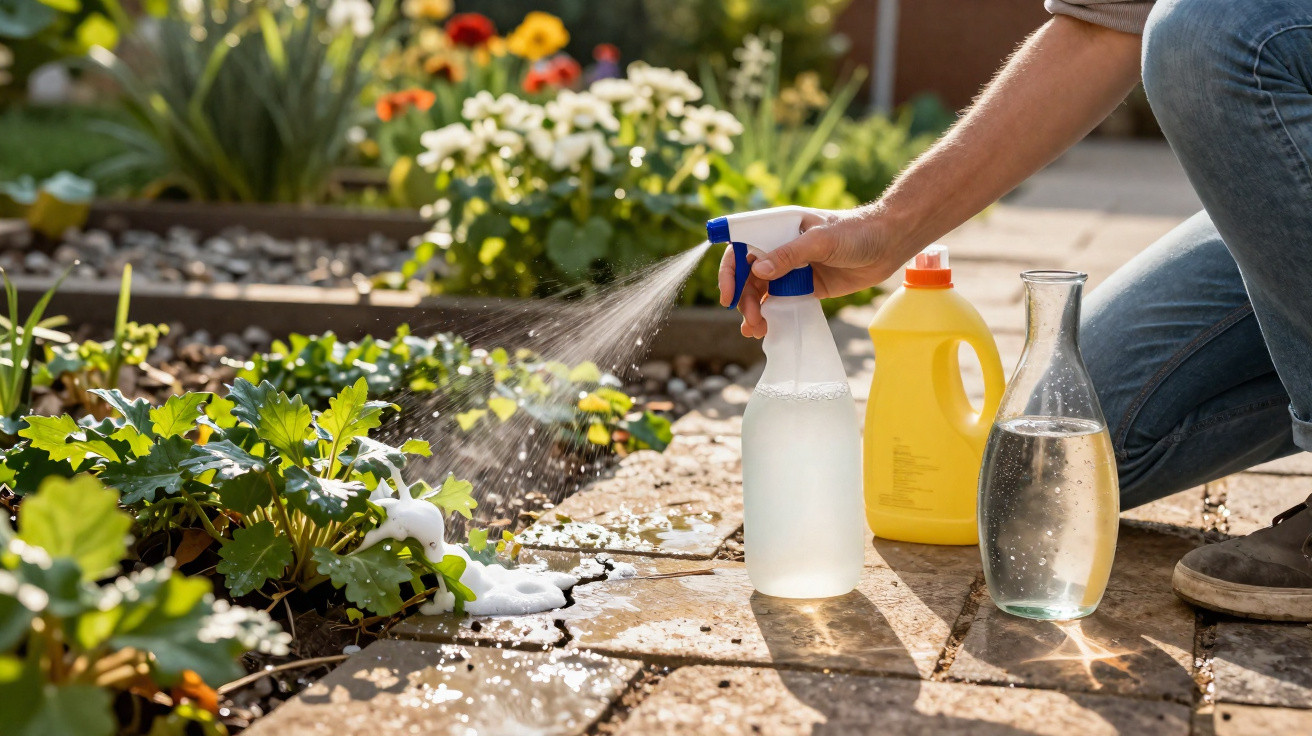
You scrub the patio and sweep the driveway - yet just a few days later, new tufts of weeds push up between the stones. If you then reach for a watering can filled with vinegar, you quickly notice the problem: the leaves may wilt, but the plants rarely disappear for good. That is why many gardeners are now turning to a different kitchen staple, tucked away in the cupboard under the sink - and, when used alongside vinegar, it can be surprisingly effective against weeds in paving joints.
Why ordinary vinegar usually only half works against weeds
Vinegar - often plain, colourless household vinegar - has long been treated as a handy tip for tackling unwanted growth in joints. Its acidity attacks the soft parts of the plant. Leaves and stems discolour, droop and can look dead within a short time. At first glance, it seems as though the issue has been dealt with.
Below the surface, though, the picture is different. In many cases the roots are barely affected. They sit protected in the ground, and the acid does not reach them properly. A few days later, the remaining root system simply produces fresh shoots.
Vinegar “burns” the visible parts of the plant, but often leaves the roots alive - so the weed simply starts up again.
For isolated, very young plants, vinegar can be enough. In joints that are heavily overgrown or on gravelled areas, however, the effect is usually short-lived. Anyone who wants a patio that stays neat would need to spray again every few weeks. That takes time, becomes irritating - and makes misuse more likely, for example on a lawn or in a vegetable bed, where vinegar has no place.
Washing-up liquid: an underrated helper in the fight against weeds in paving joints
This is where something almost everyone uses daily comes in: washing-up liquid. Many bottles contain what are known as surfactants. These substances cut through grease and grime, but they also have another property that matters in the garden.
Leaves have a natural, slightly waxy protective layer that causes water to bead and run off. Surfactants interfere with this layer. When washing-up liquid is applied with water, it changes the surface tension: the liquid clings more effectively to the leaf and can penetrate the tissue more easily.
Even on its own, washing-up liquid can weaken a plant. The leaves become less able to retain moisture, dry out more quickly and gradually die back. When combined with vinegar, the effect becomes noticeably stronger. The acid can reach the cells more effectively, and the contact is both more intensive and longer-lasting.
Washing-up liquid acts like a “door opener”: it breaks the leaves’ protective layer and boosts the effect of the vinegar.
The popular mix: how washing-up liquid becomes a weed weapon
Many hobby gardeners now rely on a simple kitchen mixture when weeds start spreading between paving stones, across gravel paths, or along the garage drive. The basic recipe is quick to mix and uses only a few ingredients.
Basic recipe for troublesome joints and gravel paths
- 1 tablespoon of washing-up liquid
- 1 litre of water
- optional: 1 cup of household vinegar
Put everything into a watering can or, better still, a spray bottle. Shake well before each use so it disperses evenly. Then spray directly onto the unwanted plants - ideally on a warm, dry day with sunshine. Damp leaves or rain shortly after spraying will significantly reduce the effect.
Variations for different areas of use
Depending on how heavy the growth is and how sensitive the surroundings are, the mix can be adjusted:
- Gentle version: 1 litre of water + 1 tablespoon of eco-friendly washing-up liquid. Suitable for young, delicate plants in joints where you want to be cautious.
- Stronger version: 1 litre of household vinegar + 2 teaspoons of washing-up liquid. For heavily overgrown paved areas and gravel paths where more punch is needed.
- Radical version with salt: 1 litre of household vinegar + 40 grams of salt + 10 millilitres of washing-up liquid. Only use where you truly want nothing to grow long-term, such as under wheelie bins or along hard-to-reach kerb edges.
The salt mix belongs only on purely mineral surfaces - in other words, where you are deliberately avoiding any greenery.
How to use washing-up liquid mixtures correctly in the garden
The biggest mistake is spraying too generously and without precision. Washing-up liquid, vinegar and salt do not stay only on the leaves - they also end up in the soil. Salt, in particular, can keep affecting the ground for longer than many people would like.
A few practical rules help prevent damage:
- Spray only on stone, gravel and other areas without useful plants.
- Choose calm, windless moments so the mist does not drift onto the lawn or perennials.
- Avoid broad, blanket treatment as if using a garden sprinkler - always aim at individual plants or specific joints.
- Use salt-based recipes sparingly and only rarely, to avoid lasting harm to the soil.
- Wear rubber gloves, especially if you have sensitive skin.
If too much washing-up liquid gets into the ground, it can affect soil structure. The soil may then absorb water less well, which can stress desired plants over time. The salt version is even more critical: salt breaks down slowly, disrupts soil life and micro-organisms, and can reduce growth in neighbouring beds.
Where the home method makes sense - and where it does not
The washing-up liquid–vinegar mixture is best suited to “dead areas”: patios, driveways, steps, kerbs, gravel strips along walls. In short, places where no bed is planned and no rain garden has been created.
The mixture should not be used in the vegetable garden. The same applies to lawns, perennial borders, or areas near ponds and water butts. In these spots, the downsides outweigh any benefit - for plants as well as for insects and soil-dwelling creatures.
Don’t overlook mechanical alternatives
If you are uneasy about washing-up liquid or vinegar getting into the soil, you can tackle the problem mechanically. It can take longer at first, but often brings more lasting calm to the area:
- Joint scrapers and narrow knives to pull roots out of the joints
- Hot-water devices or weed burners that damage plants with heat
- Topping up joints with sand or special jointing material so there is less space for weeds
A combination of occasional scraping, targeted use of the washing-up liquid mix, and suitable jointing material keeps many areas clean for much longer than relying on a single measure.
Why “weeds” are not always the enemy
Between slabs and gravel, you often find wild plants that can be genuinely useful: they provide food for insects, help prevent the ground from drying out, and can even look attractive. If you automatically fight every green tip, you can end up missing out on potential in the garden.
A pragmatic approach works well: decide which areas must stay completely tidy - for example, the path to the front door - and allow zones where a bit of wild growth is not an issue. In those places, it is fine to let something flower now and then without immediately spraying it away.
If you use washing-up liquid as a helper against weeds in paving joints, it is worth remembering what it is doing: it is not harmless “water”, but a cleaning product that interferes with the natural system. When it is correctly dosed, carefully targeted and not used as a permanent routine, it can noticeably reduce the unwanted creeping between paving stones - without reaching straight for harsh chemical products from the DIY shop.
Comments
No comments yet. Be the first to comment!
Leave a Comment