
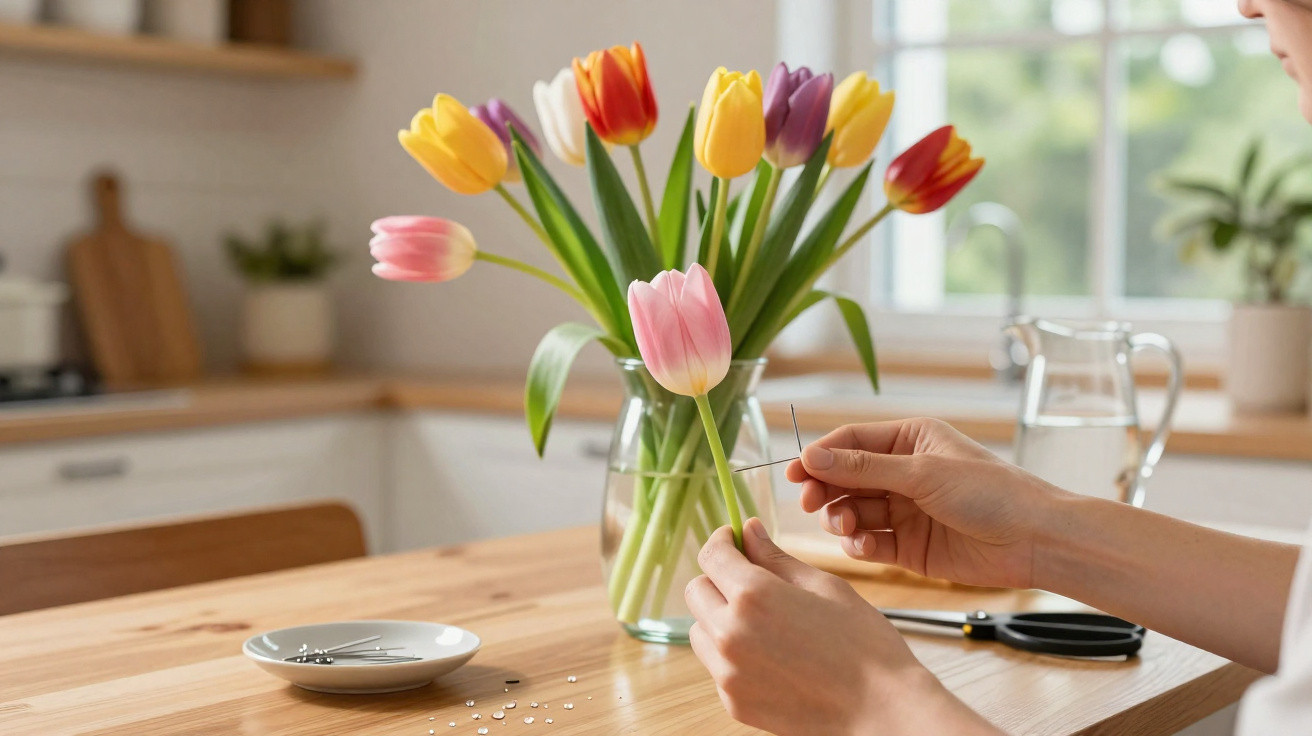
A simple needle trick from the home gardening community can get them standing upright again in seconds.
Many people know the situation: fresh tulips go into a vase in the evening, only for their stems to droop sadly over the rim the next morning. Rather than looking like a romantic spring bouquet, the arrangement resembles discounted flowers at the end of the day. However, a British home gardener tested several methods against one another in her kitchen – and found a surprisingly simple winner that takes only a few seconds.
Why tulips droop so quickly in a vase
Tulips behave differently in a vase from many other cut flowers. They continue growing after being cut, reach towards the light and subtly alter their direction each day. This flexibility is part of their distinctive appeal, but it also means the stems can quickly lose their strength.
Their stems are soft and hollow inside. As the flower head becomes heavier, the stem can bend towards the edge of the table or vase. Dry heated air makes matters worse: the cells lose water, the structure weakens and the flower droops.
There is another issue, too. Small air bubbles and pockets of bacteria can form inside the hollow stems. They obstruct the fine channels that carry water and nutrients to the flower. The vase may still be half full, yet the tulip can look as though it is dying of thirst.
Tulips continue to grow in a vase, are hollow inside and extremely sensitive to warmth, air bubbles and contaminated water – which is why they droop so quickly.
It was precisely this combination of growth, warmth and concealed air pockets that the Instagram gardener investigated when her own bouquet suddenly wilted beside the kitchen sink.
Four methods tested in the kitchen – only one really works
The home gardener set up a small experiment. She divided one bouquet of tulips between four miniature vases, placing two stems in each glass. Every stem received a fresh diagonal cut under water, and the vases were then kept in the same spot in her kitchen – with the same temperature, light and starting conditions.
The four options were:
- Vase 1: water with a splash of vodka
- Vase 2: tap water with a few coins
- Vase 3: plain water only (the control)
- Vase 4: plain water plus a tiny puncture in the stem made with a needle
She watched the flowers for six days. The alcohol test performed surprisingly badly: the stems looked limp and the leaves rapidly lost their firmness. The coin method lasted somewhat longer, but remained visually far from upright, taut tulips. The plain-water group also leaned noticeably over the vase rim.
The tulips with the needle puncture were entirely different. They remained upright, appeared plump and lasted considerably longer than those in the other glasses. For the gardener, the winner was obvious – and the video went viral on social media.
The 3-second needle trick for tulips explained
The idea behind the trick is remarkably straightforward: a clean, tiny puncture just beneath the flower lets trapped air escape from the hollow stem. The internal water channels can then work properly again without obstruction.
A clean puncture with a thin needle directly beneath the flower head releases the air blockage in the stem and helps tulips stand upright again.
How to do it step by step
- Take the tulips out of the vase: Lift the stems carefully from the water so that nothing snaps.
- Make a fresh cut: Trim around 1 to 3 centimetres from each stem at an angle under water. This prevents new air bubbles from entering.
- Use a clean vase: Rinse the container thoroughly, ideally with hot water, to reduce bacteria.
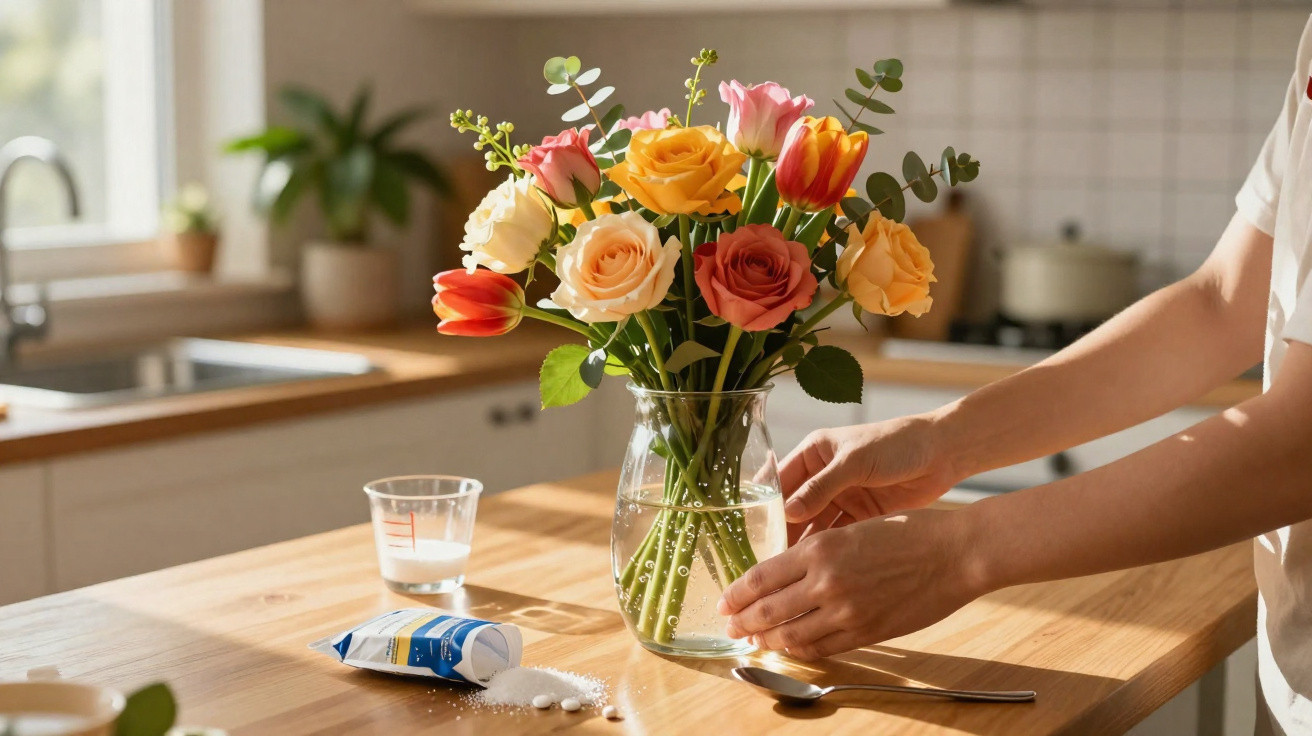
- Fill it with cool water: Add fresh, preferably cool tap water to the vase, optionally with the supplied flower food.
- Prepare the needle: Briefly clean a thin drawing pin or sewing needle with alcohol or hot water.
- Make the puncture: Push the needle straight through the stem once, just below the base of the flower – make only one small hole and do not repeatedly poke around.
- Put the flowers back: Return the tulips carefully to the water without unnecessarily squeezing the puncture point.
This takes only a few seconds per flower. Many home gardeners say that previously drooping tulips visibly straighten up within a short time.
How to keep revived tulips fresh for longer
The needle trick restores the stems, but it is not a substitute for good care. A few straightforward habits can noticeably extend the life of the bouquet.
Position: choose a cool corner, not a windowsill above a radiator
Tulips prefer cool conditions. They age far more quickly directly above a radiator, beside a fireplace or in strong sunshine. They also fare badly beside fruit bowls, as ripening fruit releases ethylene, a ripening gas that makes flowers wilt sooner.
A better location is:
- away from heat sources
- out of direct sunlight
- as free from draughts as possible
- away from bowls containing apples, bananas or pears
Water care: clean, cool and changed regularly
Clean water is essential for tulips. Cloudy water means bacteria, which can block the stem channels again. Changing the water every other day and cutting another 0.5 to 1 centimetre from the stem ends at the same time gives the flowers better conditions.
| Care step | Frequency | Benefit for the tulips |
|---|---|---|
| Replace all the water | every 1–2 days | fewer bacteria, better water uptake |
| Recut the stems | every 2–3 days | fresh cut surface, less air in the stem |
| Check the location | briefly every day | protection from heating, sun and fruit gases |
Common mistakes that make tulips age faster
Many problems arise simply through habit. The usual pitfalls include:
- Vases that are too narrow: When stems are crowded together, they push one another sideways and bend more easily.
- Old, blunt scissors: Crushed stem ends absorb water less effectively than a clean cut made with a sharp knife.
- Water that is far too warm: This greatly speeds up ageing; the blooms open quickly but do not last as long.
- Mixed bouquets containing strongly scented flowers: Some foliage and flowers release substances into the water that make tulips more sensitive.
Avoiding these mistakes and using the needle trick gives you a much better chance of enjoying a bouquet for many days.
How safe is the needle trick for the flower?
The prospect of piercing a stem may initially seem brutal. Experts take a more practical view: the puncture mainly reaches the air-filled interior rather than all of the conducting tissue. A clean needle and one precise puncture are what matter.
If you are unsure, try the trick first on two or three stems and compare their progress with the remaining tulips. Many people report that florists who were initially sceptical now pass the tip on to customers themselves, because it works so often in practice.
Getting more from a tulip bouquet
It also becomes interesting when combined with other care techniques. Some florists cool the entire bouquet overnight in a cool room or hallway, while others wrap the tulips in paper and place them in the fridge briefly to stabilise them. Used alongside the needle trick, these methods can produce arrangements that stand especially evenly.
Anyone who enjoys decorating with flowers can use the effect deliberately: tall, narrow vases create particularly crisp lines, while rounded vessels give a more loosely growing appearance. With a little practice, you can even allow for tulip growth during the first few days to create particular shapes in an arrangement.
Ultimately, the tulip’s charm lies in this slight unpredictability. Yet clean water, a cool location and a single needle can greatly reduce the risk of a complete collapse – so the spring bouquet remains a showpiece for several mornings rather than just one.

Comments
No comments yet. Be the first to comment!
Leave a Comment