
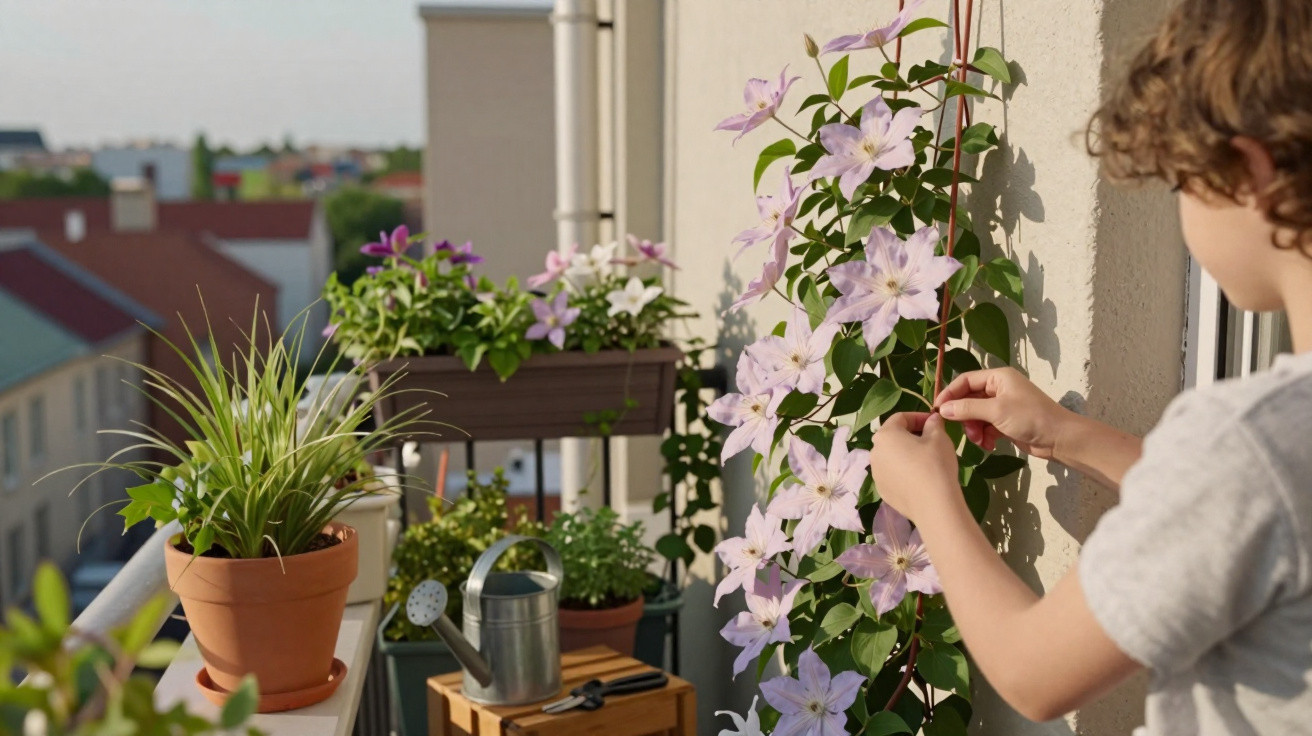
If you only have a narrow courtyard, a tiny garden or a few square metres of balcony, you’ll know the frustration: plant pots end up blocking the walkway, and larger shrubs instantly feel out of proportion. This is exactly where a group of plants comes into its own-long treated in England as a secret weapon for tight urban spaces, and with enormous potential here too.
Why compact clematis is the saviour of small city gardens
We’re talking about clematis varieties that stay small, often sold as dwarf or mini clematis. Instead of racing upwards like traditional clematis by 3–4 metres, these usually top out at around 1–2 metres. For narrow city balconies, slim terraces or postage-stamp front gardens, that’s a real gift.
Compact clematis use height instead of floor space-they create a wall of flowers without blocking the ground.
These plants climb neatly upwards, need only a modest footprint, and turn fences, walls or railings into thick curtains of bloom. Where older varieties often look bare at the base, newer breeding lines flower almost from the rim of the pot and continue right up.
Well-known compact cultivars such as ‘Ithemba’, ‘Eliza’ and ‘Queens Nurse’ show the direction things are heading: bold flowers, but in a size that suits the city. Colours ranging from bright white through soft blues to strong pink bring impact even on north-facing balconies.
Flower wall instead of pot chaos: how to save space
The idea is straightforward: if you don’t have room on the ground, you make up for it on a wall or railing. A clematis in a container might take up no more than the area of one paving slab at floor level-yet above it you get a whole vertical tapestry of flowers.
- On mini balconies: one large pot in the corner, a support fixed to the railing-leaving the rest clear for chairs
- In narrow courtyards: clematis trained up the house wall or a neighbour’s wall, while the floor stays usable for a table, bike, bins
- In a terraced-house garden: a slim flowering screen for privacy instead of a wide hedge
- On roof terraces: lightweight trellises with clematis rather than heavy “hedges” in tubs
Because they grow so vertically, you get visual fullness without having to weave your way around containers. Particularly in rented flats with tiny balconies, this is often the only way to create a genuine garden feel.
Perfect for pots, window boxes and hanging baskets
Compact clematis are made for container growing. To keep them thriving long-term, the key factors are pot size and good drainage.
Choosing the right container
The pot can-and should-be larger than you might expect. As a rough guide, around 40–45 cm in depth and width is a solid minimum for a single plant. Even more crucial are several drainage holes so excess water can escape and the roots don’t sit in soggy compost.
Suitable options include:
- large terracotta or ceramic pots with a saucer
- tall planters that take up little floor space
- wide balcony boxes with an integrated support
- sturdy hanging baskets for especially small varieties
For narrow windowsills and railings, compact types such as Clematis tangutica ‘Little Lemons’ work well. This cultivar is more shrub-like, reaches only about 45 cm, and covers itself for months with yellow, bell-shaped flowers. Afterwards, it keeps attractive, fluffy seed heads that look almost like small pom-poms.
Cultivars like ‘Bijou’ also show what’s possible: they stay fairly compact and let their shoots drape casually over the edge of window boxes or hanging planters-ideal for adding an unexpected twist among trailing geraniums, petunias or herbs.
Compost, drainage and companion plants
Clematis roots prefer cool conditions and steady moisture-moist, not wet. That makes a high-quality, free-draining compost essential. Many gardeners blend standard potting compost with a little sand or some broken expanded clay.
A tip from professional nurseries: smaller, ground-covering plants around the rim of the pot shield the roots from heat and disguise the container.
Good choices include:
- trailing petunias
- heliotrope
- small pansies or violas
- creeping thyme or other low herbs
This creates a miniature “border” in a pot: colour and scent at the base, with a light climber above that heads upwards.
Planting, pruning and care-easy, as long as you follow a few rules
Planting correctly and providing support
Once you bring your clematis home, plant it slightly deeper than it sat in its nursery pot. It’s fine for the root area to be covered by 2–3 cm of compost-this helps the plant become tougher and more resilient.
For climbing support, a discreet trellis, a few bamboo canes or a metal frame pushed into the pot is often enough. Thin stems will grip by themselves; on thicker railings or posts, help them along with a few loose plant ties.
Watering, feeding, and a flush of flowers
Clematis in containers need regular but restrained watering. The compost should stay lightly moist, never soaking wet for long periods. In hot weather, it’s best to check the top layer daily with your finger.
For abundant flowering, a potassium-rich feed (similar to tomato fertiliser) works well. As soon as the first buds appear, you can feed weekly until the blooms are just about to open. Then pause-this mild nutrient stress often encourages the plant to set even more buds.
When temperatures sit consistently well above 25 to nearly 30 °C, some clematis respond with yellowing leaves and slip into a resting phase. At that point, don’t “water it through” out of sympathy; instead, water moderately and give the plant a bit of shade, for example by placing other pots in front.
Pruning without fear
Many amateur gardeners feel nervous about pruning clematis-completely unnecessarily. Compact varieties are usually straightforward: once a year, typically in late winter or very early spring, cut the stems back firmly, depending on the cultivar to around 30–50 cm.
This hard prune keeps the plant neat, renews the older wood, and ensures it shoots again from low down. In very small gardens that’s invaluable, because you avoid ending up with woody, unattractive frameworks.
How mini clematis can transform city balconies for the long term
Compact clematis fit perfectly with an urban lifestyle where flexibility matters. If you move, the flowering tower in its pot simply moves with you. In rented homes, supports can often be fitted in ways that don’t require permanent drilling.
Another advantage is structure over many months. Many varieties flower in late spring or summer, and some deliver a second burst in autumn. Seed heads often remain decorative well into winter. If you combine early- and late-flowering varieties, you can achieve an almost continuous season of bloom.
They’re valuable for insects too-especially in densely built-up areas where little else is flowering. Bumblebees and solitary bees use the blooms as a nectar source, particularly on higher balconies that otherwise offer very little food.
If you already grow vegetables in containers, clematis can be integrated easily: tomatoes, peppers and herbs stay in the sun, while the clematis is happy with its roots in a slightly shadier, cooler position. This creates a small but surprisingly versatile garden ecosystem within just a few square metres.
For beginners, it’s worth visiting a specialist retailer and asking specifically for “compact clematis for a pot”. Many garden centres now stock dedicated lines for small spaces. With the right cultivar, a generously sized container and a simple support, a seemingly useless balcony corner can quickly become a vertical garden of flowers-where every centimetre suddenly counts twice.
Comments
No comments yet. Be the first to comment!
Leave a Comment