
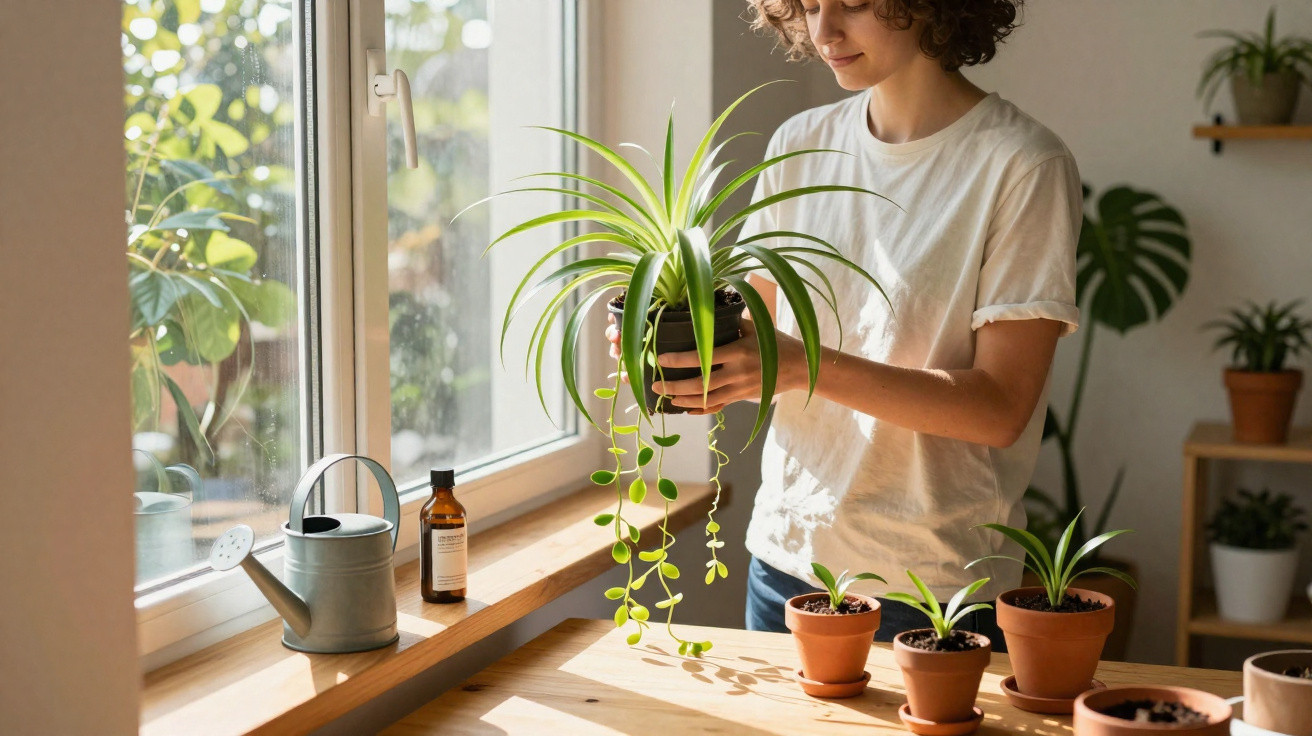
Many people dream of a spider plant draped in offshoots – yet look in frustration at their own plant, which produces nothing but leaves.
The good news is that this is usually not because you have the “wrong” plant, but because a few aspects of care need adjusting. By getting the light, pot size and a small, deliberate stress trigger right, you may see your spider plant covered in baby plants within just a few weeks.
Why your spider plant is not producing offshoots
The familiar “babies” of a spider plant are small plantlets that develop at the ends of long, arching stems. These stems emerge after an inconspicuous bloom of tiny white star-shaped flowers. Only afterwards do the characteristic young plants grow, ready to be detached and potted up later.
If your plant is growing strongly but still produces no offshoots, one of these causes is usually responsible:
- The plant is still too young – before it reaches around one year old, it often has not yet entered its “reproduction mode”.
- There is not enough light – without sufficient brightness, the spider plant will not flower, so it cannot form offshoots either.
- It is too comfortable – a large pot, plenty of fertiliser and ample root space encourage leaf growth rather than new plants.
Do not worry that you have a “male” or “infertile” specimen: spider plants naturally have the ability to produce plentiful offshoots when conditions are right.
The species Chlorophytum comosum reproduces both from seed and through its side plantlets. In a living room, this vegetative method of propagation is the most relevant. If the plant is simply kept in comfortable partial shade with lots of compost, it may grow plenty of foliage but will not create trailing garlands.
Light, a snug pot and real darkness: the essential trio
Bright positions instead of a gloomy corner
Spider plants thrive in bright, indirect light. Suitable locations include:
- on an east- or west-facing windowsill
- one to two metres back from a south-facing window with a light curtain
- in a very bright stairwell that does not receive full sun
When the plant remains in low light, it mainly produces long, soft leaves and stays in a kind of “survival mode”. It needs an energy surplus to make offshoots, and it can only build this up with good light levels.
Day length is also important. Research into the so-called photoperiod indicates that stems carrying offshoots begin to form when the plant receives intense light but fewer than 12 hours of brightness each day for several weeks. This also requires periods of genuine darkness at night.
Why a snug pot delivers better results
Many owners mean well by moving a spider plant into a much larger pot. In fact, this can slow down offshoot production. In nature, limited room in the soil encourages plants to reproduce in good time. You can replicate this effect at home.
A slightly root-filled pot tells the spider plant: “Space is getting tight – time to produce offspring.”
Check the root ball: it is ideal when the roots fill the pot well but are not yet forcing their way out in large numbers. When repotting, a container only one size larger is usually enough. Increasing the pot diameter from 12 to 30 centimetres is more likely to hinder than help.
Using little fertiliser enhances this effect. The spider plant’s fleshy roots store water and nutrients and, according to specialist literature, even contain notable amounts of fibre, potassium, protein and carbohydrates. Strong roots that are not constantly overfed support balanced growth with plenty of flowers and plantlets.
Proper nights rather than constant illumination
In many homes, lights remain on until late, while televisions and computers add further illumination. That may feel cosy to us, but it can confuse the plant: its internal clock receives no clear signal for “day” and “night”.
For generous offshoot production, try a three-week “light programme”:
- Place the spider plant directly beside a bright window.
- Let it absorb plenty of light during the day.
- From early evening onwards, keep its surroundings as dark as possible – reduce artificial light, close the curtains and avoid constant lighting immediately beside it.
This combination of strong daylight and genuine nights encourages the plant to develop flower stems. Soon afterwards, the first small arching shoots with flowers, followed by offshoots, should appear.
The practical plan: turning your spider plant into an offshoot factory
Step 1: check its health and inspect the pot
Carefully lift the plant from its pot. Look out for the following:
- Age: at least one year is ideal.
- Roots: pale, firm and slightly swollen, with no soft or unpleasant-smelling areas.
- Pot: the roots fill it well, but are not yet pushing out everywhere.
If the root ball is completely tangled and already falls apart as you lift it out, the new pot may be slightly larger. A loose, free-draining growing medium with a slightly acidic to neutral pH value (around 6.0 to 6.5) is important. Spider plants do not tolerate waterlogging well, so a drainage hole in the pot is essential.
Step 2: move it and manage the light
Move the plant somewhere noticeably brighter if it has previously been kept in a corner of the room. A position directly by a window often works wonders. Temperatures between 15 and 25 degrees are ideal.
For the next three weeks:
- Day: provide plenty of indirect light, but avoid harsh midday sun through an uncovered south-facing window.
- Evening and night: reduce nearby light sources, use curtains or blinds, and do not leave a lamp burning directly above the plant.
Step 3: water and feed – but in moderation
Water the spider plant once the top layer of compost feels dry. A finger test is sufficient: if the top centimetre is dry, it is time to water again. In winter, allow slightly longer intervals.
When it comes to fertiliser, less is more:
- Use liquid fertiliser at a low dose no more than every two to three weeks.
- Do not give it a “power start” after repotting by combining heavily pre-fertilised compost with additional liquid feed.
Too many nutrients primarily encourage leaf growth. Plants kept slightly short of nutrients are much more likely to invest in flowers and plantlets.
Step 4: make the most of the offshoots
Once the first long stems with small spider plants at their tips appear, the most exciting stage begins. You can propagate these young plants in three ways:
- Pot them up directly: detach the offshoot and place it in a small pot of moist compost.
- Root them in a glass of water: stand the young plant with its base in water for a few days until roots are visible, then pot it up.
- Place a pot beneath it: position a small pot of compost under the offshoot, rest the rosette on the surface and only cut it free once it has rooted there.
The final method has the highest success rate because the offshoot is still supplied by the parent plant while it establishes roots of its own.
Mistakes that reliably hold back offshoots
Common day-to-day pitfalls are easy to avoid. These are frequent obstacles for an otherwise healthy spider plant:
- Permanently dark locations, such as windowless hallways
- Large decorative pots without drainage holes, where water collects
- Constant illumination until late at night from lamps or a television positioned beside the plant
- Regular “fertiliser binges” in the hope of rapid growth
Correcting these issues often leads to noticeably different behaviour after only a few weeks: flower stems appear first, followed gradually by new plantlets.
How a spider plant affects your home
Spider plants are not merely easy to care for; they are also among the houseplants associated with research into indoor air. Their long leaves and strong roots process airborne pollutants and can therefore contribute to a more pleasant indoor climate. This makes them especially popular in offices and children’s rooms.
If you grow several offshoots, you can place them in different parts of the home: in the bedroom, above the desk or in the bathroom beside a bright window. Over time, this creates a small green network throughout the household that links the spaces visually and has a positive effect on air quality.
The psychological effect is interesting too. Many plant enthusiasts report that a parent plant cascading with offspring creates a sense of achievement. It feels as though you have done something right – and that feeling encourages you to explore houseplants and their care further.
So, if you currently have a spider plant in your living room without a single offshoot, there is no need to give up on it. With targeted light management, a deliberately chosen pot that is on the snug side and restrained feeding, you can effectively reprogramme the plant. Step by step, an unremarkable clump of leaves can become the iconic trailing houseplant, with stems full of young plants reaching almost to the floor.



Comments
No comments yet. Be the first to comment!
Leave a Comment