
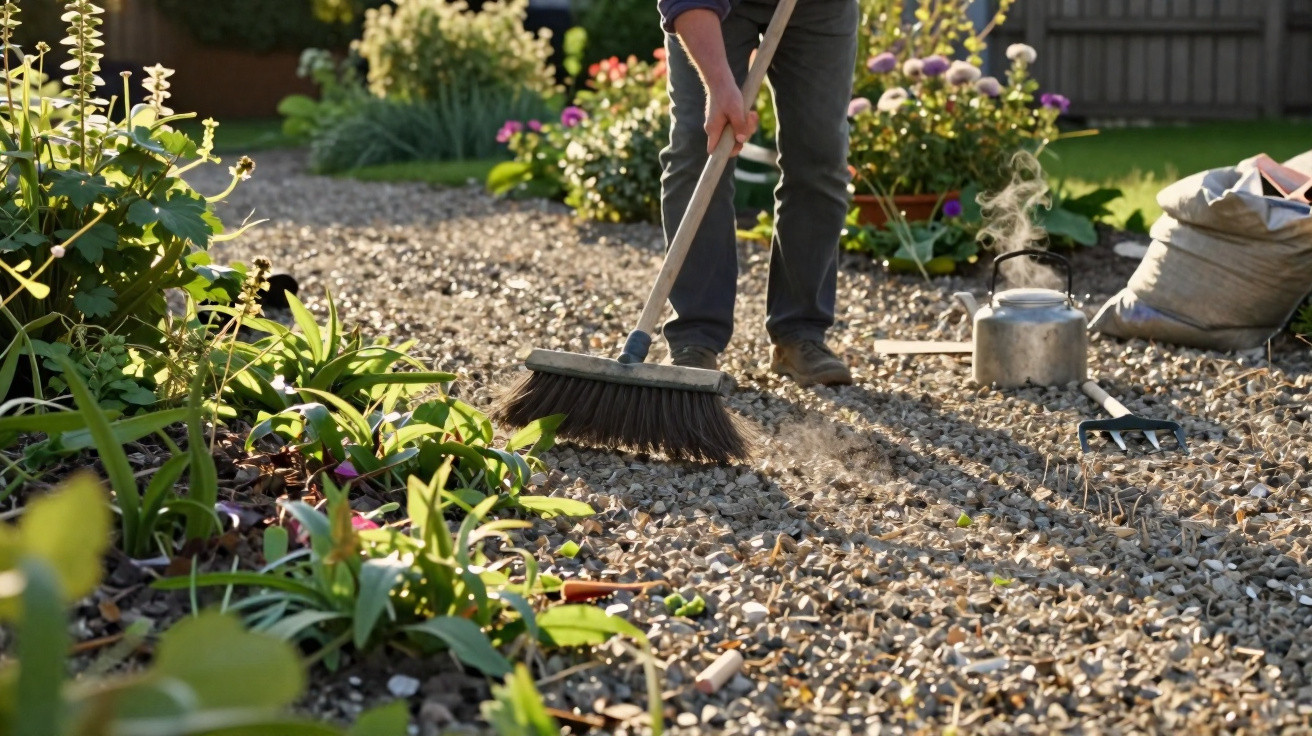
Before summer arrives, many gravel paths in the garden risk becoming a weed nightmare – but acting in good time can save hours of weeding.
Purslane, dandelions and couch grass can suddenly appear between the stones, bending down causes backache, and strict water restrictions apply in many areas at the same time. Many amateur gardeners eventually give up in frustration or reach for chemical weedkiller. Yet the battle for the gravel path can be made far more manageable with three targeted, natural measures.
Why a gravel path becomes overgrown so quickly
Gravel looks neat, contemporary and easy to maintain. However, it is not genuinely maintenance-free. The stones do not form a sealed layer, allowing air, light and organic matter to pass through. Over time, dust, leaves, pollen and tiny pieces of plant material accumulate in the gaps.
This creates a thin, fertile layer in which seeds carried by wind, birds or pets can germinate without difficulty. This happens particularly quickly when:
- the gravel layer is too thin;
- rounded, ‘rolling’ stones have been used;
- the base has not been compacted properly;
- leaves and grass clippings are left in place.
Once temperatures rise and there is an occasional heavy shower, wild plants have ideal conditions for getting started. Even in very dry areas, brief summer thunderstorms are often enough.
If plants are simply left to grow, their roots become entangled with the base, retain moisture in the ground and can eventually turn individual patches into muddy, slippery surfaces. At the same time, more organic material collects in the path, creating a self-perpetuating cycle for further waves of weeds.
Weeds in gravel are not a sign of ‘poor-quality’ gravel, but of excessive nutrient deposits and light reaching the ground.
Using a chemical total herbicide at this stage does not just harm soil life and insects. Many products pollute groundwater and surface water, and some are no longer permitted at all in front gardens, driveways and public areas.
Three natural strategies to keep the gravel path clean all summer
The good news is that three straightforward, largely mechanical measures can keep the path clear, without a watering can or chemicals. The most important rule is to start early, ideally in late spring before the intense heat arrives.
1. A mineral ‘shield’: careful construction and upgrading
Anyone planning a new gravel path, or intending to renovate an existing one thoroughly, can now lay the foundations for less work over the coming years. The aim is to prevent light reaching the ground while still allowing rainwater to drain away.
A proven construction is as follows:
- Remove existing weeds as completely as possible, digging out roots or loosening them with a patio weeder.
- Level the base and compact it thoroughly so that hollows do not form later.
- Lay a permeable geotextile, such as a root barrier or weed membrane, which lets water through while slowing the rise of weeds from lower layers.
- Apply an even layer of angular, crushed gravel, around 5 to 7 centimetres deep.
Why use crushed gravel in particular? Its edges interlock more effectively, it shifts less and allows less light to reach the soil. Rounded decorative pebbles may look elegant, but they leave more gaps.
A defined edge restraint is equally important, for example kerbs or metal edging. This keeps the gravel where it belongs and stops lawn from growing into the path.
A properly constructed base with membrane and a sufficiently deep layer of angular gravel prevents most later weed problems.
Even without rebuilding the entire path, improvements are still possible: rake through the old material, remove heavily weeded patches, install membrane in targeted areas and add fresh crushed gravel. It takes some time, but substantially cuts future maintenance.
2. The ‘magic brush’: brief sessions, major results
The second key is a light but consistent routine: brush rather than bend. Dedicated joint or path brushes with metal bristles dislodge young shoots and moss without requiring constant crouching. A very stiff plastic brush on a handle also works well on many gravel paths.
A short session every fortnight during the season is ideal. At this point, very young seedlings can be rubbed out quickly before they establish proper roots.
Practical advice for the brushing routine:
- Work early in the morning or after light rain, when the ground is just slightly damp.
- Move across the surface in circular motions, much like scrubbing.
- Be particularly thorough around edges, cracks and transitions, as weeds often start there first.
- Collect loosened plant debris immediately with a broom or rake and dispose of it.
Leaving the debris behind simply builds up another thin humus layer, ready for the next generation of wild plants. The brushed-out material should therefore go on the compost heap or into the garden waste bin.
3. Boiling water for particularly persistent clumps
Despite membrane and brushing, a few especially tough plants usually remain: couch grass, plantain and deep-rooted dandelions. For these cases, there is a surprisingly effective method that uses no chemicals whatsoever: boiling water.
Using a kettle, ideally one with a spout, the hot water can be poured precisely onto the root area. The heat destroys cell structures in leaves and roots within seconds. Shallow-rooted species such as chickweed or young purslane often succumb after just one application.
A few points will help keep this method safe:
- Use it only on gravel and paved surfaces, never in borders or on lawns.
- Aim accurately to avoid scalding ornamental plants.
- Repeat after 10 to 15 days if individual clumps grow back.
- Work only on dry days, so the water cools quickly and does not run off over a wide area.
Boiling water works locally, dissipates quickly and leaves no residues in the soil – ideal for small problem areas in a gravel path.
How often does a gravel path really need attention?
Many garden owners overestimate the amount of work involved. Those who prepare the gravel path thoroughly in spring will usually manage during summer with short, regular sessions:
| Period | Task | Frequency |
|---|---|---|
| Spring | Thorough cleaning, check the membrane, top up gravel | Once |
| May–August | Brush the surface | Every 2 weeks |
| May–August | Apply boiling water to problem spots | Every 10–15 days as needed |
| Autumn | Remove leaves, rake through the surface | 1–2 times |
Following this rhythm removes wild plants before they can set seed. As a result, the pressure decreases a little more each year.
How these methods differ from chemical weedkiller
The three steps described rely not on poison, but on straightforward drying out, blocking light and mechanical removal. This protects soil organisms, earthworms, solitary bees and other beneficial insects in the garden.
Chemical products generally kill all plants in the treatment area, including small desirable seedlings from a neighbouring border. Residues can move into adjacent areas. This is particularly problematic on driveways, near drains and on slopes. In many local authorities, using such products on private paths is even prohibited.
The mechanical approach requires slightly more planning, but saves water and reduces the workload over the long term. Keeping a brush and kettle ready by the garage or in the garden shed soon makes gravel-path maintenance a minor task, completed in five to ten minutes.
Additional advice: deliberately allow plants or keep the area consistently clear?
One final question many gardeners consider is whether a gravel path really has to be completely ‘sterile’. Some intentionally leave low-growing, walkable species such as thyme or Roman chamomile around the edges. This attracts insects and creates a more lively appearance.
Anyone taking this approach should establish clear zones: a genuinely unobstructed central walking area, with side strips where plants are tolerated or even deliberately planted. The three measures described then mainly help on the main path, while the edge areas can be designed intentionally.
For driveways, accessible entrances or shaded areas, however, a consistently clear surface is advisable. Wet leaves and tall weeds can quickly become a slip hazard there. The same principle applies here: the better the construction in spring, the more relaxed the summer will be.
Replacing indiscriminate chemical use early on with membrane, gravel, a brush and hot water keeps a gravel path permanently clean, saves water and avoids dependence on increasingly strict rules governing weedkiller use.

Comments
No comments yet. Be the first to comment!
Leave a Comment