

Many amateur gardeners know the pattern all too well: spring looks lush, high summer throws everything off balance, gaps open up in autumn, and winter leaves the garden looking bleak. Yet you can create a consistently colourful display with three carefully chosen perennial ground cover plants - without weekly effort and without expensive replanting.
The trick: three ground cover plants that share out the year
The principle is straightforward: rather than mixing lots of different species at random, you focus on three tough, perennial plants whose flowering times dovetail neatly. Each one carries a different part of the year, and together they cover all twelve months.
Professional gardeners particularly recommend this combination:
- Winter heath (Erica carnea) - brings colour from January to April
- Moss phlox (Phlox subulata) - takes over from May to August with dense carpets of flowers
- Leadwort (Ceratostigma plumbaginoides) - provides vivid blue flowers from September to December, plus red autumn foliage
“This trio fills the typical ‘quiet spells’ in a border and turns bare patches into a continuously lively play of colour.”
All three are perennial, winter-hardy, and well suited to our climate. Some die back in winter or lose their leaves, but they reliably reappear in spring - with no need to plant again.
The perfect formula: 5 plants per square metre
To make a bed look full and attractive throughout the year, choosing the right species is only half the job. Planting density matters just as much. A proven rule of thumb is: 5 young plants per square metre.
Here’s how to do it:
- Clear the area thoroughly of the worst weeds and loosen the soil.
- Plan the planting holes: on one square metre, mark out five points.
- Plant the three species alternately, avoiding straight rows.
- Water in well after planting and watch for drying out during the first few weeks.
The best planting times are mid-October or early spring. That way, the ground cover has time to root in properly before heat or severe frost arrives.
Why they don’t “smother” each other
Many garden owners hesitate to mix different ground cover plants because they worry that one will dominate and the others will disappear. With this trio, that generally doesn’t happen - for reasons linked to how they use the soil and how their growth peaks are staggered through the year.
Different root depths instead of direct competition
These three plants draw on different layers of soil and hit their nutrient and growth windows at different times. Think of it as separate “storeys”:
| Plant | Root depth (general tendency) | Main period in the year |
|---|---|---|
| Winter heath | fairly shallow, finely branched | late winter to spring |
| Moss phlox | shallow to medium depth | spring to high summer |
| Leadwort | somewhat deeper, stronger | late summer to winter |
Because they occupy different layers, they clash less often. While one plant is pushing fresh shoots, another is focusing on root reserves or easing into a resting phase.
A triangular planting plan instead of rows
Rather than neat, orderly rows, a different layout works far better: interlocking triangles. Across the area, imagine repeating triangles, and plant a different species at each corner in rotation.
It may look almost random at first glance, but it creates several practical benefits:
- No obvious “blocks” that go bare one after another.
- The transitions between flowering periods look softer and more natural.
- Small gaps close faster because each species is surrounded by neighbours from the other two groups.
“The triangle plan imitates what nature does on its own: a mosaic of plants instead of artificial stripes.”
A year in the bed: who flowers when?
Across the seasons, these three ground cover plants work like a well-drilled relay.
Winter to spring: winter heath sets the pace
From January to April, winter heath brings life to a time when little else is in flower. Its small, bell-shaped blooms often show even when there’s still snow about. Meanwhile, moss phlox spreads quietly, without yet putting on its main display.
Spring to summer: moss phlox takes over
From May, the whole look shifts. Moss phlox lives up to its name, forming a dense, colourful mat. Depending on the variety, colours range from white through pink to violet. During this spell, winter heath recedes visually but remains as a green backdrop.
Autumn to year-end: leadwort as the finale
From around September, leadwort comes into its own. It produces intense, sky-blue flowers, and at the same time its leaves turn copper-red to fiery red. In a sheltered spot, this combination often lasts into December. As this happens, winter heath and moss phlox are already building strength for their next turn.
Little work, big impact: care at a glance
The main advantage of this approach is that, once established, it stays relatively low-maintenance. With the ground almost fully covered, weeds have very little opportunity. Watering is usually only needed in the first few weeks after planting and during prolonged dry spells.
Useful care tasks through the year:
- In late winter, lightly trim winter heath to keep it compact.
- After moss phlox finishes its main flowering, shorten spent growth to encourage a denser mat.
- In spring, thin leadwort if necessary if it is shooting too strongly.
- Every one to two years, work a little compost in between the plants.
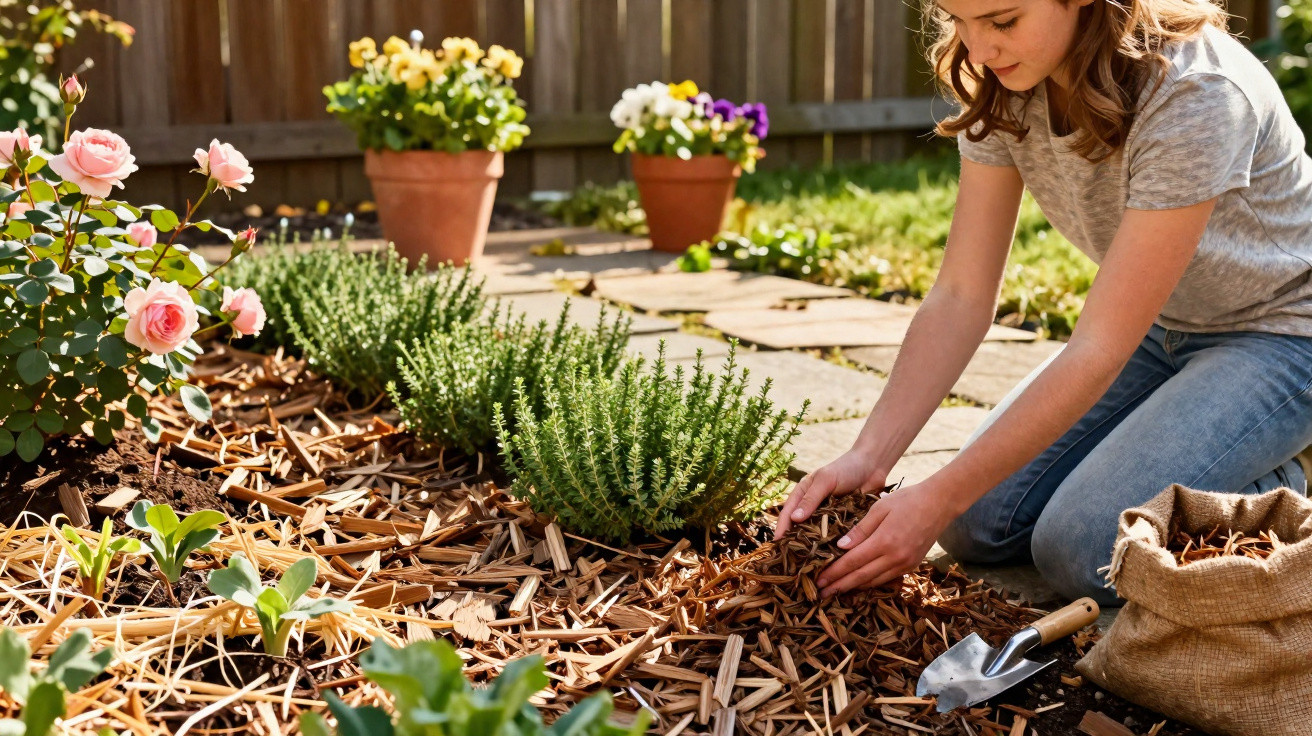
If you like, you can mulch lightly between the plants in the first year until the carpet closes. After that, the plants’ own foliage largely takes over that protective role.
Where this trio is especially worthwhile
This combination isn’t only for classic borders. In fact, many awkward spots benefit most from this planting.
- Slopes and banks: the roots help stabilise the soil, and weeds are held back.
- Front gardens: a tidy, cared-for look all year without constant replanting.
- Grave plots: low effort, yet still seasonal change.
- Around shrubs and small trees: beneath open-canopied shrubs or small trees, you get a colourful carpet.
A sunny to semi-shaded position with free-draining soil is important. None of the three likes waterlogging. On very heavy soils, sand or fine grit can help improve structure.
What “perennial” really means in day-to-day gardening
For many people, the phrase “perennial plant” can sound a bit abstract. In practical terms it means: plant it once, and it returns year after year. The above-ground parts may disappear in winter, but roots and buds survive in the soil.
That not only reduces costs compared with annual bedding plants. It also makes the garden feel more stable, because familiar plants return and gradually knit together in a natural way.
Small additions that fit well - and what to avoid
If you want extra variety, restraint matters. Too many additional species can upset the balance. Small bulbs placed sparingly - such as crocuses or miniature daffodils - are a good match: they flower in very early spring and then disappear into the sea of foliage.
Less suitable are aggressively spreading ground cover plants such as ivy or certain cranesbill (Geranium) types. They can throw off the carefully balanced relationship between the three main performers. Large shrubs in the middle of the area are also unhelpful, as they steal light and take up the space the ground cover needs.
If you stick to the underlying principle - three well-matched species, a clear planting density, and a triangular pattern - you end up with a border that genuinely carries itself through the seasons with minimal input. That’s exactly what makes this method so appealing for busy people, reluctant gardeners, and anyone who simply wants borders that look good.


Comments
No comments yet. Be the first to comment!
Leave a Comment