
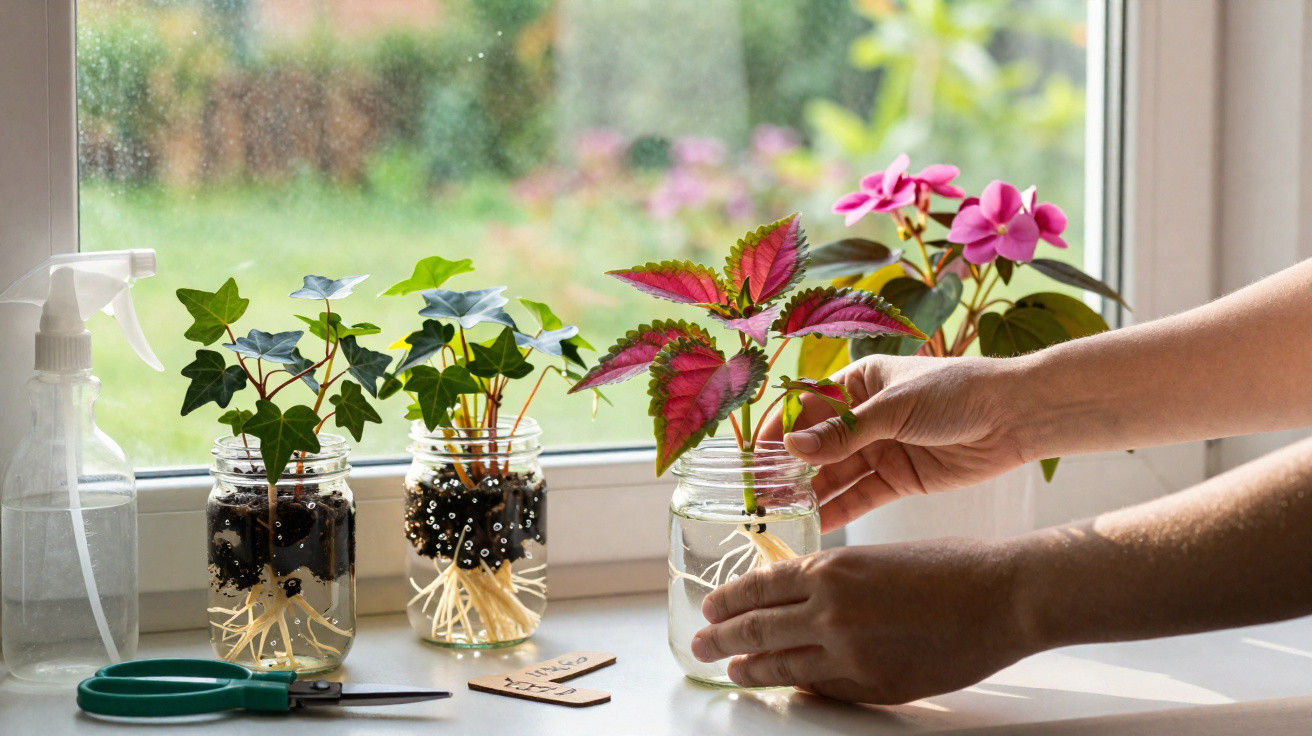
Many amateur gardeners know the feeling: at the beginning of summer, borders can still look rather sparse, while the wallet is noticeably lighter after a trip to the garden centre. Yet three popular ornamental plants can be used to produce new plants in no time, requiring only water, a glass and a little patience.
Why early summer is the perfect time
Cuttings can usually be propagated successfully from April to September. June and early summer are especially favourable, however. Plants are putting on strong growth at this point, their shoots are young and pliable, and temperatures generally sit between 20 and 25 °C.
“During this growth phase, healthy shoots often develop strong roots in water within just one to four weeks.”
For amateur gardeners, this means that cuttings placed in water now can usually be planted into compost later in the same month. A small number of parent plants can quickly provide whole rows of new plants for borders, containers and window boxes, with no need for another shopping trip.
The three stars of water propagation
Not every plant is happy sitting in a glass of water. These three species, however, form roots particularly reliably:
- Ivy – a hardy climber for fences, walls and hanging baskets
- Coleus – a colourful foliage plant for pots and window boxes
- Busy Lizzie (Impatiens) – a long-flowering choice for partially shaded and shaded spots
All three root quickly, tolerate minor mistakes and give beginners a prompt sense of success. That makes them particularly well suited to trying this method for the first time.
Basic equipment: what you really need
No professional equipment is required for water propagation. Most of what is needed will already be in the home:
- clean, sharp secateurs or a knife
- clear glasses or transparent cups
- tap water left to stand for a few hours
- a bright position away from direct midday sun, such as a windowsill
Rooting hormones and specialist additives can sometimes speed up the process, but they are generally unnecessary for these three plants. Cleanliness matters more: washing tools and containers beforehand significantly reduces the risk of rot.
The basic method for cuttings in water
Whichever species you choose, the process follows the same essential steps:
- select a healthy shoot that has not become woody
- cut the shoot to a suitable length, between 7 and 15 centimetres
- make the cut just below a node, where leaves join the stem
- remove leaves from the lower section so that nothing rots in the water
- place one or two nodes in water, keeping all leaves above the surface
- change the water regularly and keep the glass clean
- plant into compost once the roots are around 2.5 to 5 centimetres long
“The node beneath the water surface is the crucial area: this is where the new roots emerge.”
Cutting the stem at an angle slightly increases the cut surface and can help root formation get underway. It is still important not to crush or smear the cut end with your fingers.
Ivy in a glass of water: a miniature climber
Ivy is among the hardiest plants for water propagation. Once prepared correctly, one parent plant can supply numerous new trailing shoots.
How to root an ivy cutting
- choose a strong trailing shoot measuring roughly 10 to 15 centimetres
- make sure it has several nodes
- cut immediately below a node
- remove the lower leaves completely
- submerge two nodes in water, leaving the remaining section above it
Placed somewhere bright but out of direct sun, the cutting will usually produce clear clusters of roots after two to four weeks. Once they are approximately five centimetres long, the young ivy can be moved into a pot of loose compost. This keeps its growth manageable, so it does not immediately take over the entire border.
Coleus: an explosion of colour from a glass of water
Coleus is prized above all for its brightly coloured foliage. Starting several cuttings at once makes it possible to grow on entire colour combinations at no cost.
What coleus cuttings need
Soft, unbranched shoots between 8 and 12 centimetres long are ideal. Remove flower stems thoroughly, as they use up the plant’s energy and slow root development. Leave only two or three leaves at the top and remove everything below them.
“Less leaf mass means less water loss – allowing the cutting to put its energy into roots.”
If the glass is kept in a bright place and the lower leaves are consistently removed, fine roots often appear after only one to two weeks. When the white mass of roots reaches roughly the length of a matchstick, it is worth potting the cutting into low-nutrient, loose compost. Coleus will then quickly grow bushier and can later be divided or used for further cuttings if required.
Busy Lizzie: a cloud of flowers from a few shoots
Busy Lizzie is a classic choice for shaded window boxes. Buying plants can become expensive, particularly when large quantities are needed. Water propagation makes it easy to fill entire boxes.
Turning a few shoots into full rows
- select shoots between 7 and 10 centimetres long
- do not leave buds or flowers on the cuttings
- strip off the lower leaves neatly
- ensure that only the bare part of the stem sits in the water
Refresh the water every two to three days, as Busy Lizzie is sensitive to rot. After one to two weeks, root lengths of 2.5 to 3 centimetres are sufficient to plant the young specimens into a window box or border. In a partially shaded or shaded position, they will soon create a dense display of flowers.
Common mistakes that are easy to avoid
Beginners often wonder why cuttings in a glass turn yellow or become soft. The most frequent causes can be avoided with a few simple measures:
- too many leaves in the water: this causes rot, so remove leaves generously
- forgetting to change the water: refresh it at least every five days
- direct sun: this heats the glass and stresses the cuttings
- waiting too long before potting on: very long water roots break easily when planted
Avoid placing the glasses too close together and inspect each cutting individually to spot issues early. Cloudy water or a musty smell are clear warning signs.
From the glass of water into compost: making the transition
The delicate stage comes when young plants move into growing medium. A few basic rules make establishment easier:
- use loose, fairly fine compost that is not overly rich in nutrients
- ensure the pot or window box drains well and avoid waterlogging
- spread the roots carefully rather than pressing them down firmly
- lightly firm the compost and water thoroughly
- keep plants in a shadier spot for the first few days and maintain even moisture
“The best time to plant is on a mild, overcast day – when young shoots lose less water through evaporation.”
With this gentle treatment, roots can grow out from their previous water environment and into their new surroundings. After around two weeks, strong new growth shows that the transition has worked.
Why water propagation pays off over time
After using this technique a few times, its benefits soon become clear. It not only protects the budget but also gives greater flexibility when designing the garden. Rather than searching garden centres for matching colour combinations, favourite plants can simply be multiplied at home.
It also improves resilience: even if individual plants do not survive the winter or are weakened by a hot day, replacements are often already waiting in a glass of water or a pot. Many gardeners deliberately build up a “cutting reserve” during summer, ready to use again in autumn or the following spring.
Those who enjoy experimenting can later try the technique with other plants too, including scented geraniums, certain herbs and houseplants such as devil’s ivy and philodendron. The three classics described here remain ideal practice partners: forgiving, quick-growing and grateful for every attempt.



Comments
No comments yet. Be the first to comment!
Leave a Comment