
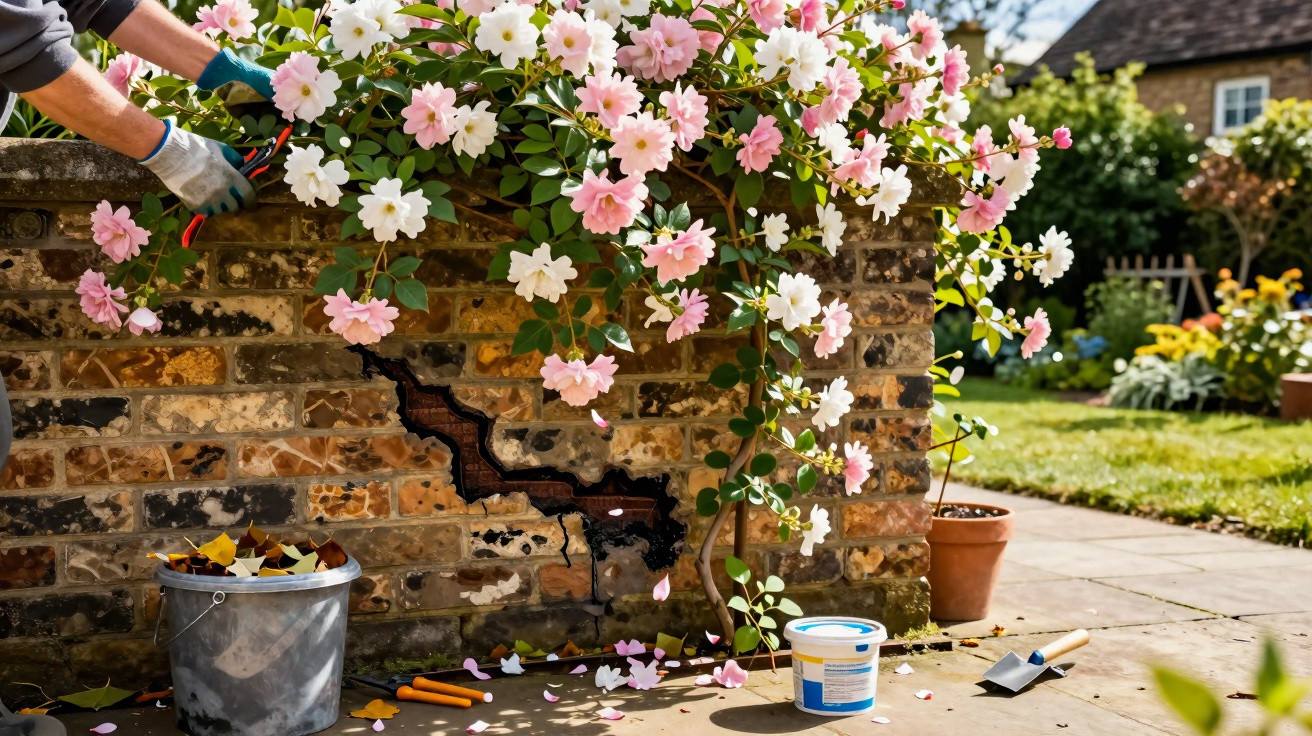
A cascade of wisteria, with violet flowers spilling across a white-brick front, is the sort of scene neighbours stop to photograph for Instagram. From close range, however, the paint was flaking, the gutters distorted and the air carried a sour, faintly decayed smell that only becomes apparent when you pause. Its owner, a weary-looking woman in gardening clogs, spoke quietly, as though the plant could listen. “I kind of hate it now,” she whispered.
She gestured towards roots heaving up the path, window frames stained black with mildew and bees gathering so densely that her children would not open their bedroom windows. This was not the romantic catalogue vision of a climbing plant. It was demanding, invasive labour: more pruning saw than poetry. The flowers were undeniably beautiful, but they brought costs that no one tends to mention.
The uncomfortable reality is straightforward.
The dark side behind those picture-perfect blooms
Spring is when most people succumb to climbing plants. You look at a bare fence, an unattractive wall or a balcony resembling a storage space, and a clematis or jasmine suddenly appears to be the quickest way to “fix” your life. Within a few months, the flowers erupt and you feel unexpectedly pleased, almost as though the plant were your own achievement. You share photos, friends respond and neighbours ring the bell to ask which variety it is.
Then, one morning, you spot the vine working its way into the gutter, winding behind the downpipe and almost smugly reaching out from the roof. Those flowers you adored a month earlier are now falling in their thousands, blocking drains and adhering to paving after rain. The romance does not vanish at once. Instead, it wears away petal by petal, while the maintenance cost gradually becomes clear.
Any roofer or exterior decorator is likely to say much the same. Climbing roses tear at forearms during repainting. Ivy enters hairline cracks and enlarges them year after year. Wisteria slowly bends metal railings out of shape, like a python in slow motion. Instagram never shows the actual damage: a broken gutter or a wasps’ nest concealed behind a thick mass of fragrant flowers.
There is an unspoken pattern in many older streets: homes covered in substantial climbers often require façade repairs sooner than identical homes with bare walls. Naturally, nobody blames the plant. We would rather attribute it to “time” or “weather”. Yet, from a ladder, you can pull back one heavy vine and find decayed timber that has remained wet for years beneath leaves and petals. Garden brands rarely include that part of the story.
The reasoning is harsh but simple. Climbing plants do more than flower: they take over space. Each fresh shoot searches for something to grip, force apart or constrict. The more impressive the display, the more energetic the hidden growth tends to be. That dense screen intended to create privacy can reduce airflow around a wall, hold in moisture and turn each rainfall into a prolonged, concealed supply of damp for rot and mildew.
We like to believe we are in charge because we purchased the plant and installed the trellis. Actually, the plant follows its own agenda: light, support and reproduction. Your attachment to its flowers is merely incidental. Once you see it like that, you don’t look at a wall of blossom quite the same way.
How to enjoy climbing plant blooms without damaging your home
How you establish a climbing plant determines many of the problems you may face later. The first error is placing it right beside the wall “so it has support”. A modest gap can transform the situation. Keeping 30–45 cm between the stem and the masonry provides airflow, space for roots and a clear strip that remains available for weeding and inspection. That bare line of soil is not wasted; it is your breathing space.
The next choice concerns the structure it will climb. Ivy attached directly to a solid wall may appear romantic, but a separate support is more forgiving: tensioned wires, a freestanding trellis or a pergola fixed slightly away from the house. Approach it like a landlord aware that repainting will eventually be necessary. You should be able to lower or cut back the plant without having to fight your own brickwork.
There is also the calendar, the least appealing but most practical part. To remain attractive and safe, climbers require firm, routine pruning. That means proper seasonal work rather than a brief trim when they reach the window: late winter for shape, after flowering for tidying and midsummer when growth becomes wild. On a compact urban balcony, this might take ten minutes every two weeks. On the wall of a large house, it can mean an afternoon with loppers and a ladder.
In real life, this clashes with everything else. Long working days. Rain during your only spare weekend. Children’s homework, elderly parents or simply wanting to relax with a glass of wine. Let’s be honest: nobody truly does this every day. That is why so many climbers quietly shift from “romantic” to “out of control” while their owners are occupied with living their lives.
The most difficult part is emotional: recognising that abundant flowers often demand substantial cutting back. You prune, thin and remove promising buds to prevent branches from becoming too heavy and breaking. You clear foliage from gutters and windows long before there is visible damage. This can seem harsh when the plant looks “so pretty right now”. But lasting enjoyment of climbers depends less on what you allow to grow than on what you refuse.
“People think I hate flowers because I tell them to cut half their climber,” a veteran gardener told me. “Truth is, the only way to keep loving those blooms is to decide where they’re not allowed to go.”
- Keep leaves at least a hand’s width from gutters, vents and windows.
- Wear gloves and long sleeves, as many climbers have thorns or skin-irritating sap.
- Set aside one essential pruning session for the week after peak flowering.
- Train fresh shoots horizontally at first to promote more flowers and less height.
Living with the mess - and choosing your kind of chaos
There is another fact gardeners seldom acknowledge openly: flowering climbers are untidy housemates. They shed petals, sticky nectar, aphid honeydew and, after storms, sometimes entire pieces of dried stem. On a path, this can create a slippery mixture of petals and mud. On a terrace table, it becomes a daily coating of natural confetti. On a parked car, it leaves marks that do not disappear with a single wash.
On a dry summer evening, such mess can seem like a gift. Bees drift back home, petals catch the fading light and the air is rich with jasmine or honeysuckle. On a wet Tuesday morning before work, the identical setting means wearing work shoes, carefully stepping through decaying petals and removing sticky residue from the door handle. On a difficult day, one partly rotted flower crushed beneath your foot can alter your mood completely.
Some people deal with it by removing every plant. Bare walls. Bare fences. No petals and no complications. Others go entirely the other way, accepting disorder as part of the arrangement. Most of us fall between those extremes, bargaining with our plants: you may have the fence, but not the gutter; you may flower wildly, but not above the neighbour’s car. We prune slightly too late. We sweep when possible. We overlook an occasional mildew patch and call it “charming”.
The disquieting point is that a flowering climber is not merely decoration. It affects insect movement, humidity, light entering a neighbour’s windows and even how birds act along your street. A flower-covered wall is an ecosystem rather than wallpaper. Once you accept that, the question is no longer “Is it pretty?” but “Is this the kind of wild I’m okay living with?” There is no universal right response. There is only the version you can continue agreeing to, season after season.
| Key point | Details | Why it matters to readers |
|---|---|---|
| Select the right plant for the right setting | Vigorous species such as wisteria, English ivy or certain rambling roses can grow to 10–20 m and place considerable physical pressure on structures. Less forceful choices, including clematis, star jasmine or annual sweet peas, remain smaller and are easier to redirect or replace. | Choosing a climber suited to the size of your wall, balcony or fence prevents the gradual shift from “pretty” to “structurally risky” and cuts down the time spent on a ladder with pruning shears. |
| Create a secure support system from the outset | Fit stainless-steel wires, a freestanding trellis or a pergola positioned away from gutters and roof edges. Leave enough space between fixings to get tools behind the plant and examine masonry without pulling roots away from the wall. | A thoughtfully planned support directs growth away from vulnerable areas, allows painting or repairs in future and enables you to enjoy thick flowering without concealed harm to brick, render or woodwork. |
| Establish a practical pruning and clearing routine | Reserve two or three defined weekends each year for cutting back, plus a quick 10–15 minute sweep after peak flowering to clear petals from steps, drains and decking. At the same time, inspect gutters and air vents for obstructions. | Frequent, manageable maintenance avoids blocked drains, slippery paths and decay, letting you retain the romance of the flowers without constantly resenting your own plants. |
FAQ
- Are climbing plants really bad for walls? They are not inherently destructive, although some varieties can worsen existing faults. Self-clinging ivy pushes its roots into minute cracks and holds them damp, speeding deterioration in old mortar or soft brick. Climbers trained on separate wires or trellises, with sufficient airflow and routine pruning, are much less likely to create lasting structural issues.
- How close to my house should I plant a vigorous climber? For large plants such as wisteria or climbing roses, allowing 30–45 cm from the wall base is a sensible rule. The gap lets roots spread without compromising foundations, while leaving a clear strip for weeding, checking for damp and moving hoses or tools along the wall when needed.
- How often should I really prune a flowering climber? Most mature climbers respond well to one substantial structural prune each year, followed by a lighter tidy after flowering ends. Especially energetic types may require another cut-back in midsummer. Rather than relying solely on calendar dates, look for growth that begins to obstruct windows, gutters or paths, and treat that as your cue.
- Can I grow a climber on a rented balcony without causing damage? Yes, provided every element remains freestanding and removable. Choose large containers with an integrated obelisk, or a freestanding trellis attached to planters rather than walls. Opt for lighter, non-woody choices, such as annual climbers or compact clematis, which can be cut back completely when you leave.
- What should I do if my climber has already invaded the gutter or roof? First, cut the growth back to a safe distance below the roofline, then carefully free stems from gutters and downpipes while checking for blockages. If there are signs of water damage or decayed wood, ask a professional to inspect it. Afterwards, train the plant onto a dedicated support system so it cannot reach the same problem areas again.
Comments
No comments yet. Be the first to comment!
Leave a Comment