
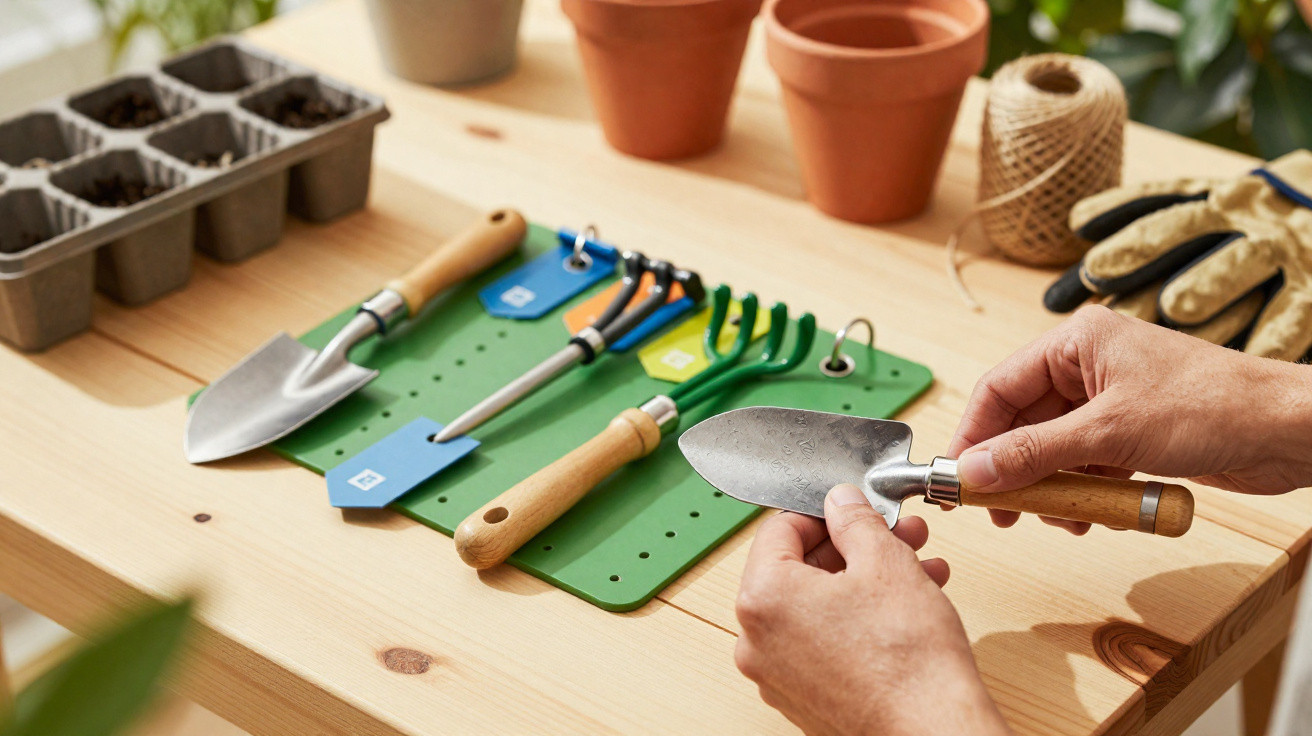
The shovel was there yesterday. You remember propping it against the shed, with mud still stuck to its blade as the sun dipped behind the fence. This morning, coffee in one hand and a planting tray in the other, you are standing in that very spot facing a jumble of handles: rakes, hoes, forks and three different trowels, all in the same uninspiring shade of wood.
While you lift one tool after another, grumbling to yourself, your seedlings are beginning to dry out. The pleasure of planting season slips into mild irritation, then the kind of annoyance that makes you want to throw everything straight back into the shed. There is just one small thing missing: clear labels.
A single word on a handle can transform the entire morning.
Why unlabelled tools quietly sabotage your garden time
Step into almost any back-garden shed in April and the view will be familiar: hand tools in a bucket, rakes resting against a wall and a hose curled up like a sleepy snake. At first it can seem charming, even a little poetic. That impression disappears as soon as you need a particular tool.
You pick up the wrong weeder, a trowel in the wrong size, or the secateurs intended for roses rather than thick branches. As you rummage through the clutter, your knees start to hurt. A peaceful gardening ritual becomes an unwanted, low-level treasure hunt.
Volunteers at a community garden plot in Leeds once timed their working sessions. They found that nearly 20 minutes of every session went on “finding the right tool”. It may not sound like much until it is added up over an entire planting season. Those are hours spent hunting, comparing and doubting your choice.
One of the older gardeners, Pat, finally spent a wet Sunday writing labels on every handle with a thick black marker. At the next session, everyone arrived, put away their coats and headed straight for the labelled wall: “Long-handled hoe”, “Child-size rake”, “Soft-grip trowel”. There were no questions and no arguments. The pace of the whole morning changed.
The reasoning behind labelling is almost painfully straightforward: your brain has more useful work to do than test its memory in an overcrowded shed. When similar-looking tools surround you, they create a stream of small but irritating choices. Should you take this one or that one? Are these the sharp secateurs, or the pair that crushes stems?
Labels break that cycle. You read the name, take the tool and carry on. Making fewer tiny decisions leaves more mental room to notice the texture of the soil, the condition of your plants or whether the birds sound different today. In a modest but meaningful way, words on wood return your attention to the garden instead of its clutter.
How to label your garden tools so they actually help
Usually, the most straightforward option works best: use a thick weatherproof marker on a clean handle. Remove the dirt, allow the wood to dry, then write the name clearly in large letters along its side: “BORDER SPADE”, “POTATO FORK”, “LIGHT WEEDER”. If the space is shared, add the owner’s name or use a colour code for separate beds.
For a longer-lasting solution, wind coloured electrical tape around the base of the handle and attach a small metal or plastic tag. Make a hole, secure it with garden twine and write on the tag with a paint pen. You do not need an art degree; rough but legible is better than attractive but useless. The important thing is instant identification, including when you are half awake and squinting in the spring sunshine.
One mild warning: a smart label maker will not help if its labels peel away at the first encounter with rain and mud. Plenty of gardeners stick smooth office labels to rough wooden handles, then wonder why they have disappeared by July. Choose materials that withstand hard use: paint pens, exterior-grade stickers or, for a more refined appearance, engraved tags.
In practical terms, prioritise contrast. Use dark ink on pale wood or a white pen on black tape. Your future self, worn out after work and hurrying to plant seedlings before sunset, will quietly appreciate it. That future self may also be muddy and slightly cross if the labels have faded or disappeared. You are not the only one.
This practice offers more than tidiness. A labelled tool wall creates an unspoken agreement among everyone who uses it. Children learn where each item belongs. Visitors helping out do not need to keep asking, “Which one is the cultivator again?” The shed begins to feel like a shared language rather than a personal puzzle.
“When the tools are named and have a place, people treat them differently. It’s like they suddenly matter,” said a small urban gardener I met, staring proudly at a pegboard filled with handwritten tags.
- Choose bold, high-contrast labels that withstand soil and sunshine.
- Pair written names with colours or symbols for fast recognition.
- Use matching labels on the tools and on their storage locations.
- Renew or rewrite faded labels at the beginning of every planting season.
- Mark specialist tools especially clearly to prevent misuse.
The small habit that protects your energy all season long
Labelling tools can seem like another task on an already lengthy list. However, this modest routine helps safeguard something delicate: your desire to go outside and actually garden. On cold mornings, when the sofa is tempting and the soil seems far away, even a little extra effort can send you back indoors.
If your tools are clearly labelled and easy to pick up, beginning requires less determination. You open the shed, look over the handles and get going. There is no grumbling, searching or “Where on earth did I put that thing?” The entire process becomes gentler, as if someone had already set out your clothes before a run.
| Key point | Detail | Benefit for the reader |
|---|---|---|
| Clarity saves time | Clear labels reduce time spent searching in the shed or garage | More time for planting and less time spent frustrated |
| Visual systems support memory | Names, colours and symbols make tools immediately recognisable | Children, guests and tired adults can more easily find what they need |
| Care and respect increase | Labelled tools feel “owned” and better looked after | Longer-lasting tools and a more organised outdoor space |
FAQ:
- Should I label every single garden tool? Begin with the items you use most: trowels, secateurs, spades, hoes and rakes. Once you notice the difference, extend the approach to specialist tools.
- What’s the best type of label for outdoor tools? Weatherproof paint pens or permanent markers applied to clean wood, together with plastic or metal tags for added clarity, usually last the longest through sun, rain and mud.
- How do I keep labels from rubbing off? Apply writing to dry, dust-free surfaces and allow the ink to cure before using the tool. For additional durability, seal the area with a light layer of clear outdoor varnish.
- Isn’t this overkill for a small garden? Even in the smallest garden, repeatedly looking for the right tool soon becomes tiresome; clear labels make brief after-work gardening sessions easier and more enjoyable.
- What if my family never puts tools back in place? Match labels on the tools to labels on hooks or shelves, then make it a gentle shared rule; let’s be honest: nobody truly does this every day, but having a system makes “clean-up days” far easier.

Comments
No comments yet. Be the first to comment!
Leave a Comment