
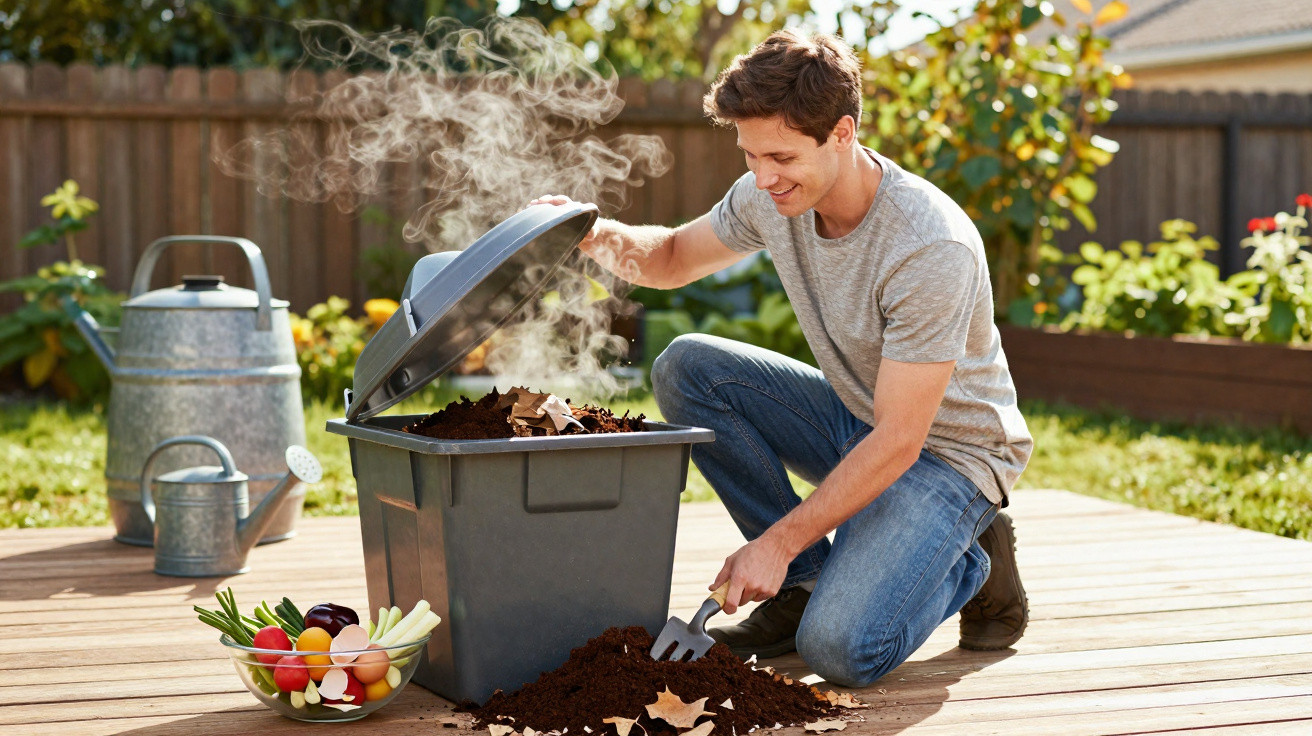
The first warm day of spring arrives, and you lift the lid of your compost bin expecting the rich, woodland scent everyone on YouTube talks about.
Instead, you are hit by an odour somewhere between rotten eggs, an abandoned lunchbox and a damp dog. You shut the lid immediately, eye the neighbour’s garden with suspicion and quietly decide you are “done with compost forever.”
Five minutes later, you are still on Google, mildly panicked and typing: “Is my compost supposed to smell like death?”
The brief answer is no.
The more useful answer is that you can sort it out more quickly than you might expect.
Why your compost smells like a rubbish lorry in July
A smelly compost bin nearly always means the contents are out of balance. It is not permanently ruined; it simply needs retuning.
What you can smell is food waste decomposing without sufficient air or without the right mix of materials. Imagine a slow-motion gym-locker smell developing in your garden.
When a compost heap becomes sour, it is generally signalling one of three issues: it is overly wet, tightly compacted or loaded with kitchen scraps but short on dry materials. Work out which applies, and the solution becomes remarkably straightforward.
Imagine a compact urban garden with a plastic compost tumbler and a very keen novice. After watching three TikToks about composting, they add coffee grounds, fruit peelings, leftover salad and the half-bag of spinach that nobody ever finishes before it goes off.
Two weeks later, opening the lid releases such a powerful cloud of odour that the dog will not come close. The neighbour casually remarks that “something rotting” seems to be near the fence.
What had happened was simple: they made a dense, damp, oxygen-deprived lasagne of kitchen waste. There was no air circulation, no structure and no carbon-rich “browns” to counterbalance all that nitrogen-rich material.
The scent of compost is chemistry that your nose can detect. In a healthy, oxygen-rich heap, aerobic bacteria are in charge. These tiny workers produce that pleasant woodland-floor aroma.
If the heap becomes waterlogged or compressed, air vanishes and anaerobic bacteria take over. That’s when your compost starts smelling like sewage, vomit, or rotten eggs. Methane, ammonia and hydrogen sulphide are not merely unpleasant: they are your warning lights.
Imbalance is the other major cause. Too many “greens” - such as food scraps and grass cuttings - and too few “browns” - including dry leaves, shredded cardboard and straw - means the material rots rather than composts. The encouraging part is that adding a handful of suitable material in the right spot can change the situation within minutes.
Quick fixes that clear the stink fast
When you open the bin and the smell strikes, begin by giving the compost air. Push a garden fork into the centre and loosen the contents as though you are tossing an enormous salad.
Move the heavy, wet material from the middle towards the outer edges. Separate any slimy masses of grass or food waste. As you turn it, add dry materials such as shredded cardboard, dead leaves, wood shavings or even ripped-up paper bags.
That single step can alter the smell in minutes because it allows the heap to breathe again. Oxygen is the quickest natural deodoriser available to you.
Adding dryness and structure is the other essential rescue measure for smelly compost. Treat “browns” like kitchen roll in a greasy frying pan: they absorb surplus moisture and create small pockets of air.
If the heap appears shiny, slimy or like a failed green smoothie, it probably needs twice as many browns as you think. Add a generous layer, give it a light mix and then cover the surface with further dry material as if tucking it under a blanket.
Realistically, nobody keeps up this routine every day. You will forget, or empty a full week of kitchen scraps into the bin at once. That is fine. Keep a bag of leaves or shredded cardboard beside the bin and add a handful on top whenever you deposit scraps. It is an odour-control system for lazy people.
If the odour persists, it can help to learn from people who have spoiled a few heaps before finding the right approach.
“Compost only smells bad when we treat it like a trash can instead of a living thing,” says a community garden volunteer I met in a city plot that never stank once all season. “Every time someone tossed in food, they added a handful of leaves. It became a habit, like washing your hands.”
For an easy checklist, remember these three steps:
- Add air: turn the heap or make holes through it.
- Add browns: use leaves, paper or straw to absorb the slime.
- Adjust size: chop up large items and avoid big, wet clumps.
Once you regard your compost as something that needs feeding and breathing, rather than as a place to dump waste, the smell often fades almost by itself.
From embarrassment to bragging rights
A rancid compost bin brings a quiet sense of embarrassment. You begin to wonder whether the neighbours are discussing it. You open the lid less often, hoping the smell will somehow sort itself out.
Oddly, though, a foul-smelling heap often proves that you made an effort. You collected scraps, bought or set up a bin and got started. The stink is merely the uncomfortable teenage stage in your compost’s life.
Once you understand airflow, moisture and balance, it changes from a “gross experiment” into a surprisingly rewarding hobby. People start asking how your soil became so dark. You may find yourself prodding the compost simply to enjoy how warm and crumbly it has become.
The more gardeners you speak with, the more obvious it becomes that almost everyone has had a smelly heap at some stage. Usually, the difference between those who give up and those who now swear by compost comes down to one moment: the day they chose not to throw it all away, but to see it as a problem they could solve.
You begin to spot the patterns. Grass cuttings on their own create slime and odour. Coffee grounds without paper become heavy and sour. Yet when you layer materials, mix them and let air in, your nose is the first thing to confirm that it is working.
Some people even become slightly obsessed. They turn the heap after rain, stockpile cardboard and smell it like coffee beans to monitor its progress. It sounds absurd until you collect your first wheelbarrow of dark, sweet-smelling compost and realise you created it from “trash.”
The simple reality is this: smelly compost is not failure; it is feedback.
When you know how to interpret that feedback, compost becomes a tool that fits around your life rather than the reverse. Had a busy week? Cover the scraps with extra browns and turn the heap when you have time. Using a tiny balcony bin? Cut materials into smaller pieces and keep the mix lighter and drier.
You do not need a qualification, a flawless method or costly equipment. All you need is a fork, some dry material and a willingness to get your hands slightly dirty. After that, the smell - or lack of it - is your best guide. That is when compost quietly changes from an embarrassing secret into something you are unexpectedly pleased to show people.
| Key point | Detail | Value for the reader |
|---|---|---|
| Bad smells mean imbalance | Odours result from excess moisture, too many “greens” and insufficient air | Helps you identify problems quickly rather than abandoning your bin |
| Fast fix: air + browns | Turn the heap and add dry, carbon-rich materials such as leaves or cardboard | Gives you a simple, repeatable way to remove odours in minutes |
| Smell as your guide | Earthy smell = on track; rotten or sour = adjust air, moisture and mix | Allows you to manage compost instinctively, without complicated rules or tools |
FAQ:
- Why does my compost smell like rotten eggs? That sulphur odour usually indicates that the heap has become anaerobic: too wet, too compacted and lacking air. Turn it thoroughly, then add plenty of dry browns such as shredded paper, straw or leaves.
- Can I still use compost that smelled bad? Yes, provided you allow it time to finish decomposing and for the odour to disappear. When it is crumbly again and smells earthy, it is safe to use in the garden.
- How wet should my compost be to avoid smells? A useful guide is that it should feel as moist as a “wrung-out sponge”. If water drips out when you squeeze a handful, it is too wet. Add browns and turn it. If it is dusty and will not clump together, add a little water or more fresh scraps.
- Are there foods that always cause bad smells? Large amounts of grass cuttings, lots of citrus and oily or fatty foods can start smelling quickly. Meat and dairy are the worst offenders in outdoor bins, so many home composters avoid them completely.
- How often should I turn my compost to keep it from smelling? Every 1–2 weeks is enough for most home heaps. Small, highly active heaps may benefit from a quick fluff more regularly, particularly after rain or after adding a large amount of kitchen scraps.



Comments
No comments yet. Be the first to comment!
Leave a Comment