
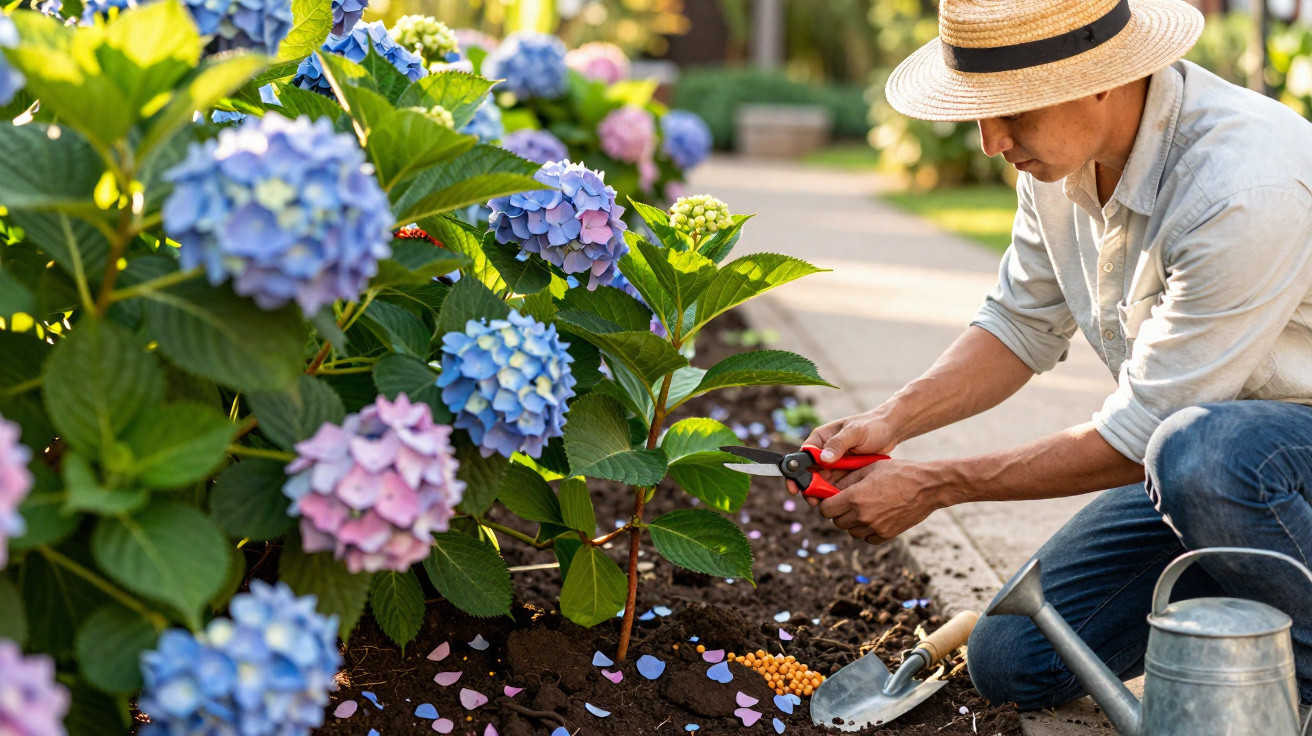
Many amateur gardeners become frustrated when their hydrangeas produce nothing but leaves instead of flowers – yet the answer lies in the spring.
A few well-timed tasks between the end of winter and the start of spring determine whether hydrangeas merely look green later in the year or take over the garden with colourful balls of bloom. Those who prune properly now, feed the soil and keep a brief eye on their shrubs can enjoy dependable, vigorous flowers for years, without any professional equipment.
Why many hydrangeas barely flower after a few years
The familiar scenario is a shrub with dense foliage that appears healthy but produces only a handful of flowers, or none at all. The “poor summer” or the “wrong soil” often gets the blame. In many instances, however, the real cause is incorrect pruning – or no pruning at all – carried out at the wrong time.
Hydrangeas set their flower buds earlier than many people realise. Some types form buds during the previous year, while others do so in the current growing season. Cutting back without knowing which applies can mean removing every flower for the following summer in one go.
“The crucial period for abundant hydrangea flowers falls within the few weeks between late winter and spring – this is when the course is set for the whole season.”
It is precisely during this window that a few careful, targeted measures can keep the shrub youthful, vigorous and free-flowering for many consecutive years.
The right timing: when to prune hydrangeas in spring
In central European conditions, the ideal pruning period is from late February to early March. By then, the hardest frosts have usually passed and the buds are swelling, but have not yet fully opened.
- Wait until the strong buds are clearly visible and slightly swollen.
- Do not prune in autumn, as fresh shoots would then enter winter without protection.
- If severe late frosts are expected, delay pruning by one or two weeks.
Pruning too early can expose fresh cuts to frost damage. Pruning far too late makes it easy to remove flower buds that have already formed.
Identify the type before reaching for the pruners: what hydrangeas flower on
Before using the pruners, answer one key question: which type is your shrub? This determines how far back – and how boldly – it can be cut.
Type 1: flowering on previous year's wood
This group mainly includes:
- Mophead hydrangeas (Hydrangea macrophylla)
- Lacecap hydrangeas and similar varieties
- Mountain and oakleaf hydrangeas (serrata, quercifolia)
- Climbing hydrangeas
These varieties develop their flower buds in the preceding year. Drastic spring pruning will therefore remove the entire season's display.
Type 2: flowering on current year's wood
These include, for example:
- Panicle hydrangeas
- Hydrangea arborescens, including the well-known variety ‘Annabelle’
They produce fresh shoots in spring, then form flowers on those shoots. As a result, they can cope with much harder pruning and reward it with plenty of strong, flowering new growth.
Three simple pruning rules for hydrangeas that flower reliably
Light pruning for mophead hydrangeas and similar types
With all hydrangeas that flower on previous year's wood, a cautious approach is best. The main aim is to remove faded flower heads and old wood without harming the new buds.
- Cut away only the old flower heads, just above a strong pair of buds.
- Remove thin, dried-out or dead stems completely at the base.
- Each year, take out one to three of the oldest, thickest branches low down to rejuvenate the shrub.
This leaves enough young, healthy shoots carrying flower buds. The shrub becomes more open and dries more readily, which also reduces the risk of fungal disease.
More confident pruning for panicle hydrangeas
Panicle hydrangeas can withstand considerably more cutting back. The aim here is to maintain a sturdy framework while encouraging vigorous young shoots.
A typical method is:
- Shorten every shoot by around one third to one half.
- Make each cut just above a pair of outward-facing buds.
- Remove weak or poorly positioned shoots entirely.
The result is a compact, sturdy shrub with plenty of young growth and firm panicles that will not immediately flop over in rain.
A harder cut is fine for ‘Annabelle’ and similar varieties
The hugely popular ‘Annabelle’ can be cut back particularly hard. The gardener may reduce the shrub to around 20 centimetres above ground level without losing that year's flowers.
“Fewer buds often mean fewer but noticeably larger flowers here – anyone who likes XXL heads should thin them out decisively.”
For lots of medium-sized flowers instead, leave several more buds on the shrub and avoid cutting quite so low.
After pruning: soil care, feed and protection
Once the pruners have been put away, it is worth taking a quick look at the ground. What happens around the root area has a major effect on reliable flowering in the years ahead.
Clear and feed the soil
Start with a spring clean:
- Remove old, diseased leaves and dead plant material around the roots.
- Apply a thin layer of mature compost or a dedicated hydrangea fertiliser.
- Then cover the ground with bark mulch or shredded leaves.
This combination supplies nutrients, helps the soil retain moisture for longer and protects fine roots from temperature fluctuations.
Water properly and watch for late frosts
Young plants in particular can quickly become stressed when spring begins dry. One thorough watering is more useful than repeatedly sprinkling the plant with a watering can.
During dry spells, it helps to:
- Water less often but deeply, so that moisture reaches the lower roots.
- Water in the early morning or evening to limit evaporation.
Late frost nights are the main spring danger. Buds that have already swollen can be damaged. A light covering of horticultural fleece or an old bedsheet, placed over the shrub in the evening and removed again in the morning, prevents a great deal of trouble.
How to spot problems early – and respond
A quick, regular check of the shoots is worthwhile. Branches that are blackened, soft or split not only look unattractive; they also drain the plant's energy.
A useful spring routine includes:
- Cutting out black or clearly dead shoots completely.
- Cutting damaged branches back to healthy wood.
- Removing shoots growing strongly inwards so air and light can reach the centre of the shrub.
This keeps the plant vigorous and makes life much harder for fungal diseases.
Extra tips: colour, position and common mistakes
Many people wonder why some hydrangeas flower blue while others are pink. In certain varieties, the colour is strongly influenced by the soil. Acidic soil rich in aluminium often intensifies blue shades, whereas neutral to slightly alkaline soil tends to produce pink tones. Special soil additives can support this effect, but they are no replacement for sound basic pruning.
Position also makes a significant difference. Too much direct midday sun is particularly hard on mophead hydrangeas, which soon wilt in these conditions. A bright but slightly sheltered spot with morning sunshine and some afternoon shade provides good conditions for abundant flowers.
Common mistakes that can be avoided include:
- Cutting mophead hydrangeas hard back to ground level – flowering often fails completely as a result.
- Applying fertiliser in summer heat without watering – this can damage roots.
- Allowing constant wetness around the roots because water is sitting there – improve drainage instead.
Anyone who keeps these points in mind and spends one or two hours on pruning and care in late winter will be rewarded with densely packed balls of flowers in summer. With a little practice, spring pruning becomes a quick routine – and the shrub that once caused concern becomes a reliable focal point in the garden or on the patio.

Comments
No comments yet. Be the first to comment!
Leave a Comment