
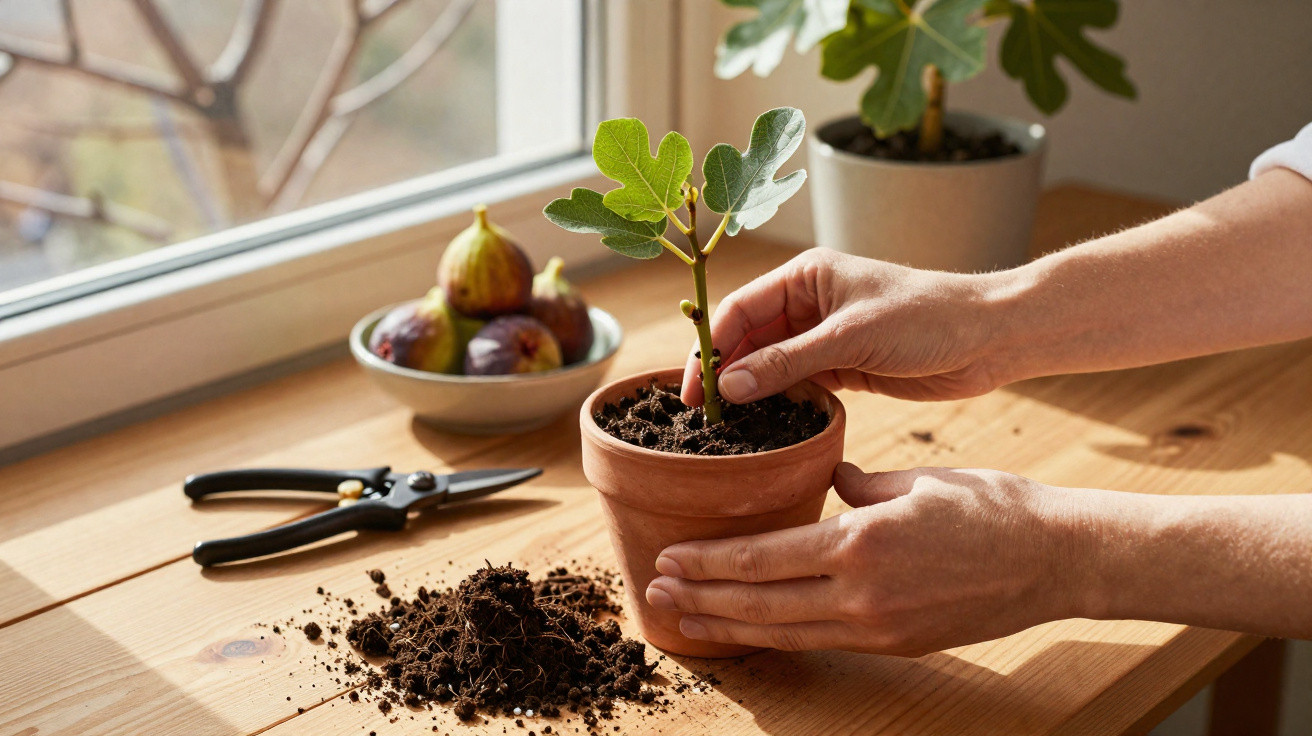
Many amateur gardeners do not realise that an existing fig tree may already hold the potential for another one. With one well-timed, simple action, a single branch can be turned into a vigorous new fig tree – without specialist equipment or extensive gardening experience.
Why late winter is the ideal time for fig cuttings
Although a fig tree still looks bare and almost lifeless in February, plenty is happening beneath its bark. Sap is beginning to rise gradually, while the wood contains stored nutrients that provide excellent conditions for root development.
Taking cuttings now directs the plant’s energy towards forming roots rather than leaves. That is precisely what a cutting needs to establish itself. Once buds begin to break and leaves unfurl, energy and nutrients are directed into the canopy instead – and cuttings make a noticeably poorer start.
The best period: from late winter until no later than early March – before the buds visibly begin to open.
In colder areas, do not leave it too late. Once spring becomes clearly noticeable, the most successful window for taking cuttings has usually already closed.
Choosing the right branch: which fig tree shoot can become a new tree
For a branch to become a new tree, the quality of the shoot is crucial. It is not about selecting the longest or thickest piece, but the healthiest and most mature section.
How to identify the ideal shoot
- It grew during the previous year, meaning the last summer’s growth.
- It is woody and firm rather than green and soft.
- Its bark is grey to brown, not glossy green.
- It has no damage, splits or dark areas of rot.
As a useful guide, the shoot should be roughly the thickness of a pencil. Several cuttings can be taken from one such section.
Taking fig cuttings: length, shape and cutting method
From a suitable branch, cut several sections measuring around 20 to 25 centimetres long. Every section should have three to four clearly visible buds.
- At the bottom: make a clean, horizontal cut directly beneath a bud.
- At the top: make an angled cut about one centimetre above the final bud.
Using two different cuts is more than a cosmetic detail. It lets you identify the top and bottom immediately later on – an important point, as a shoot inserted upside down will not root.
The right growing medium: a loose mix rather than pure garden soil
Fig trees root well when the growing medium is airy and allows water to drain quickly. Heavy garden soil or waterlogged pots can quickly lead to rot. A light, homemade mix is the better option.
A tried-and-tested mix: two parts multipurpose compost, one part sand or perlite – loose, free-draining and suitable for figs.
For a pot with a capacity of around five litres, for example, use:
- approximately 3.3 litres of multipurpose compost
- approximately 1.7 litres of sand or perlite
Where possible, choose a fairly deep pot. Figs tend to produce longer roots that grow downwards. A tall, narrow container is therefore better suited than a shallow bowl.
Planting fig cuttings: how deeply they should go into the pot
Insert each shoot into the prepared pot to around two-thirds to three-quarters of its length. At least one bud must remain above the surface of the compost, as this will later produce the new shoots.
Firm the growing medium gently around the cutting, without compacting it too tightly. Then water it until the compost is thoroughly moist, but not soaking wet.
Keep them moist – but avoid waterlogging
To prevent the cutting from drying out, it needs reasonably consistent moisture. At the same time, water must not collect in the pot, otherwise the wood can start to rot.
One straightforward practical trick is to cut the base from a clear plastic bottle and place it over the cutting as a small cover. Leave the cap slightly loose or open it by a small gap so that excess moisture can escape.
Care during the first few weeks: patience pays off
The first small leaves often appear in spring, even though the roots are barely developed at that stage. The cutting is then living mainly on the reserves stored in its wood. This can sometimes seem worrying, but it is entirely normal.
Never pull on the cutting to “test” the roots. At worst, this can tear away the delicate newly formed roots.
Keep the growing medium lightly moist and avoid major swings between bone dry and saturated. Young roots develop most reliably when the pot is placed in a sheltered, bright position away from intense midday sun.
After several weeks, more even new growth will show that the cutting has genuinely established itself. New leaves will then emerge gradually, rather than appearing only as a brief “burst” powered by the remaining reserves.
When a young fig tree can go outside
Even if the cutting looks strong during its first summer, give it time in its pot. The young fig tree must first build a stable root system before it can cope with frost, wind and dry conditions in the open ground.
- during the first year: keep it in a container in a sheltered spot on a balcony, patio or protected courtyard
- the following autumn: plant it in a sunny, warm location in the garden, or move it into a much larger container
This allows the small fig tree to harden off step by step. It significantly reduces losses during its first winter outdoors.
Which fig variety suits your location?
One important point is that a cutting is a clone of the parent plant. It inherits every characteristic, from its growth habit to ripening period and frost resistance. It is therefore worth choosing the original tree carefully.
Two crops or one? Biferous and uniferous varieties
Broadly speaking, figs can be divided into two groups:
- Twice-cropping varieties produce two harvests each year – an early crop and a later one. They are better suited to warm, sheltered locations.
- Once-cropping varieties produce only one harvest, but are often tougher and more reliable in cooler areas.
For small gardens, patios or balconies, compact-growing varieties are a sensible choice. For larger plots, you can choose more vigorous, fast-growing figs that can become impressive trees within a few years.
Extra tip for beginners: plant several fig cuttings at once
Anyone trying fig cuttings for the first time can improve their chances by playing it safe. Rather than taking just one cutting, take three or four from the same tree and plant them in one or more pots.
Experience shows that figs have a fairly high success rate – using several cuttings increases your chance of raising at least one strong young tree.
Always make sure your tools are clean before cutting. Disinfecting secateurs with alcohol reduces the risk of introducing fungi or bacteria into the cut surfaces. Pick a dry, frost-free day so the cut ends can dry quickly.
Common mistakes with fig cuttings and how to avoid them
Many setbacks come down to a small number of causes. Knowing these pitfalls saves time, frustration and plant material.
- Compost that is too wet: This encourages rot. Solution: use a free-draining growing medium and water sparingly.
- Full sun too early: Fresh cuttings can scorch quickly. Solution: place them somewhere bright but lightly shaded at first.
- The wrong way round: The cutting has been inserted upside down. Solution: the upper cut should always be angled, while the lower one is straight.
- Taking cuttings too late: Cuttings are taken only once the buds have already opened significantly. Solution: use the late-winter period.
What makes figs so special – and why the effort is worthwhile
Figs are not merely delicious fruit; they also bring a Mediterranean feel to the garden. Anyone who has tasted a sun-warmed fig straight from their own tree will quickly understand why so many amateur gardeners become genuinely addicted to these plants.
In addition, figs are regarded as relatively easy to care for compared with many other fruit trees. With a sheltered position, free-draining soil and some pruning, many varieties cope well. This is exactly why propagation from cuttings is such a good option: you multiply a hardy plant that has already proved itself in your own location.
Anyone taking the opportunity in late winter can create a valuable supply of young plants with just a few simple steps. One cutting may later be planted in your own garden, while another could become a gift for friends or neighbours. In this way, one fig tree can soon spread across several gardens – at no cost, and with plenty of enjoyment in late summer.




Comments
No comments yet. Be the first to comment!
Leave a Comment