
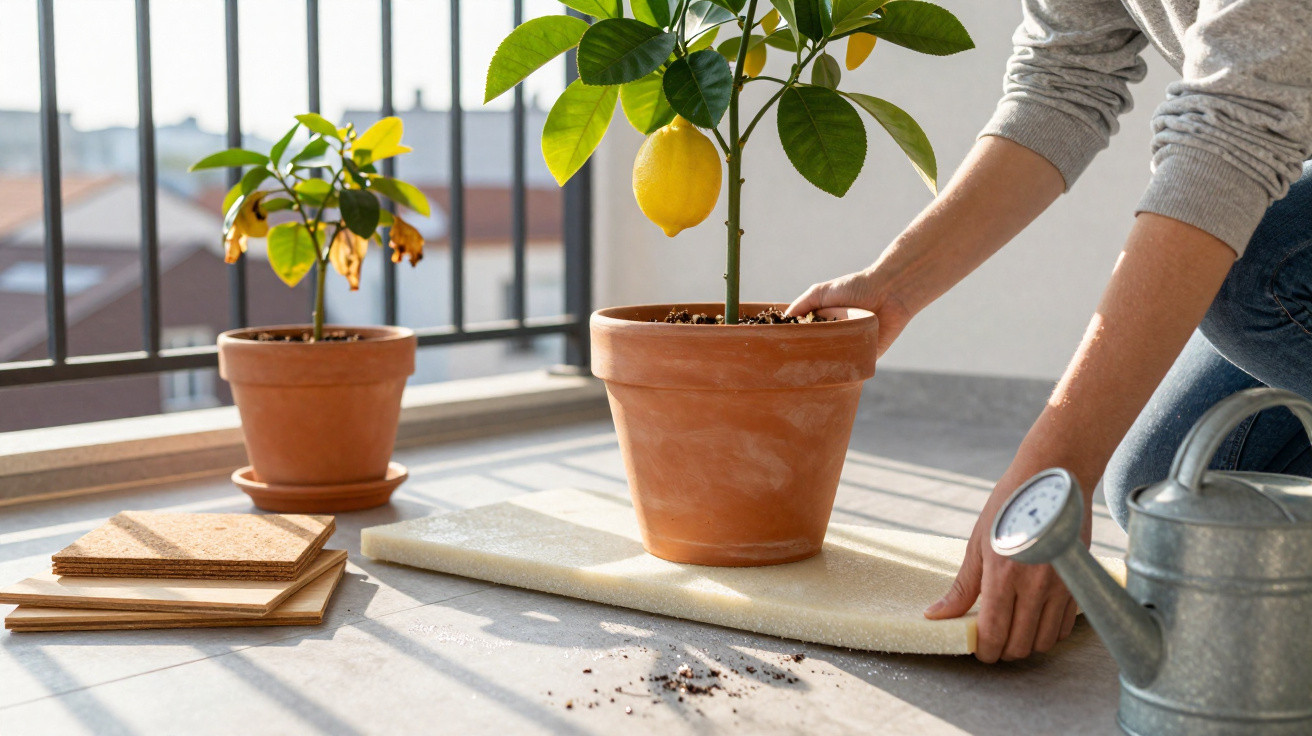
Many amateur gardeners breathe a sigh of relief after winter: the lemon tree on the balcony or terrace starts growing again, the days lengthen and the sun gains warmth. Yet this is often when an unexpected blow arrives: one icy March night, and the seemingly healthy potted lemon tree declines within days. The reason is not simply the air temperature – the threat literally comes from below.
Why March frost is so treacherous for potted lemon trees
Citrus plants in pots can soon look hardy in spring, with fresh shoots, new buds and richly green foliage. Many people then put them outside early, on the balcony or right at the edge of the terrace. The air feels mild, daytime temperatures reach 12 to 15 degrees, and the sun is shining. In these periods, late frosts are easily underestimated.
In March, a clear sky and dry air alone can be enough for night-time temperatures to slip to minus two or minus three degrees. This is often still manageable for the visible parts of the plant, particularly when protected with horticultural fleece. The root area inside the pot, however, faces an entirely different situation.
“The decisive cold shock often reaches the lemon tree from underneath – via the balcony slab or terrace surface.”
Materials such as concrete, stone tiles and natural stone retain the night-time cold and conduct it straight into the base of the pot. Root balls in containers react exceptionally sensitively to such sudden drops in temperature. The fine root tips that absorb water freeze, sap flow is disrupted, and a few days later the leaves darken and drop.
The most common mistake: protecting the top but forgetting the bottom
Understandably, many gardeners focus on the visible part of the plant. Typical protective measures include:
- covering the crown with horticultural fleece or a winter-protection cover
- placing it in a sheltered corner away from wind
- watering less so that the root ball does not become cold and wet
These measures help, but they are not enough. The actual “cold corridor” remains exposed: the pot is in direct contact with the cold surface beneath it. This contact creates a thermal bridge – a channel carrying cold from the ground into the root area.
As a result, the base of the pot can freeze even when the crown appears protected by fleece. Many people then ask: “But I had wrapped the tree up!” The damage starts out of sight, right in the root zone.
The simple solution: an insulating board beneath the pot
The good news is that this invisible cold bridge can be tackled with a remarkably simple measure. All you need is a light, pressure-resistant insulating material to place underneath the container.
Suitable materials for a lemon tree pot
Good options include:
- a thicker rigid foam board, such as polystyrene from packaging
- a firm cork board or several cork mats
- an old, thick wooden chopping board no longer wanted in the kitchen
- a sturdy, thick felt or coir mat
The exact product matters less than what it does: the board must form a clearly insulating layer between the cold ground and the pot.
“A material thickness of 2 to 5 centimetres is generally enough to interrupt the flow of cold effectively.”
The board should be slightly wider than the pot, extending roughly one to two centimetres beyond its base. This ensures that the entire bottom of the pot is shielded from the cold surface.
How to set up the protection properly
To make the method work as effectively as possible while still allowing water to drain away, follow three straightforward steps:
- Cut the board so that it extends slightly beyond the pot on every side.
- Put several small spacers on the board, such as halved corks or flat stones.
- Place the pot on these spacers so that a narrow air gap is created.
The air gap keeps the pot’s drainage hole clear, preventing problems with waterlogging. At the same time, the board acts as a barrier to cold, while the small air layer provides an additional buffer.
How this “secret helper” works physically
Horticultural specialists have pointed this out for years: with container plants, the ground is almost as important as the air temperature. Stone, concrete and tiles become very cold overnight, hold that cold and release it again for hours. Directly above them is the citrus tree’s most vulnerable area – where most of its fine roots are found.
In open ground, the layer of soil acts as a huge heat buffer. It cools much more slowly and retains winter warmth for a long time. A pot lacks this buffer. Just a few centimetres of plastic or terracotta separate the roots from the freezing surface below.
“The insulated mat breaks this thermal bridge – the cold stays in the ground, while the root ball retains its residual warmth.”
In practice, this often provides precisely the one or two degrees that determine whether the plant survives or suffers total loss. Especially on sunny south-facing balconies with large day-to-night temperature swings, the added insulation works like invisible life insurance.
How long does a lemon tree need this protection?
Experienced gardeners often use the so-called Ice Saints in May as a guide. Late frosts are not unusual before then and, depending on the region, can even occur until mid-May. To be on the safe side, leave the insulating board beneath the container from the end of February until at least the middle of May.
The base does not interfere with daily use, is barely noticeable and can be reused year after year. That makes it one of the most affordable forms of frost insurance available for a container-grown citrus plant.
How to combine the protection sensibly
Anyone with an exposed site – such as an open balcony in a cold area – can combine ground insulation with additional measures without having to wrap up the entire tree:
- move it close to a south-facing house wall, where the building fabric stores warmth during the day
- loosely place light horticultural fleece over the crown and pot when frost is forecast
- raise the pot slightly higher if the surface becomes particularly cold
- add an insulating “second skin” around the pot, such as bubble wrap covered with hessian
A light frost-protection fleece often provides a temperature buffer of two to three degrees around the plant. Combined with the insulated base, it creates a small microclimate that makes the tree significantly more resilient.
Watering, location and risk: other points to consider
Alongside the mat, two other factors play a major role: water and wind. A soaking-wet root ball cools far more quickly than one that is slightly moist. Water only moderately before cold nights, and avoid leaving standing water in the saucer.
Wind also removes a great deal of warmth from the plant and causes greater temperature fluctuations. A sheltered location, for example beside a balcony balustrade or beneath a canopy, helps the tree maintain its temperature more effectively.
Risks are greatest when several unfavourable conditions occur together:
- an exposed, draughty position
- direct contact between the pot and stone or concrete
- sharply fluctuating temperatures, with warm days followed by frosty nights
- a root ball that is too wet or completely dried out
Anyone who deliberately avoids this combination and uses the simple insulating-board method can significantly reduce the risk of losing their lemon tree.
Practical examples and useful additions for balcony gardeners
Many everyday items are more suitable than they might seem. A thick section from an old yoga mat or camping mat can easily be cut into appropriately sized squares. Packaging boards from expensive electrical appliances, or cork material from wine-delivery boxes, would otherwise go in the bin – but beneath a citrus container they can serve reliably for years.
If you have several container plants, you can create a small “frost-protection station”: a corner of the terrace where all sensitive plants stand on insulated boards and can quickly be covered together with a single sheet of fleece when necessary. The same principle can also protect olives, figs and bay trees.
The major benefit of this approach is that it does not compromise appearance. While bubble wrap or thick fleece can quickly look like an emergency measure, a thin board under the pot is barely visible. This makes the solution especially appealing on urban balconies, where appearance and tidiness matter.
With one carefully considered step, you create a reliable barrier against late frost and give your potted lemon tree the chance to begin every warm season in good health.

Comments
No comments yet. Be the first to comment!
Leave a Comment