
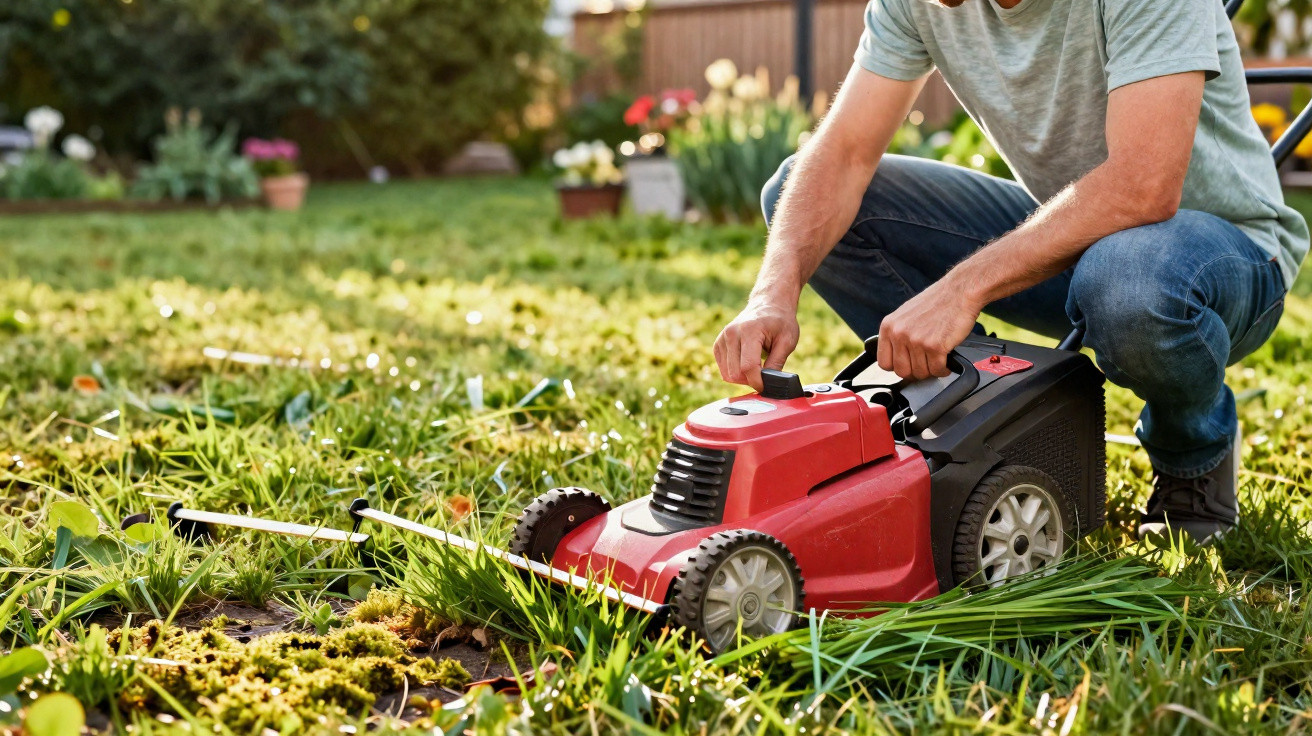
The real culprit is often something far more mundane in the garden shed: lawnmower wheels set to the wrong height. Just a few centimetres too high or too low weakens the grass, creates gaps - and that is exactly where moss takes hold for good.
Why mowing height determines whether your lawn stays healthy
Grass blades act like tiny solar panels. The more leaf area they have, the better they can photosynthesise and store energy reserves down in the root zone. That reserve fuels a thick, resilient sward that gives moss very little opportunity.
If you constantly cut the lawn too short, that leaf area disappears. The plant starts drawing on its stored energy, roots stay shallow, the soil warms up more and dries out faster. The turf yellows, bare patches appear - and those weak spots become an open invitation to moss and broad-leaved weeds.
Letting grass get too long causes trouble as well. The foliage flops over, moisture lingers, and a dense layer of thatch builds up. In this permanently damp layer, moss species thrive - especially in shady or wet parts of the garden.
“The right mowing height strengthens the roots, keeps the soil shaded and removes moss’s habitat - without any specialist products.”
The ideal mowing height for different lawn types
There is no single ‘perfect’ height for every garden. Light levels, how the lawn is used and the grass type all make a difference. Garden experts suggest these guide figures:
- Standard family/utility lawns in full sun: 4–5 cm
- Shady or damp areas: 6–8 cm
- Fine ornamental lawns (bowling-green style, formal ornamental areas): 2–2.5 cm - only for intensively maintained surfaces
For a typical family lawn used for children’s play, barbecues and sunbathing, keeping it around 4–5 cm for most of the year is generally ideal. Below that, even tough varieties begin to suffer.
In shaded spots - for example beneath trees or on the far side of buildings - grass needs extra leaf area to capture enough light. In those areas, a target of about 6–8 cm works better. Longer blades act like a larger solar panel and give grass a clear advantage over moss.
Seasonal fine-tuning: how to adjust height through the year
If you want to stay largely moss-free year-round, it helps to tweak the mower height with the seasons. A rough guide:
| Season | Recommended mowing height | Note |
|---|---|---|
| Spring | 4–5 cm (sun), 6–7 cm (shade) | Step down gradually from a higher winter setting to the normal height |
| Summer | 5–6 cm (sun), 6–8 cm (shade) | Keep it slightly longer to reduce drying out |
| Autumn | 5–7 cm | Enough leaf for reserves, but not so long that it goes into winter overgrown |
Cutting the lawn down extremely short heading into winter does more harm than good. The grass enters the cold season weakened, while thatch and frost damage become more likely.
The “one-third rule”: the most important rule for preventing moss
Professionals follow a simple rule of thumb: in any one mow, never remove more than one third of the current blade length. Taking off more than that stresses the grass, slows recovery noticeably and encourages the roots to retreat.
“It’s better to mow a little more often and just take the tips off, than to mow rarely and ‘scalp’ the lawn every time.”
In spring, when growth is fast, that can mean mowing twice a week. From March to October, mowing once a week is usually enough, as long as conditions allow.
Common mowing mistakes - and how to avoid them
- “As short as possible so I can leave it longer”: The classic mistake. The grass becomes stressed, gaps open up and moss exploits them relentlessly.
- “I only mow when it’s really tall”: Infrequent, harsh cuts remove too much leaf area. Better: cut regularly and moderately.
- Blunt blades: Instead of a clean cut, they tear the grass. Tips fray, turn yellow and the lawn becomes more vulnerable.
- Soil that’s too wet: Wet grass clumps, blades get pressed down, the effective cutting height becomes inconsistent and diseases spread more easily.
How to set your lawnmower correctly
Many mowers only show numbers on the height adjuster - 1, 2, 3, 4 - and those can correspond to very different centimetre settings depending on the model. A quick check is worth it:
- Place the mower on a flat, level surface.
- Hold a measuring stick or tape measure next to a wheel.
- Measure the distance between the ground and the lower edge of the blade.
- Move the height up or down by one or two settings to match your target, then measure again.
These five minutes can save a lot of hassle later with moss, thatch and bare patches. If you note the position once (for example, “setting 3 = 4.5 cm”), you can return to the correct adjustment quickly each spring.
Use simple extra measures to push moss back for good
Correct mowing height is the foundation. If moss is already present, a few add-ons can speed up results significantly:
- Aerate or spike the lawn: Use a garden fork or a lawn aerator to punch holes into the soil. This gets air to the roots, improves drainage and reduces waterlogging.
- Check the pH: Many moss species prefer acidic soil. A soil test kit from a garden centre will show whether a light application of lawn lime makes sense.
- Remove thatch: Use a scarifier or spring-tine rake to lift out old clippings and dead material. This reduces the damp layer where moss establishes.
- Overseed gaps: Reseed any open patches with a suitable grass mix so moss cannot move back in.
“If you control mowing height, soil aeration and nutrient supply, you usually don’t need moss killers or specialist fertilisers.”
Why moss seems so persistent - and what grass does to counter it
Moss does not develop deep roots; it mainly clings to the surface. It manages with very few nutrients, tolerates shade and copes well with constant moisture. That is why it can look as though it is ‘taking over’ the lawn - in reality, it is simply exploiting weaknesses in the grass.
A strong, deeply rooted sward deprives moss of light, space and some of the available moisture. To achieve that, grass needs:
- sufficient mowing height
- regular, gentle mowing according to the one-third rule
- free-draining soil that isn’t overly compacted
- watering that’s matched to conditions rather than keeping the surface permanently wet
If you follow these points, you shift the microclimate of your garden in favour of grass. In many locations, moss then fades away over the course of months because the conditions no longer suit it.
Practical examples for different garden situations
A heavily used, sunny family garden benefits from a steady 4–5 cm cutting height, a sharp blade and weekly mowing from spring onwards. Under those conditions, the dense turf often suppresses most early moss growth on its own.
In a narrow terraced-house garden with lots of shade, a different approach pays off: keep the height consistently at 6–8 cm, avoid cutting too short before summer, aerate once or twice a year, and apply a light lime dressing if the soil becomes strongly acidic. That way, grass can build reserves even with limited light.
If you maintain an ornamental lawn directly in front of the patio, you can work with 2–2.5 cm in small areas. However, that demands very frequent mowing, targeted feeding, careful watering and good aeration. Without that level of care, the area quickly tips towards moss and thatch.
In the end, a ‘miracle cure’ in a bag or bottle is not what keeps a lawn richly green; it is the combination of mowing height, mowing frequency and soil condition. The good news is that all of this is under your control - often it only takes a few clicks on the mower’s height adjuster and a slightly shorter gap between mowing days.



Comments
No comments yet. Be the first to comment!
Leave a Comment