
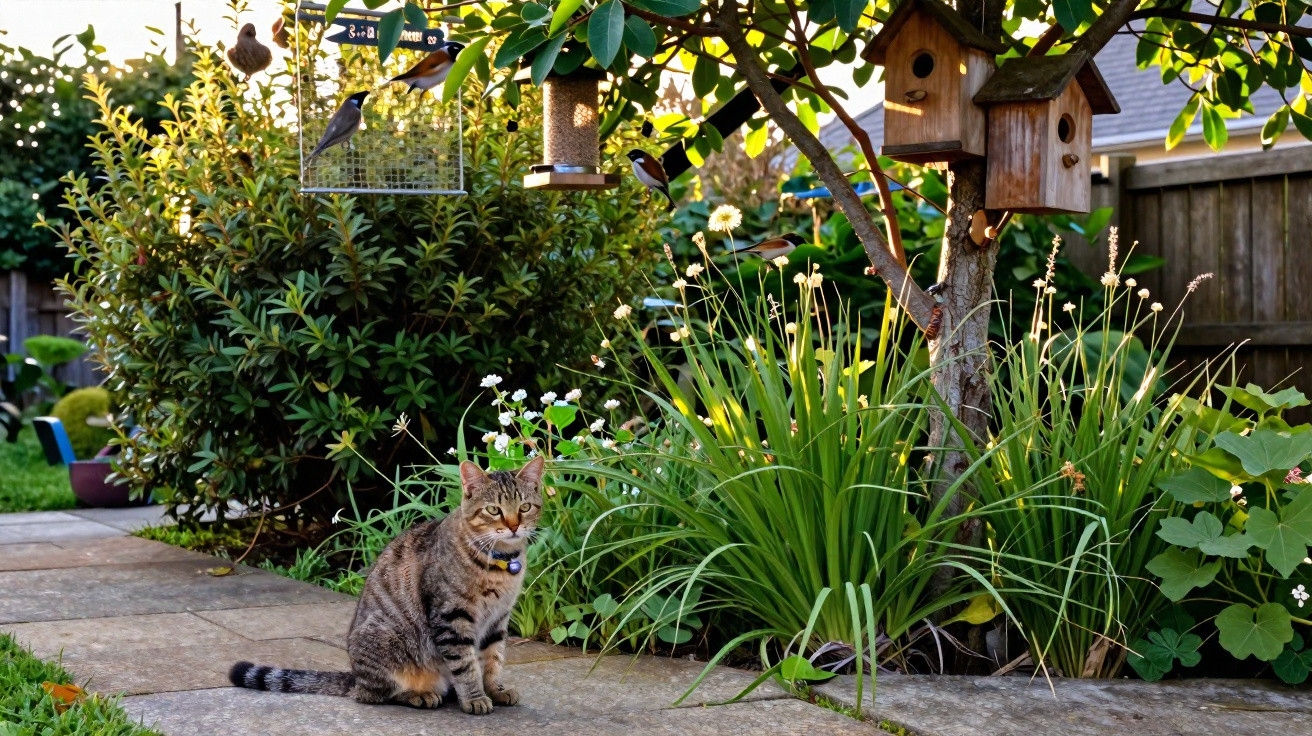
Anyone who lives with an outdoor cat will recognise the moment: your tomcat struts through the patio doors with a bird in his mouth. It’s the kind of scene that leaves you feeling guilty and powerless at the same time. The good news is that a few smart changes in the garden can dramatically cut bird deaths-without punishing your much-loved pet or keeping him shut indoors.
Why your garden becomes a hunting ground
Domestic cats may look fluffy and lazy on the sofa, but they still carry a fully operational predator’s brain. Even cats that are well fed will hunt-out of instinct, boredom, or simply because an opportunity appears.
That mix becomes especially risky between March and July. Many bird species are nesting then; fledglings spend time on the ground or in low hedges, fly poorly, and are easy targets. For a cat, it’s a buffet on four paws.
Another contributor is the typical “tidy” garden. What looks neat to people can be dangerous for birds.
- Bare, weeded beds with no cover
- Closely mown lawn with nowhere to retreat
- Cleared-away leaf piles, old stems and stacks of branches
When those features disappear, birds lose hiding places, escape routes and nesting materials. Nests are more exposed, young birds are left in the open-and the tomcat has an easy time of it.
"A ‘perfectly’ tidy garden turns into an open shooting range for cats-and a death trap for birds."
The “Refuge 3-2-1” principle: turning the garden into a stronghold for songbirds
Instead of keeping everything short and spotless everywhere, it helps to rethink the space: plan part of the garden deliberately as a bird refuge. A simple framework makes it practical-three layers, two effects, one quiet zone.
Three layers that break the hunter’s line of sight
A workable structure looks like this:
- Layer 1 – Ground cover: Dense plants such as cranesbill or sedges create a green “tangle carpet”. Cats struggle to see precisely where birds land or move.
- Layer 2 – Shrubs with bite: Thorny or very dense shrubs such as hawthorn, blackthorn, wild roses, barberry or hazel provide safer perches and nesting sites. Paws don’t slip through easily.
- Layer 3 – Small trees: A light canopy takes away the cat’s overview, so not every branch and movement is immediately visible.
The aim isn’t to let the whole garden run wild. Even one corner planted consistently in three tiers can noticeably shift the balance. If you’re unsure where to start, choose an area close to a fence or hedge.
One no-shears zone: a quiet area for the breeding season
One straightforward rule is particularly effective: between 15 March and 31 July, keep the shears in the shed in at least one garden zone.
Small steps in that area are often enough:
- leave at least 1 m² of leaves under hedges
- build a branch or log pile in a quiet corner
- before the first mow, leave a strip of grass long
- keep dead, hollow perennial stems standing until summer
- cover bare beds with a thick layer of organic mulch
These small changes have an outsized impact because they provide food, nesting material and cover for insects and birds. And when small animals can hide, the hunter’s success rate drops sharply.
"A single well-protected corner in the garden can decide whether an entire brood survives-or not."
Securing bird nests: what often goes wrong with nest boxes
Many cat owners put up nest boxes with the best intentions-and accidentally set a trap for birds. What matters is not only that a box is installed, but exactly where and how.
How to hang nest boxes safely
- Height: around 3 metres above the ground
- Distance: no horizontal branches, wall tops or roof edges within an easy cat jump
- Direction: entrance hole roughly facing east or south-east, so it isn’t exposed to wind and rain all the time
- Inside depth: 15–20 centimetres between the entrance hole and the floor, so a cat’s paw cannot reach the nest
- No perch below: remove decorative sticks or bars under the hole-they act as a step for cats
"The worst solution is a feeder or nest box on a wall or hedge that the tomcat can jump onto with ease."
Your own tomcat as a partner-not an enemy
Many owners underestimate how strongly they can influence their pet’s hunting behaviour. No one has to lock an outdoor cat indoors permanently. The goal is to manage the highest-risk times and places.
Limit the most dangerous times of day
Most songbirds are most active early in the morning and again at dusk. Those are exactly the periods when a tomcat likes to lie in wait. If you can control when the door opens during the breeding season, hunting success drops noticeably.
- In spring and early summer, avoid letting your cat out right at sunrise where possible.
- Shorten evening dusk patrols, or replace them with indoor activities.
- Instead, schedule consistent play sessions during the day using teaser toys, balls or food puzzles.
The more mental and physical stimulation happens indoors, the less urge your tomcat tends to have to track every movement outside.
Tools that reduce hunting success
There are now several ways to make cats more visible and less effective-without causing distress.
| Measure | Effect | Note |
|---|---|---|
| colourful safety collar cover (or bright fabric on the collar) | birds notice the cat earlier | only use with a breakaway safety clasp |
| mesh guards around tree trunks | stops climbing to nests in the canopy | do not cut into or crush the bark |
| used coffee grounds and citrus peel | creates a scent barrier in sensitive spots | refresh regularly; watch pets’ reactions |
| strongly scented ornamental plants such as pepper bush | many cats avoid the immediate area | useful along bed edges around nesting zones |
Over the long term, neutering and solid day-to-day enrichment generally reduce roaming, which in turn lowers the number of hunting trips.
Practical approach: one tree, one shrub, one win
If you try to overhaul the whole garden in one go, frustration usually follows. A staged approach is far more realistic.
- Choose one “key tree”: for example, the apple tree where blackbirds or tits nest each year.
- Secure the trunk: fit a smooth guard ring made of mesh or metal so the tomcat cannot reach the canopy.
- Add structure around it: plant a few shrubs beneath, leave some leaf litter, and avoid mowing too short.
- Observe: over one season, note how many young birds fledge-this is hugely motivating.
- Expand bit by bit: next year, add another corner or a second tree.
This keeps the project manageable, and birds often benefit visibly in the very first year.
What else owners should pay attention to
A few extra points matter more in day-to-day life than you might expect:
- Feeding: a well-fed tomcat will still hunt, but is often less relentless about every single piece of prey.
- Bells on collars: many birds get used to the ringing, and some cats still stalk successfully even with a bell. It’s worth checking honestly whether it’s actually making a difference.
- Indoor enrichment: food puzzles, clicker training or simple cardboard hideaways channel hunting energy into controlled activities.
- Neighbourhood: ideally, owners on the same street coordinate. If two or three gardens become safe islands, you create a small but effective network for sparrows and other birds.
Some measures can sound like restrictions for your tomcat at first. In practice, the opposite is often true: the garden becomes richer and more interesting-more scents, more insects, more tracks-and no longer just a bare lawn with prey in the spotlight.
Ultimately, success depends on how consistently people adjust small routines: when the patio door is opened, which area is left undisturbed in spring, and where a nest box is placed. Plan those details deliberately and you’ll see more lively fledglings in the shrubs during summer-and far fewer encounters with a proud hunter carrying a dead sparrow.





Comments
No comments yet. Be the first to comment!
Leave a Comment