
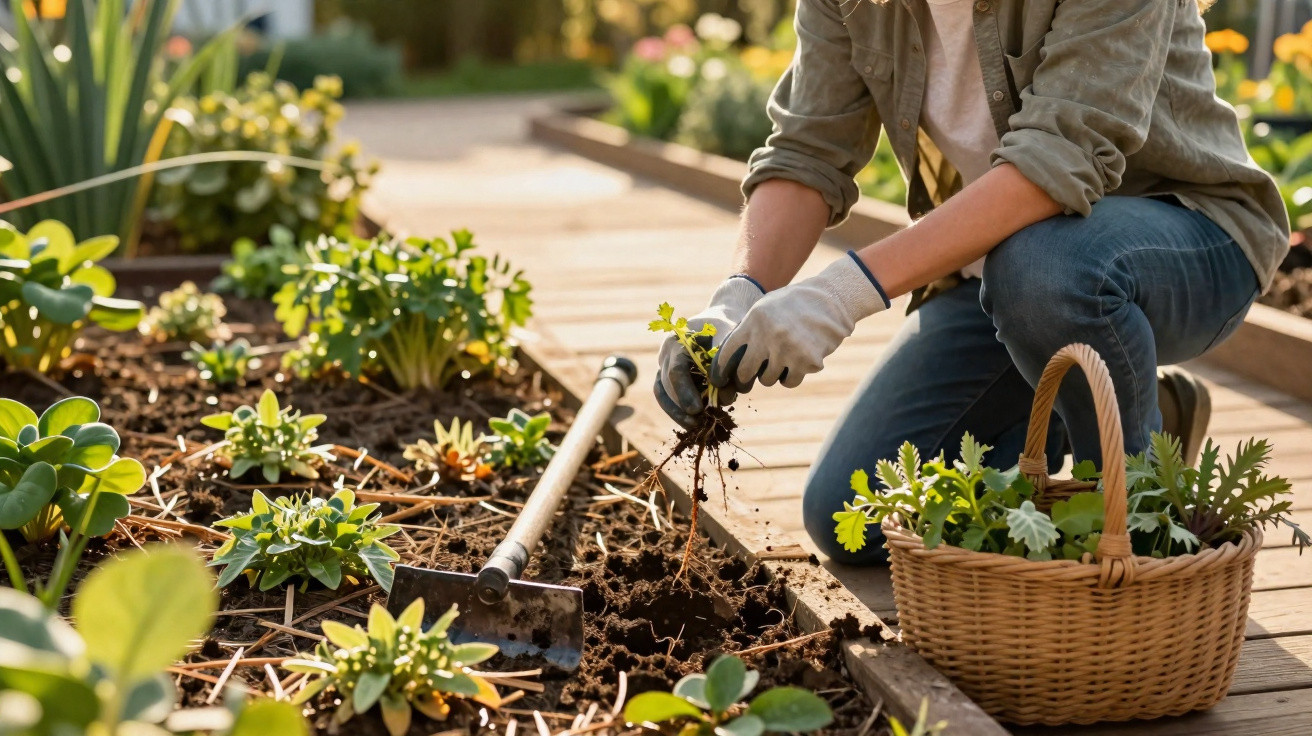
You had sworn that “this time” you would do it properly, that the weeds would be dealt with once and for all. Yet every time you pull out a handful, another green patch seems to appear beside it. Your back aches, your knees complain, the pile of garden waste grows… and you already know it will all be back within a fortnight.
Two gardens away, a neighbour watches with a laugh, holding a slim weeding knife as she calmly works through a border that is almost free of intruders. There is no chemical smell and no sprayer tucked away in a corner. Just accurate movements, dark mulch and paths as tidy as those in a show allotment. “Want to have a go?” she calls.
That evening, between pulling out clumps of roots, you begin to realise that the answer is not weeding more frequently. It is weeding differently - and stopping these quiet invaders from returning.
Understanding why weeds always come back
You can spend three hours weeding a flower bed, turn it into something worthy of a Pinterest photograph… then, after one spell of rain, tiny green shoots return. We have all had that moment when it feels as though the garden is mocking us. It seems unfair, almost personal.
In truth, it has nothing to do with whether you have green fingers. The real battle takes place below ground. Beneath every bed lies a store of dormant seeds, ready to spring into life as soon as the soil is disturbed. Add a few tough roots capable of regrowing from the smallest piece left behind, and the picture becomes clear. Unless you tackle both enemies - seeds and root reserves - you are merely cutting off the tip of the iceberg.
Horticultural researchers estimate that a single square metre of soil may contain thousands of viable seeds. They can remain hidden for years, until a spade brings them up into the light. It is rather like opening a box you assumed was empty, only to find it overflowing. Some plants, including couch grass and bindweed, can even grow again from a root fragment just a few centimetres long.
Naturally, this changes the way we need to weed. If every deep pass with a hoe brings fresh seeds to the surface, the job becomes endless. To prevent regrowth without harsh products, disturb the ground as little as possible, target the root at the right time and make conditions unsuitable for self-sown seedlings. Weeding then becomes less of an occasional chore and more a collection of small habits that interrupt the weed cycle.
Precise hand-weeding techniques without chemicals
Your first weapon is the technique itself. Forget the heroic wholesale pulling session in June; instead, work the soil in an almost surgical way. A weeding knife, dandelion digger or small fine claw can make a real difference. Slip the tool beneath the rosette, sever the taproot as deeply as you can, then gently lift out the entire plant.
For spreading roots such as bindweed and couch grass, the ideal time is after rain or a thorough watering. The softened soil allows the weed to come away in long white strands that are almost satisfying to watch emerge. Let us be honest: nobody manages this every day. But ten focused minutes each week in vulnerable areas is better than two exhausting hours once everything has taken hold.
A retired English gardener I met on an allotment near Bristol showed me his “knack”. He kneels down with a bucket on his right and his knife on his left. He chooses a square measuring one metre across, no more and no less, and does not move on until every intruder has been removed at the root. He admitted that he would rather tackle seedlings while they are very young, before they flower. The roots have less energy and there is less risk of regrowth. His closely planted perennial borders leave very little bare space, already greatly restricting new spontaneous arrivals.
This method requires a slight shift in perspective. The aim is not to turn over the soil as people did in the past. In fact, it is the opposite: lightly skim the surface, cut attachments cleanly in the right place and leave the rest of the ground undisturbed. Lightweight tools such as a push hoe, used with a pulling action rather than for digging, create a thin dry crust that prevents surface germination without bringing up further seeds. Quite simply, the less often you open the door, the fewer unwanted guests get in.
Preventing regrowth: mulch, ground cover and smart timing
The other major secret is to stop light reaching dormant seeds. This is where mulch can seem almost magical. A 5–8 cm layer of organic matter - chipped prunings, fallen leaves, half-rotted compost or straw - blocks light, retains moisture and makes life difficult for new growth. Any seedlings that manage to emerge through this layer are weak and easy to remove with one simple movement.
The key is to mulch after a proper weeding session, when the area is already clear. Allow cut stems to dry in place for two or three days, then cover them with mulch to reduce regrowth further. Some gardeners first lay brown cardboard, without glossy ink, across the soil and wet it thoroughly before adding mulch on top. Perennial weeds underneath are smothered, seeds receive no light, and the cardboard slowly breaks down to feed the soil. It is a simple action with a huge effect on regrowth.
It is easy to assume that one application of mulch in spring will solve everything for the year. The reality is more subtle. Heavy rain, a cat scratching around, a child running through the border: each can expose small areas of soil and create fresh entry points for unwanted plants. This is where gentle consistency matters. Checking once a month, topping up material where bare earth is visible and pinching out very young shoots prevents major weeding “emergencies”.
“The best weedkiller is your shadow passing regularly over the garden,” an elderly market gardener in Kent once remarked. She did not mean spending entire weekends there, but simply having a look and acting quickly when you go out to pick a few salad leaves. A watched garden is a less overrun garden.
To take this further, some gardeners combine several methods to prevent regrowth:
- Dense ground-cover plants, such as hardy geraniums, strawberries and creeping thyme, to fill available space.
- A deep organic mulch wherever plants are more widely spaced.
- Targeted weeding just before annual weeds, including dandelions, speedwell and chickweed, set seed.
This trio - fill, cover and act at the right moment - often halves weeding time after one or two seasons. All without a sprayer in the shed.
Maintaining the routine without getting overwhelmed
Then there is everyday life. You get home late, it rains for three weekends in a row and the garden is left to run wild. The weeds, however, do not take a break. To avoid starting from scratch each time, one simple mental division helps: do not try to “weed the garden”; deal with one bed, or even one 2 m² corner. A small area means a small win and less discouragement.
Many amateur gardeners find that a regular quarter of an hour, either in the evening or early in the morning, makes all the difference. One hand holds the bucket while the other removes whatever is most visible or likely to set seed. Deeply rooted perennials can wait a few more days; annuals about to flower cannot. This rapid sorting stops you from adding to the soil seed bank for years to come.
Sharing experience plays a surprisingly important part in this. On community plots, the tidiest beds do not always belong to the strongest gardeners, but to the most patient ones. You hear simple sayings there, almost like mantras: “Never let a weed go to seed” and “Cover any soil you are not cultivating”. These are not strict rules, but useful guides. They remind us that a tidy garden without harsh products is built through small actions added one after another.
Far from pursuing the idea of a perfect garden, this approach allows room for imperfections. A few forgotten clumps or an intentionally retained dandelion in one corner are not failures. They can provide shelter for insects and food for bees in early spring. It is up to us to decide where the line lies between “living wildness” and “exhausting invasion”. That boundary often says as much about our pace of life as it does about our relationship with the soil.
| Key point | Detail | Benefit for the reader |
|---|---|---|
| Work on the root, not just the surface | Use fine tools to cut taproots and spreading roots deeply | Reduces regrowth and prevents you from repeating the same job every two weeks |
| Cover the soil intelligently | Use organic mulch, cardboard and ground-cover plants to block light and germination | Limits new weeds without chemical products |
| Act often, but in small doses | Work briefly yet regularly, especially before weeds set seed | Turns an exhausting chore into a light, manageable routine |
FAQ:
- How can I weed a large garden bed without breaking my back? Divide the bed into smaller sections and tackle 1–2 m² at a time. Use a kneeling pad and long-handled hoes that skim the surface instead of digging deeply.
- Are there any natural weed killers that really work? Boiling water and vinegar may scorch soft annual weeds on paths, but physical removal combined with mulching is much more effective in beds over the long term.
- How thick should my mulch layer be to stop regrowth? A 5–8 cm layer is generally sufficient. Anything thinner lets light through and allows weeds to emerge, while a thicker layer can smother shallow-rooted ornamental plants.
- What’s the best time of year for a big weeding session? Early spring and late summer are particularly useful, as you can catch many weeds before they flower and set seed, reducing the next generation.
- Can I leave pulled weeds on the soil surface? Yes, if they are young annuals that have not set seed and the weather is dry. Do not leave weeds with formed seeds or deep-rooted perennials that could grow again.

Comments
No comments yet. Be the first to comment!
Leave a Comment