
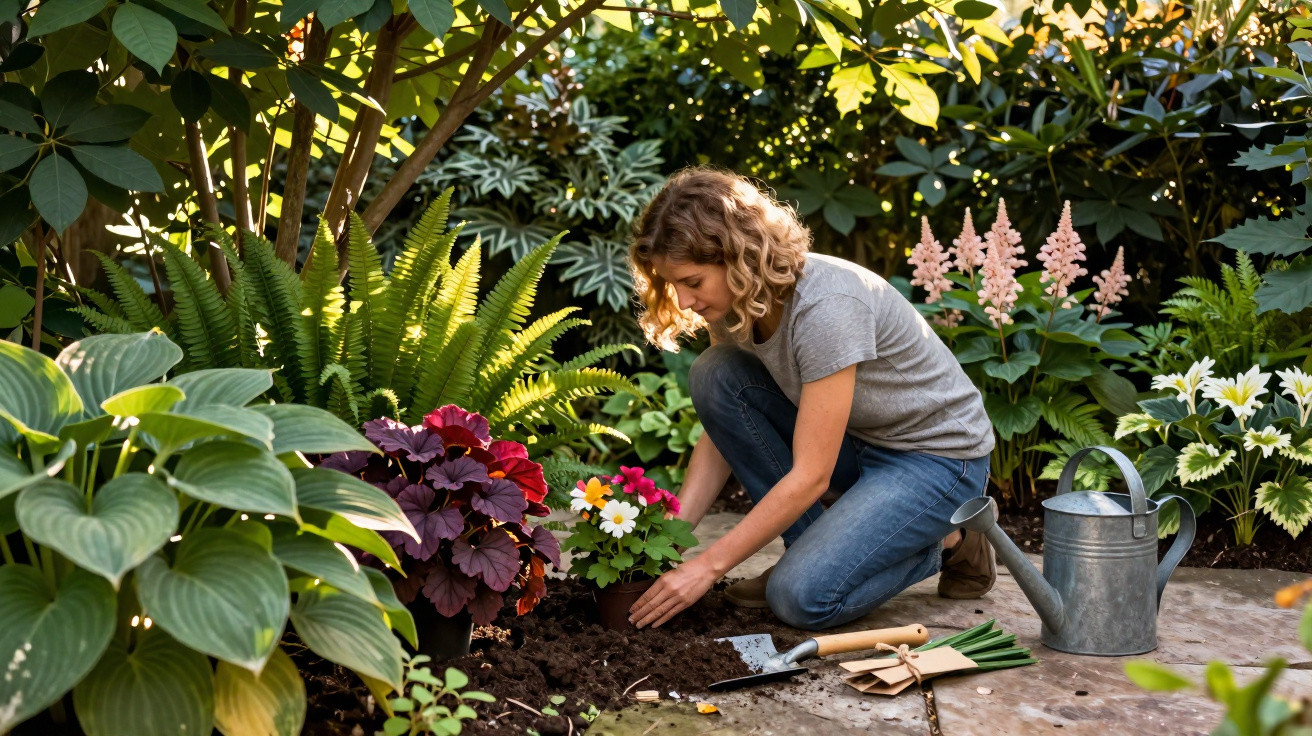
You plant a few things there in spring, cross your fingers, then close the patio door and return to the sun-drenched beds that make it onto Instagram. A few months on, the shady corner remains: patchy, vaguely green and oddly quiet.
One early-autumn morning in a modest London garden, I saw a neighbour standing in slippers with a mug of tea, gazing at a gloomy strip beneath a row of mature trees. The sunny borders were aflame with dahlias and rudbeckias. Beneath the canopy, though, a solitary hosta was being devoured by slugs, while a stray patch of ivy was mounting what looked like a hostile takeover. He sighed: “I wish this bit would just… glow, even now.”
That is the unspoken hope behind many shady gardens: colour that does not disappear as the light weakens, a border that has life in January as well as June, and a corner that no longer feels forgotten. It is possible, beginning with a change of perspective: shade is a stage rather than a problem.
Seeing shade as a secret garden stage
In any established garden, shade reveals itself as layered rather than vacant. Some of the most luminous borders sit between trees and walls, receiving filtered light instead of full sun. Ferns capture that glow like stained glass, while pale blooms appear to hover in the semi-darkness.
Creating all-year colour in shade is not about filling every inch with flowers. It means building layers of interest: foliage, stems, bark, berries and brief flowering moments arriving in succession. Once you see a shady area as a sequence of seasonal “scenes”, planning it feels less like hard work and more like directing a play.
In a north-facing Manchester terrace, a small communal courtyard had become the usual resting place for bins and bicycles. A design student in the first-floor flat chose to make it a view from her window instead. Spring brought drifts of snowdrops and hellebores beneath a compact Japanese maple. By May, frothy astilbes and lime-coloured heucheras took over. Glossy ferns and white foxgloves carried the display through summer. In winter, the red dogwood stems and the maple’s fine bare outline provided the structure.
Neighbours who had previously never exchanged a word began leaving notes asking for plant names. The courtyard was still compact and shaded; the change came from one quiet, almost geeky rule: every season needed at least one feature that made her pause halfway through an email and look outside.
Shade does not erase colour; it refines it. Deep reds and vivid oranges can fade in low light, whereas whites, limes and blues often seem illuminated from within. This is why woodland gardens may look brighter than south-facing patios. The principle is straightforward: hard light flattens, while gentle light adds depth. Perennials selected for their foliage shades, textures and flowering periods can make the most of that softness and prolong the display. Treat a shade border as a slow-burning film rather than a fireworks display: a different tempo, with just as much effect.
Layering shade perennials for colour throughout the year
The most dependable approach is to build a shady border as you would a cake, with three layers that each serve a purpose. Structural perennials and compact shrubs at the back establish the framework. Plants in the middle provide changing colour, and groundcover at the front binds the planting together so that bare, depressing soil is never on show.
Plan from winter onwards. Hellebores, epimediums and evergreen ferns preserve the border’s framework while much of the garden is dormant. Spring follows with lungwort (Pulmonaria), brunnera and primroses, casting gentle blue, pink and primrose-yellow clouds into the shade. Astrantias, hardy geraniums, hostas and foxgloves take over in summer. Autumn finishes the sequence with Japanese anemones, toad lilies (Tricyrtis) and foliage slowly deepening to copper and wine red.
On a semi-rural Yorkshire plot, a gardener planned these layers on a rough sheet of squared paper. She wrote every month along the top, with each plant listed down the side, then marked the weeks when each offered something of interest: flowers, berries, fresh foliage or glowing stems. Her aim was simply to leave no blank column in the calendar.
By its second year, the formerly uninspiring strip under her hawthorn hedge was never without visual interest. February brought hellebores and snowdrops; April delivered brunnera ‘Jack Frost’ and lime heucheras; June was for astrantia and foxgloves; and September featured Japanese anemones alongside dusky-purple bugbane. Her neighbour joked that the shade bed had “better time management than my whole life”. There was no magic involved, only a discreet fixation with timing.
In practical terms, shade planting for year-round colour rests on three principles. First comes flowering sequence: early, middle and late displays, with at least two perennials covering every period. Next is foliage contrast, pairing large with fine, matt with glossy, and dark with light, so flowerless weeks still have depth and drama. Finally, include evergreen anchors. These need not be conifers: bergenias, evergreen ferns and heucheras all prevent winter from becoming a crime scene of cut-back stems.
Spread these principles across the different layers and the border no longer lives and dies in a single burst. Instead, it continues to breathe through the year, even where the light is dim.
Practical planting: turning a muddy strip into a jewel box
To make the idea real, begin with the light rather than the plants. Spend a day or two observing the space. Where does the first sliver of sun arrive? Which spot is darkest at midday? Where does evening light reflect from a wall or window? Draw a rough sketch of the border and mark these areas; precision is not essential.
Position the most floriferous perennials where they can make the most of the available light. This may be along a path edge or at the front of the border, rather than far beneath a tree. Reserve the deeper shade for foliage-led plants such as ferns and hostas. Use compact, repeated groups of three or five instead of extended pick-and-mix rows. Repeated patterns make a small shady garden feel more abundant, allowing the eye to settle on the glow instead of searching for order.
There is a reassuring myth that shade gardens are “low maintenance”. They can be, but only if the plants suit both soil and light conditions. Dense clay below a fence corner that drips with water will suit robust lungwort, epimediums and Japanese anemones much better than thirsty hostas. Dry shade beneath trees is another challenge altogether; foxgloves, hardy geraniums and epimediums earn their place there quietly.
We have all stood in a garden centre in April, fallen for a tray of flowering shade plants, and watched them sulk three months later. The key is to consider how each plant grows in the wild. Woodland edges correspond to the front of your border, while the deep forest floor is closer to the tree trunk among leaf litter. And let’s be honest: nobody really does this every day, but even reading the label briefly and inspecting the rootball can make all the difference.
“Shade doesn’t mean less beauty,” says an experienced head gardener in Surrey. “It means you’re working in whispers instead of shouts. Once you accept that, your planting gets bolder, not safer.”
To ensure those whispers remain noticeable throughout the year, keep a short checklist in the shed or on your phone:
- One winter star for every metre: a hellebore, evergreen fern or colourful stem.
- Two spring carpets: bulbs or groundcover plants that conceal bare soil.
- One tall summer “wow” plant: foxglove, meadow rue or tall astrantia.
- At least one autumn-flowering plant: Japanese anemone, toad lily or late hardy geranium.
- One foliage “hero”, with an unusual colour or texture, in every view from the house.
Applied flexibly, this list prevents impulse purchases from taking over. It makes buying plants about filling roles within a cast, rather than simply taking home attractive faces.
Allowing your shade garden to tell its own story
The most compelling shady gardens offer a mood, not merely a list of plants. Some suggest woodland tranquillity, full of mosses, ferns and soft whites. Others are urban and graphic, with oversized hosta leaves, black mondo grass and disciplined rows of astrantias. The method remains the same: choose an atmosphere, then select perennials that maintain it in every season.
On a compact balcony with no direct sunlight, a young Bristol couple embraced the darker mood. They used plenty of deep greens and purples, punctuated by occasional flashes of white: heucheras, ferns, dark astrantias and white foxgloves. One golden grass in a pot captured the final reflected light from the building opposite. The structure endured through winter; in summer, the balcony resembled a dimly lit bar with better oxygen.
On a larger Kent plot, a retired teacher wanted something completely different. Her aim was a garden that recalled childhood woodland walks: softness underfoot, so groundcovers; feathery plants brushing her arms, so taller perennials; and little discoveries beside the path. Her finished plan included low, spreading perennials such as sweet woodruff, interrupted by ferns and foxgloves, with pockets of snowdrops and cyclamen bringing light in the colder months.
Those two shade stories could hardly be more different, yet both depend on the same understated techniques: begin with winter, arrange plants by height, repeat forms and colours, and let time refine the scheme. Plants that flop or sulk are replaced. Gaps gradually become apparent. A few failures remain as private jokes shared between you and the soil.
On a grey Tuesday next January, you may step outside, spot a single hellebore standing firm in the half-dark and realise that your border is no longer a guilty secret. It has become a small act of resistance to winter’s flatness - perhaps even to the flatness of the week.
| Key point | Detail | Benefit for the reader |
|---|---|---|
| Plant in layers | Structural planting at the back, colour through the middle and groundcover at the front | Creates depth and reduces visual “gaps” in every season |
| Plan with a calendar | Spread flowering and interesting foliage across 12 months | Ensures a shady corner remains attractive all year |
| Make foliage work harder | Contrast shapes, textures, and light and dark greens | Maintains the border’s appeal even without flowers |
FAQs
- Which perennials genuinely flower well in full shade? Hellebores, epimediums, certain hardy geraniums, foxgloves, astrantias and Japanese anemones can all handle low light, particularly in fertile, moisture-retentive soil.
- How do I brighten a very dark north-facing corner? Choose pale and lime foliage, including brunnera, heuchera and variegated ivy, alongside white or soft-blue flowers. These show up far more effectively in dim conditions than strong reds or oranges.
- What will survive very dry shade beneath trees? Try epimediums, hardy geraniums, vinca, lungwort and foxgloves, then apply a generous mulch annually to help them compete with tree roots.
- Should I improve the soil before planting? Shaded areas generally benefit from a generous amount of compost or leaf mould worked into the top layer. It recreates woodland conditions and helps roots establish.
- How long does it take for a shaded perennial border to look full? Most perennials need two to three seasons to knit together. Plant them slightly nearer than the labels recommend, then allow time for the border to grow into itself.





Comments
No comments yet. Be the first to comment!
Leave a Comment