
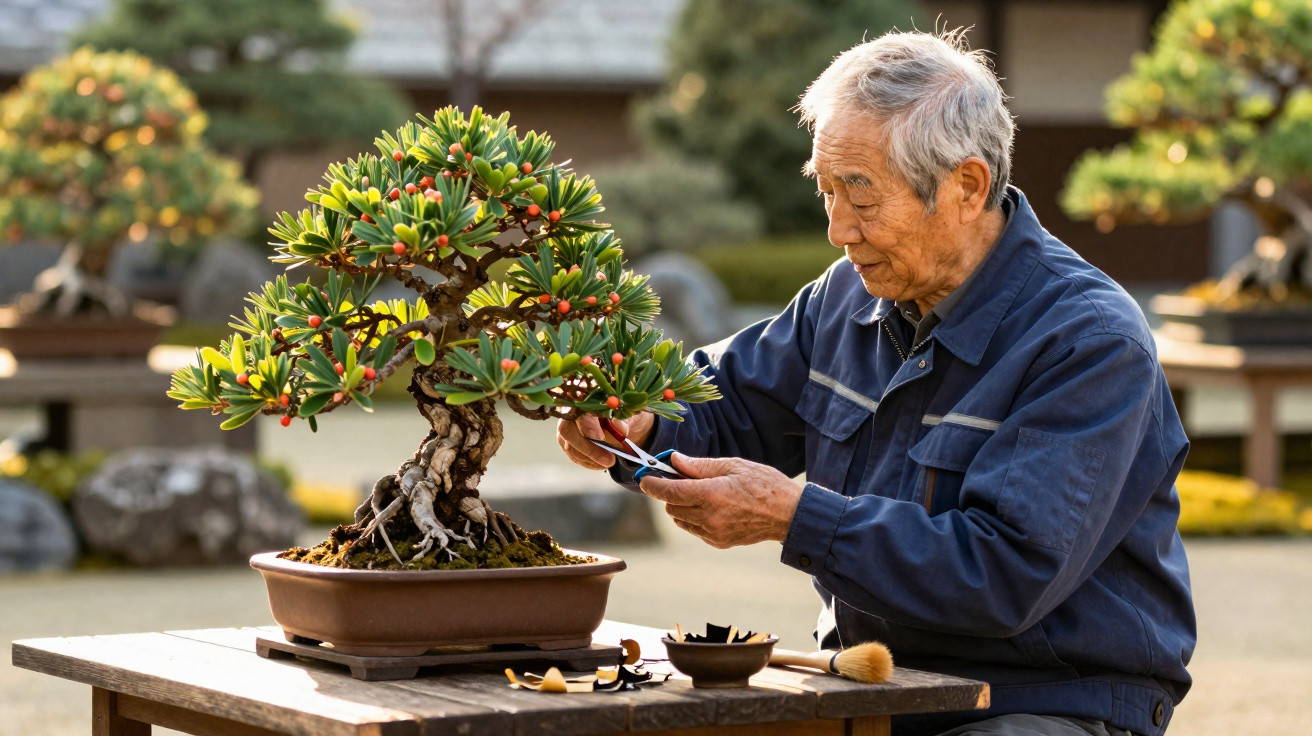
We either prune anxiously or neglect lovingly. A Japanese gardener who has trained trees older than himself says longevity in a small pot is no secret. It is a rhythm. Prune at the proper time and the tree’s internal clock eases, its sap finds balance, and growth is directed towards the places where youth remains. Lose that rhythm and you take away years that cannot be restored.
When I first met Mr. Sato, his nursery carried the scent of rain-soaked stone and bruised pine needles. He passed between ranks of miniature giants - black pines with the broad stance of ageing wrestlers, maples with delicate red-lace fingers - while his shears kept a soft, steady beat. Nothing was hurried. He spoke to his trees as people speak to sleeping children: quietly and gently, as though rousing them at the wrong time could alter what lay ahead. His fingers located an overly vigorous pine candle and shortened it with one precise cut. When sap formed at the wound, he smiled. “Good,” he said, “the blood is moving.” He then showed me a bonsai older than my grandfather, telling me that it would outlast us both. Cut to live.
How bonsai pruning changes the tree’s clock
Pruning is not merely about altering a bonsai’s outline. It determines where the tree invests its life. Mr. Sato explains that a bonsai constantly balances height against health, sunlight against shade, and youth against age. Every cut is a decision in that balance. Lower the apex and energy is redistributed to the branches below. Gently thin the inner growth and light can reach buds that have been dormant. The tree then activates those buds, producing shoots nearer the trunk and renewing itself from within. That is how a hundred years becomes possible rather than miraculous.
He pointed out a Japanese black pine whose training had begun before radio was widely used. Its crown had once risen like a tower. “Too proud,” he said. Across three growing seasons, he took away only ten to fifteen percent of its foliage at each session, beginning at the top and finishing in the darkened interior. By the following spring, small buds emerged beside the old wood like sparks. In early summer, he pinched back the most vigorous candles but left the weaker ones untouched. Its profile became gentler, the inner structure grew fuller, and its pace of growth settled into a sustainable pulse. The aged wood remained solid. Its needles became shorter. The tree appeared younger without attempting to be young.
The principle is straightforward. Trees direct growth towards their tips because hormones collect there. Remove a tip and that signal weakens. Sap pressure is then shared out, while dormant buds nearer the trunk begin to grow. Make each cut just above a bud pointing in the direction you want the branch to take. Retain a small collar, allowing the cambium to roll across the wound and seal it. Bigger cuts require sealant, not to disguise an error but to stop the wound drying too far into the wood. When thinning, seek light and airflow rather than bare space. Openings that seem graceful today may become dead areas within five years. Lasting elegance comes from photosynthesis, not from shears.
The bonsai pruning method: seasonal cuts and steady hands
Follow the calendar rather than your feelings. For pines, shorten spring candles in early summer; then decandle the strongest sections first and the weakest last, leaving a week or two between areas to even out energy. With maples, prune once the first flush has hardened, then prune again very lightly in late summer; retain leaf pairs and shorten long internodes. Pinch the growing tips of junipers with your fingers to prevent brown edges, removing whole sprays only where they block the light. Tropical species benefit from small, frequent interventions because they offer more periods of active growth. The process is uncomplicated: observe, decide, cut. Prune less, more often. Make every cut at an angle that lets rain run off like water from a roof.
The usual problem is not cruelty; it is hesitation or impatience. Some people wait for years, allowing the apex to starve everything below it of light and energy. Others embark on a “spring clean” and remove so much that the tree sulks. Everyone knows the urge to overhaul a plant when it looks untidy. Pause. Circle the tree. Take out the clearly crossing branch, then stop. Never strip a bonsai bare. Seek better light through the canopy, not openings wide enough to drive a truck through. Honestly, no one manages that perfectly every day.
Mr. Sato’s words return to me on quiet Sundays, when the house is silent and the shears seem weightier than their size suggests.
“Life in a small pot needs discipline and mercy. Cut strong growth to share energy. Leave weak growth to gather strength. If the tree can breathe and see the sun, it will choose to stay.”
- Put season before species: pine timing is not maple timing.
- Cut above outward-facing buds to establish direction.
- Keep a slight collar, as the tree needs material with which to seal the wound.
- Clean tools between trees. Clean blades save lives.
- Reduce the upper growth more heavily than the lower growth to lessen apical dominance.
Think in decades rather than weekends
A bonsai that reaches one hundred years has endured hundreds of small decisions. It is not the result of dramatic interventions. It comes from living alongside the tree’s seasons and allowing time to do most of the work. Time, not scissors, does the heavy lifting. Prune when the tree has sufficient growth to respond. Feed it while it is actively growing. Water with attention rather than by habit. Pruning should keep fresh growth close to old wood, ensuring that the design remains alive from trunk to branch tip. That is what matures beautifully. It also distributes risk: should a tip die over winter, the tree has reserves elsewhere. Share this with a friend who trims houseplants on evenings in the kitchen. The tenderness is the same, merely at another scale. Thinning a branch brings light into a future that is not yet fully visible. That is the quiet pleasure of it - you are gardening for someone you will never meet.
| Key point | Detail | Benefit for the reader |
|---|---|---|
| Timing by species | Decandle pines in early summer; prune maples after the first flush has hardened; pinch junipers rather than cutting foliage sprays with scissors | Prevents stress and browning, while improving back-budding where it matters |
| Cut placement | Cut above outward-facing buds and retain a slight collar; seal larger cuts to protect the cambium | Guides future growth and promotes faster healing for longevity |
| Energy balancing | Reduce vigorous areas and preserve weak ones; thin for light and air rather than emptiness | Keeps interior buds alive and trees compact for decades |
FAQ
- When is the best time to prune a pine bonsai? Shorten spring candles in early summer while the needles are still soft. When decandling, begin with the strongest areas, then work on medium and weak areas a week or two later to balance energy.
- How much can I remove in one session? Aim to remove 10–20% of the foliage, using the lower amount for weaker trees. Distribute major work over different seasons. Heavy pruning is occasional and deliberate, not an annual routine.
- Should I seal cuts on bonsai? Apply sealant to larger wounds and to cuts on species prone to bleeding or drying back. Small twig cuts may be allowed to dry naturally, particularly during warm periods of active growth.
- Can I defoliate maples to get smaller leaves? Partial defoliation is effective on strong trees, but it should not be done every year or on weak or recently repotted trees. Remove the larger leaf from a pair and retain the smaller one to preserve energy.
- How do I encourage back-budding on old wood? Manage the apex, thin the canopy so light reaches the interior, and prune when the tree can react. Combine pruning with sound feeding and a full season of sunlight. Back buds respond to light and balanced sap, not wishes.
Comments
No comments yet. Be the first to comment!
Leave a Comment