
Oriental lilies rank among the garden’s most dramatic flowering plants, yet without a carefully managed nutrient supply, many stems remain sparse, flowers stay small and colours look washed out. Once you understand what these bulb plants genuinely require, a handful of modest shoots can become an extraordinary display of fragrance and colour - year after year.
What Oriental lilies really need
Oriental lilies have different needs from typical bedding plants. They are not grown primarily for foliage; they are flowering powerhouses that invest huge amounts of energy in large, weighty blooms. For that reason, they are especially responsive to the nutrient balance in their fertiliser.
“Oriental lilies love plenty of phosphorus and potassium - and only moderate amounts of nitrogen.”
As a general guide, use the following NPK ratios (N = nitrogen, P = phosphorus, K = potassium):
- 5-10-10 – ideal for root development and flower formation
- 10-10-10 – a balanced option for the main growth period
- 0-10-10 – perfect after flowering to strengthen the bulb
Nitrogen produces rich green foliage. Too much of it leads to lots of leafy growth but fewer flowers. Phosphorus encourages root growth and bloom development. Potassium supports the plant overall, affecting water regulation, stem strength and colour intensity.
The right timing: fertilising by growth stage
When you fertilise is at least as important as the fertiliser you choose. Many gardeners start feeding too late or continue for too long, and the consequences become clear over winter.
| Growth stage | Recommended fertiliser | Frequency | Main benefit |
|---|---|---|---|
| Early growth | 5-10-10 | Every 2 weeks | Root development, sturdy stems |
| Vigorous growth | 10-10-10 | Every 2–3 weeks | Balanced nutrition, healthy foliage |
| Bud formation | 5-10-10 | Every 2 weeks | Flower size, colour intensity |
| After flowering | 0-10-10 | Monthly | Bulb renewal, strength for the following year |
Apply the first feed when the shoots reach around 10–15 centimetres in spring. Continue feeding every 2 to 3 weeks until the buds begin to show colour. Once the flowers start opening, stop using nitrogen fertiliser. At this point, the plant should direct its energy into flowering and, afterwards, into the bulb rather than producing fresh shoots.
Fertiliser types that are genuinely worthwhile
Slow-release fertiliser: convenience for less hands-on gardeners
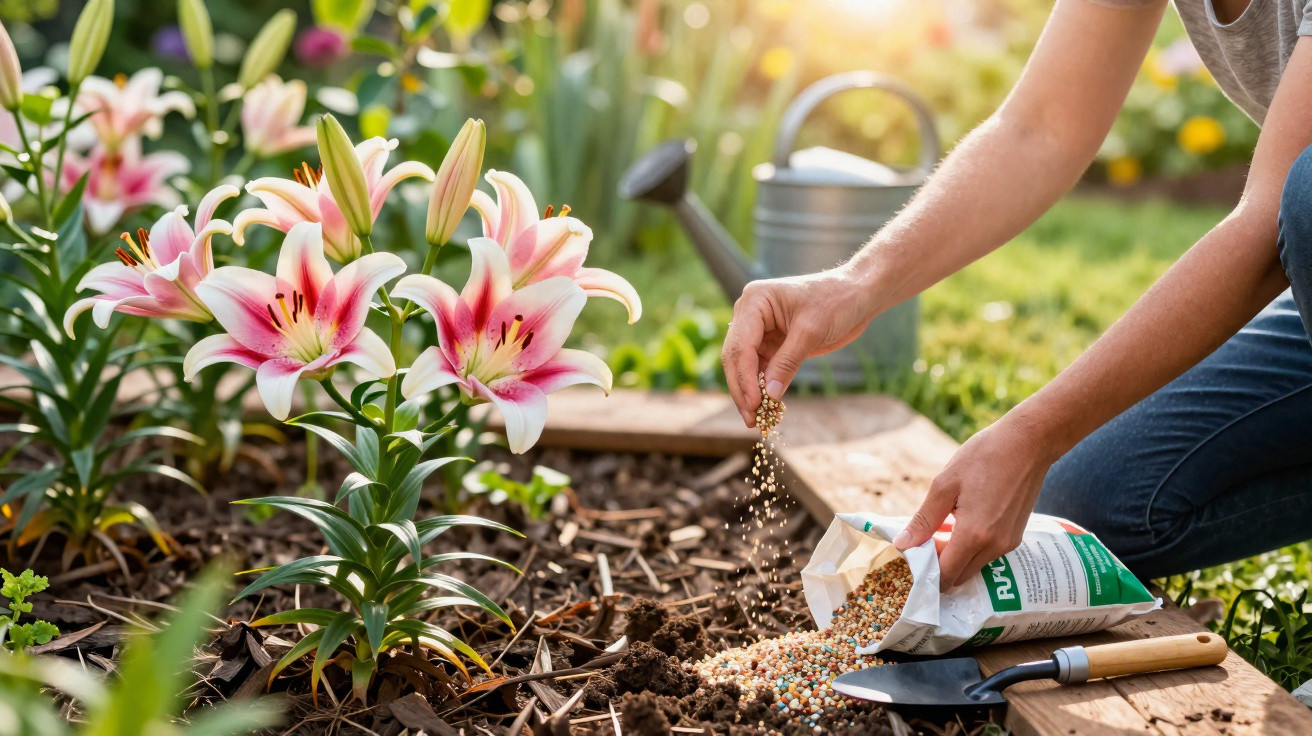
Granular slow-release fertilisers are close to ideal for Oriental lilies. They release nutrients gradually over several weeks, lowering the risk of fertiliser “shock” to the roots.
Products modelled on Osmocote Flower & Vegetable are typical examples. They respond to temperature: the warmer the soil becomes, the more nutrients they release - precisely when the lilies are in peak form.
- Work them lightly into the soil at planting time or when growth begins.
- Do not scatter them directly beside the stem; instead, apply them in a ring roughly 15 centimetres away.
- Water thoroughly afterwards so that the granules begin to dissolve.
For densely planted beds, one application in spring is usually sufficient, combined with a light top-up while buds are forming.
Liquid fertiliser: rapid, precise and ideal for pots
Gardeners growing Oriental lilies in containers will usually find liquid fertiliser more practical. Frequent watering quickly leaches nutrients from pots. Products in the “Bloom Booster” flowering fertiliser category provide readily available nutrients that reach the roots through the watering water.
“In pots, fertilise more lightly but more regularly - this avoids salt stress.”
Two practical approaches are:
- Apply a half-strength dose every week.
- Use the manufacturer’s full recommended dose every two weeks.
Important: never allow the compost to become bone dry before fertilising, as the sudden salt concentration can damage the roots.
Organic fertilisers: gentle strength from compost and more
Anyone aiming to garden as naturally as possible can feed Oriental lilies successfully with organic sources. Suitable staples include:
- Well-rotted farmyard manure – supplies basic nutrients and improves soil texture
- Horn shavings and bone meal – slow-release phosphorus for roots and flower production
- Fish emulsion – a quick nitrogen boost along with trace elements
- Mature compost – improves structure, moisture retention and soil life
Organic fertilisers act more slowly but offer longer-lasting benefits. Microorganisms must first break down the material before its nutrients become available to plants. For Oriental lilies, this creates a steady “nutrient blanket” that keeps the bulb healthy over the long term.
How to avoid the most common fertilising mistakes
Many Oriental lily problems are caused less by the variety itself than by fertiliser use. A few basic rules can prevent common damage:
- Do not apply fertiliser too close to the stem – a 10–15 centimetre gap protects roots from scorching.
- Water thoroughly after every application – this distributes nutrients and reduces salt levels around the roots.
- Avoid feeding during hot, dry conditions – stressed plants absorb few nutrients, while their roots suffer.
- Go gently with young plants – use one third less fertiliser in the first year, until the root system is well established.
- Watch the leaf colour – pale green, weak foliage can indicate deficiency, while dark, overly lush leaves suggest excessive nitrogen.
Soil, pH and mulch: the overlooked factor
Even the finest fertiliser will achieve little if the soil chemistry is unsuitable. Oriental lilies prefer slightly acidic to neutral soil, with a pH of roughly 6.0 to 6.5.
“A simple soil test shows whether the pH and basic nutrients are right - and prevents expensive blind fertilising.”
If the soil contains too much lime and is therefore alkaline, phosphorus and other nutrients can become partly “locked up” and unavailable to plants. In these situations, it helps to:
- Incorporate leaf mould or composted bark.
- Avoid regular applications of mineral lime.
- Consider raised beds filled with suitable soil where levels are excessively high.
A 2–3 centimetre mulch layer of shredded bark or compost also helps to maintain soil moisture, protect shallow roots and provide additional nutrients as it decomposes. Mulch also supports soil life - and these microorganisms are the hidden “translators” between organic matter and usable plant fertiliser.
After flowering: this is when next year is decided
As soon as the blooms fade, many home gardeners consider the job finished - but that is a mistake. During this period, the bulb replenishes its energy reserves. Targeted use of phosphorus- and potassium-rich fertilisers now helps secure robust stems and large flowers the following year.
A practical routine:
- Remove only the faded flower heads and leave the foliage in place.
- Apply a light dose of a 0-10-10 fertiliser, or a similar phosphorus/potassium-rich product.
- Keep watering until the leaves die back and yellow naturally.
The foliage may look unattractive at this stage, but it has a vital role: photosynthesis for the bulb. Cutting it back too soon deprives the plant of energy, leaving it markedly weaker in the next season.
Practical examples: the visible effect of the right fertiliser
In sandy, nutrient-poor soils with good drainage, Oriental lilies respond exceptionally well to regular but relatively low-dose feeding. Their stems remain more stable, and the number of buds on each shoot rises noticeably.
On heavy clay soils, the priority is less about quantity and more about aeration and structure. Here, organic additions such as compost and composted bark often achieve more than another scoop of general-purpose fertiliser. In many gardens, nutrients only deliver their full effect once the soil has become looser and better aerated.
Anyone trialling different fertiliser types soon sees that there is no single “miracle product”. Success depends on combining an appropriate NPK ratio with correct dosing and good timing. A simple record - noting when and with what the lilies were fed, and how they flowered - makes it possible to develop a personal approach suited to your own soil and climate conditions.
In this way, Oriental lilies can change from temperamental divas into dependable stars of the summer border, rewarding you each year with impressive flower clusters and intense fragrance - provided their nutrient supply is right from the first spring shoot to the last yellow leaf in autumn.




Comments
No comments yet. Be the first to comment!
Leave a Comment