
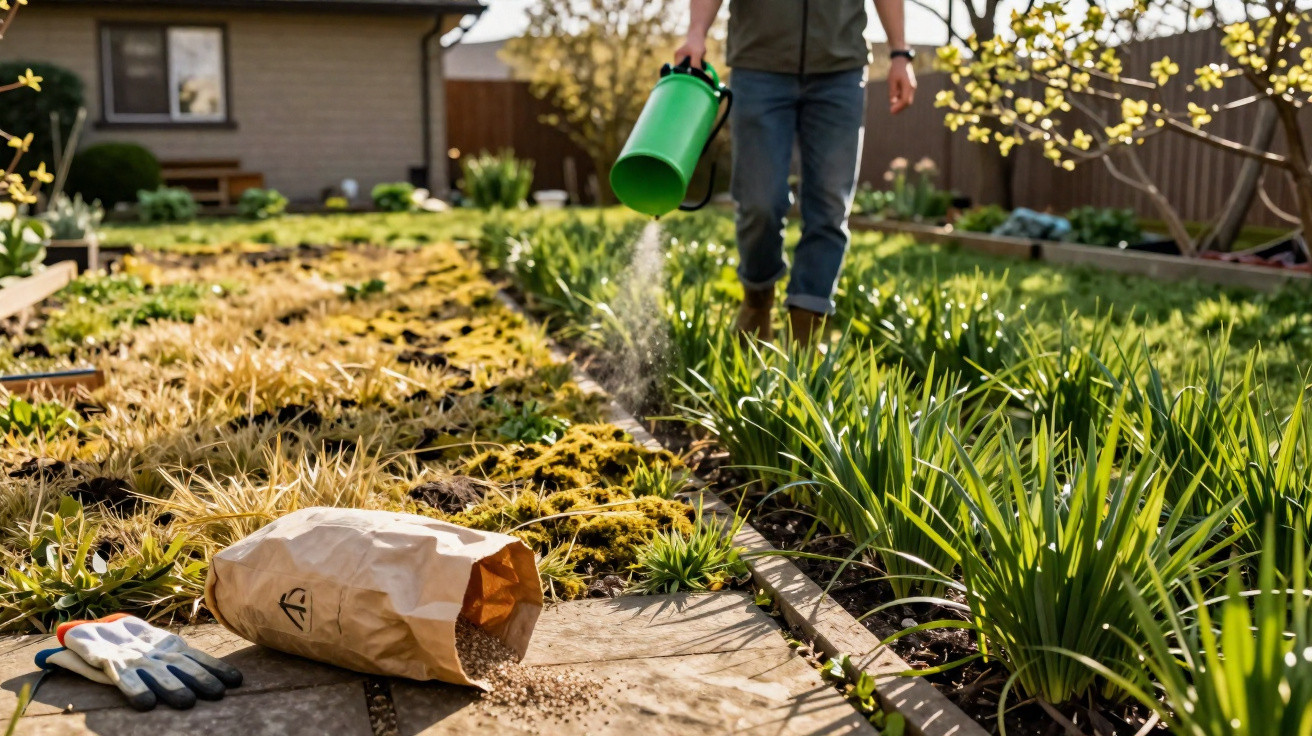
Bare patches, yellowing blades, moss everywhere - and yet one simple trick can bring back rich green.
As the days start to lengthen in March, your lawn reaches a turning point. The grasses slowly wake from winter dormancy, but the damage from the past few months only really becomes obvious now. At precisely this stage, an unassuming powder can make all the difference - making the surface look fresher and denser within just a few days.
Why the lawn looks so drained after winter
For weeks and months, moisture has sat on the turf, frost has alternated with thaws, and there has been very little sun. All of that weakens the grass. Over time the soil becomes compacted, and air and water struggle to reach the roots. An old familiar problem then moves in: moss.
Moss thrives in shady, damp and compacted ground. It spreads between individual grass blades, stealing light and space. The result is a lawn that looks increasingly patchy; the green loses its depth, and the whole area appears tired and neglected.
At the same time, March marks the start of the growth period. Temperatures rise, roots become active again, and new shoots begin pushing up. That is exactly when a targeted treatment is especially worthwhile - the lawn responds far more quickly now than it does in the cold tail end of winter.
"If you take the right steps in March, you lay the foundations for a dense, strong lawn well into summer."
The key substance: why iron sulphate slows moss and makes the lawn greener
Professionals in garden and landscape construction often reach for a proven classic in early spring: iron sulphate. Behind the plain name is a mineral powder with a double benefit - it tackles moss while supporting a deeper green.
Moss turns brown within days and disappears
When dissolved in water and applied to the lawn, iron sulphate reacts very quickly with moss. The plants effectively scorch at the surface, turning dark brown to black within hours to a few days and then dying off. That creates open spaces between the grass blades, allowing light to reach the turf again.
Important: you will notice the change on the moss first, not on the lawn. The grass is not “burnt away”; instead, it benefits in the next step from the nutrient that has been applied.
Iron as the driver of deep leaf green
Iron is a key building block for producing chlorophyll - the substance that makes leaves green and enables photosynthesis. If the soil lacks iron, grasses lose their rich colour and can look pale, in places almost yellow.
By applying iron sulphate, the nutrient is delivered straight into the root zone. The grasses can absorb it quickly, and chlorophyll production ramps up again. You can see this as a noticeably stronger, darker green - often before other fertiliser applications have even started to take effect.
"Iron sulphate works like a spring boost: moss disappears, and the lawn shifts to a darker, denser green."
How to use the powder correctly in March
For good results, timing matters most. The ideal window is early to mid-March, when daytime temperatures are several degrees above 0 °C and there is no longer any risk of ground frost.
The best conditions at a glance
- Temperature: frost-free, ideally around 8 to 12 °C
- Soil: slightly moist, but not waterlogged
- Weather: a few dry hours after application, with no rain front moving in
- Lawn: no snow cover, and cleared of leaves and larger twigs
Many manufacturers advise dissolving the powder in water. A common dosage is around 20 to 30 grams per litre of water. This solution can be spread evenly using a watering can with a rose or a pressure sprayer. If you overdo the concentration, you risk scorching the grass.
Step-by-step application in the garden
- Mow the lawn short, but not extremely close.
- Remove loose leaves and twigs so the solution can reach the soil.
- Dissolve the iron sulphate in water according to the manufacturer’s instructions.
- Apply evenly across the area using a watering can or sprayer.
- Avoid rainfall and irrigation for 24 hours if possible.
If you want to be cautious, try the mixture on a small corner first. That way you can check whether the lawn tolerates the concentration well.
Essential safety measures and common mistakes
Iron sulphate may be widely used, but it is not a harmless household remedy. Contact with skin can irritate, and on certain materials the substance can leave permanent rust-like stains.
- Always wear rubber gloves.
- Wear wellingtons or sturdy shoes that can get dirty.
- Avoid contact with paving slabs, patios, brickwork and pool edging.
- If you spill any, rinse the area immediately with plenty of water.
Another frequent mistake is applying it just before heavy rain. If the solution is washed off straight away, some of it ends up in drains or soaks away unused. The effectiveness drops sharply, and the desired result fails to appear.
"For at least one day after treatment, the area should stay as dry as possible so the product can work undisturbed."
What needs to happen two weeks after treatment
After around ten to fourteen days, the moss is usually completely dead and clearly visible: it looks black, crumbly and is no longer firmly rooted in the soil. Now comes the next crucial step - removing it.
Scarifier instead of a rake: letting the lawn breathe again
Using a scarifier or a sturdy rake, you can pull the dead moss out of the sward. It can feel like hard work, but it pays off: air and water can reach the roots again, the soil becomes more permeable, and the lawn looks more vigorous overall.
You will often uncover gaps that were previously hidden beneath the moss. Those patches need overseeding so weeds do not take hold there again.
Overseeding and nutrients for the whole season
Straight afterwards, a classic care package works well:
- Overseed with lawn seed designed for repair patches
- Work it in lightly with a rake and gently roll the surface
- Apply an organic or organo-mineral lawn fertiliser
- Water regularly with a fine spray until the new shoots have emerged
This sets the lawn up strongly for the season. The combination of moss removal, iron supply and overseeding helps the turf thicken noticeably through to summer.
When iron sulphate is not the best choice
As effective as it can be, it does not suit every situation. On very chalky soils that are stubbornly compacted, using iron sulphate alone often produces only a short-lived improvement. Soil pH and structure also play a part.
If you struggle with severe moss every year, it is worth checking as well:
- How high is the soil pH?
- Is there waterlogging, for example due to heavy soil?
- Is the area in shade for most of the day?
In some cases, only a combination of soil loosening, topdressing with sand, possibly adding lime, and adjusting watering will help. Iron sulphate then remains one component among several - not a stand-alone solution.
Practical tips for hobby gardeners with little time
If you do not want to spend hours on lawn work, you can treat smaller areas using a spreader and ready-mixed lawn fertilisers that include iron. These combine moss control with a basic nutrient feed and save you a step.
Even so, one point still matters: once a year, the lawn should be thoroughly cleared of thatch and dead material. That can also be done in April or May, once the lawn has visibly recovered after the iron sulphate treatment. If you keep up that routine, you will have far fewer problems in summer with bare patches and moss cushions.






Comments
No comments yet. Be the first to comment!
Leave a Comment