
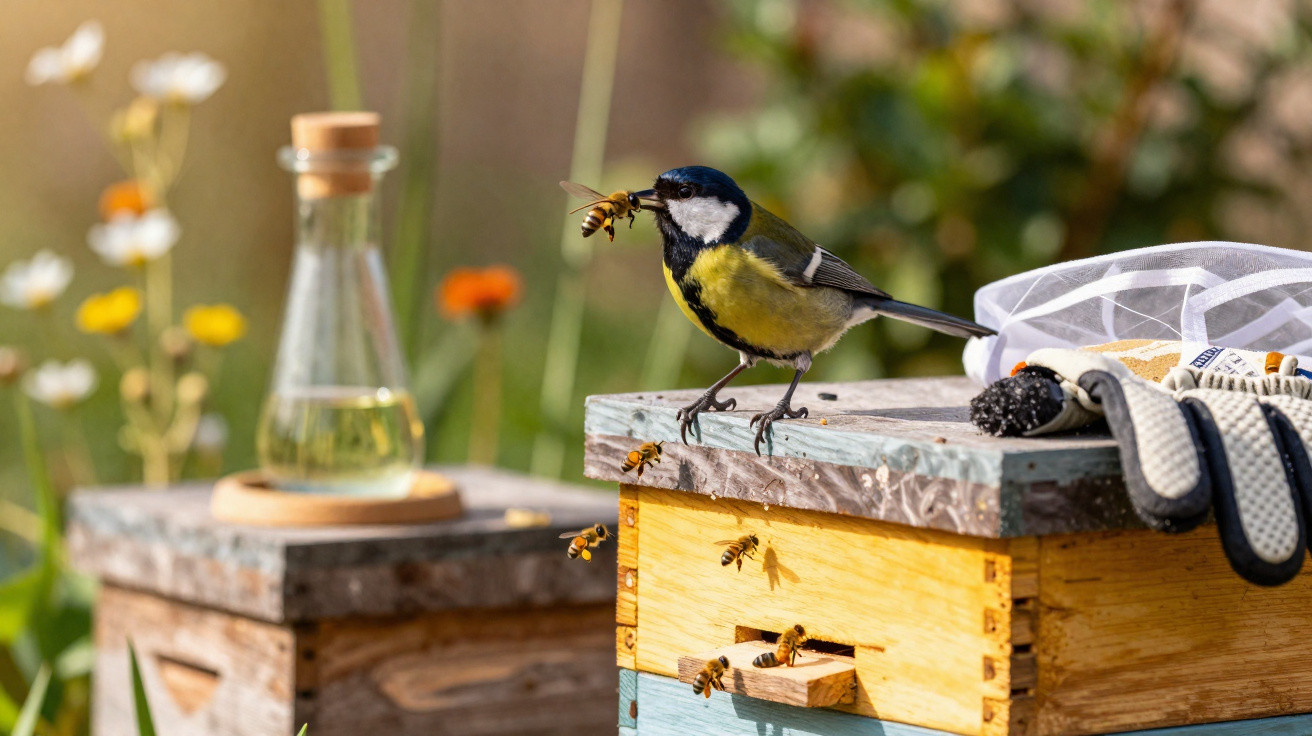
For several years now, many gardens have been facing the same new threat: an invasive hornet introduced from Asia that puts honey bees and other pollinators under heavy pressure. Traps, poisons and rushed ladder work often bring only limited results - and can be hazardous. Increasingly, however, biologists and keen gardeners are paying attention to a small bird with a big appetite: the tit. If you offer it a place to nest early in the year, you can also give your bees a quieter season.
Why March is critical in the fight against the invasive hornet
The decisive window arrives just as the garden starts to wake up. From late February into early March, queens of the invasive hornet emerge from their winter hiding places. They then quickly look for a site for their first, still modest nest - in a shed, a roof space, high up in trees, or even tucked into hedges.
If the queen is left undisturbed, the colony expands at remarkable speed. What starts as a small nest with only a few dozen workers can become, by summer, a large colony that consumes several kilograms of insects each year - including many honey bees, wild bees and other pollinators. If you only react in midsummer, you are usually too late: nests are often high up and hard to reach, and any intervention can be risky.
"The best time to do something about the invasive hornet isn’t July on a ladder - it’s March, from the ground."
Researchers broadly agree that completely eradicating this introduced insect is unrealistic. Its reproductive rate is simply too high, and the area already colonised is too extensive. Individual predators such as the bee-eater or certain birds of prey may catch hornets now and then, but not at a level that would noticeably reduce the population.
That is where tits come in. They are not hornet specialists, but they live right alongside us in gardens, they are relentlessly insect-hungry - and they can be plentiful when the conditions suit them.
Tits as natural helpers in the garden
Blue tits, great tits and coal tits - the colourful acrobats at feeders - are among the most familiar garden birds. In spring, when chicks are in the nest, they reach peak intensity: one tit family can deliver hundreds of food items every day.
What they bring back is mainly:
- Caterpillars and larvae of all kinds
- Small beetles and flies
- Spiders and other small creatures
- where available: larvae of the invasive hornet
If a hornet nest is close by, tits may also take hornet larvae. In doing so, they quietly reduce the number of young queens that would otherwise mature towards late summer. Fewer surviving queens means fewer new nests the following year.
Great tits, in particular, show a striking behaviour: they often like to nest near sites that hornets use or have used. In abandoned nests - for example at the beginning of winter - they peck out dead insects and larvae. This not only clears away “leftovers”, it also reduces the remaining breeding potential of the colony.
"Tits don’t solve the hornet problem, but they apply a constant, natural pressure on the population - right on our doorstep."
Biologists stress that no single bird, no parasitoid wasp and no carnivorous plant will regulate the invasive hornet on its own. The value of tits lies in the cumulative effect: many gardens, many breeding pairs, and countless larvae and pest insects eaten.
How to make your garden tit-friendly - and help bees at the same time
For tits to play their part as allies, they mainly need two things: somewhere to breed and enough food. The key is that both are in place by March.
The right nest box at the right time
Natural tree cavities are increasingly scarce, especially in tidy gardens and parks. Nest boxes can fill that gap. If you want to make it easy for tits, keep to a few basics:
- Material: wood, untreated or only with an environmentally friendly exterior stain
- Entrance hole: about 2.5 to 3 centimetres in diameter for tits
- Height: 2 to 5 metres above the ground, out of reach of cats
- Orientation: ideally away from the prevailing weather, slightly towards the east or south-east
- Timing: install by mid-March at the latest - earlier is better
Hanging several boxes increases the odds that one or two pairs will settle in. Leave a few metres between boxes so the birds do not compete directly.
Feeding strategy: help early, stop early
In late winter, feeding can draw birds into the garden and help them through cold spells. Suitable options include:
- Sunflower hearts
- Unsalted nuts
- Vegetable-fat balls without plastic netting
Important: by the end of March, gradually wind down supplementary feeding. More insects will be active again by then, and tits switch to protein-rich prey - precisely the larvae and insects that the invasive hornet also relies on to feed its brood.
Plants, water, and avoiding poisons
A tit-friendly garden may look simple at first glance, but it pays off in several ways:
- Native shrubs: for example elder, hawthorn or hazel provide cover, berries and insect life.
- Wild corners: a small pile of branches, some longer grass, or leaves left in place - ideal for hunting and nesting.
- Water source: a shallow dish or small basin, cleaned regularly and refilled.
- No pesticides: poisons kill insects and therefore directly harm tits, as well as bees and other pollinators.
"If you spray poisons, you remove the basis of life for tits and bees at the same time - and you help the invasive hornet."
Always report hornet nests to professionals
As useful as tits can be, they are not a replacement for targeted control. If you find a nest, do not attempt to remove it yourself. The insects defend their colony, and a sting can be life-threatening for sensitive individuals.
A sensible division of labour in the garden looks like this:
- Tits deal with larvae and dead insects, indirectly reducing the next generation.
- People report visible nests to specialists, who can remove them safely.
- Gardeners create structures that benefit many species - birds, bees and other pollinators.
What beekeepers can do in practice
For beekeepers, the invasive hornet has already become a day-to-day issue. Here, tits can offer added value because they may be very active around an apiary. Useful steps include:
- Put up nest boxes within sight of the hives, taking cats and martens into account.
- Leave hedge lines and shrubs around the apiary rather than cutting everything back short.
- Avoid using chemical treatments in the immediate area of the colonies.
Tits also help by controlling other enemies of bees, such as certain caterpillars that damage blossoms. In this way, they reinforce the wider ecosystem on which colonies depend.
Background: why the invasive hornet is so successful
The introduced hornet originates in Asia, where it is part of a natural balance. In central Europe, that correcting influence is largely absent. It finds abundant food, mild winters and plenty of nesting options - from lofts to tall poplars.
A single colony can catch several kilograms of insects each year. Some of that will be pests, but a large share are beneficial insects. Honey bees are especially affected: the hornet waits at hive entrances and snaps up returning foragers. For already weakened colonies, this constant stress can become a serious problem.
Natural enemies in Europe have so far hardly specialised. Birds may occasionally eat individual hornets, but they risk stings and tend to avoid large nests. Tits do not primarily target the workers; instead, they reduce the brood in the nest - a different lever that can be combined with human measures.
More life in the garden instead of poison and concrete
Supporting tits does more than protect bees. The garden becomes more vibrant overall: more birds, more insects, more flowers. Children can watch parent birds tirelessly bringing food, see young birds fledge, and notice how berry shrubs draw birds in during autumn.
Many everyday garden problems can be kept smaller through this “alliance” between people and birds:
- Caterpillar damage on fruit trees decreases.
- Aphid colonies are more likely to stay under control.
- The invasive hornet experiences added pressure on its brood.
Rather than setting out ever more traps and poisons, it is worth looking up: in the branches may already be the best ally a bee-lover could ask for - a tit that is simply waiting for a few nest boxes and a poison-free garden.
Comments
No comments yet. Be the first to comment!
Leave a Comment