
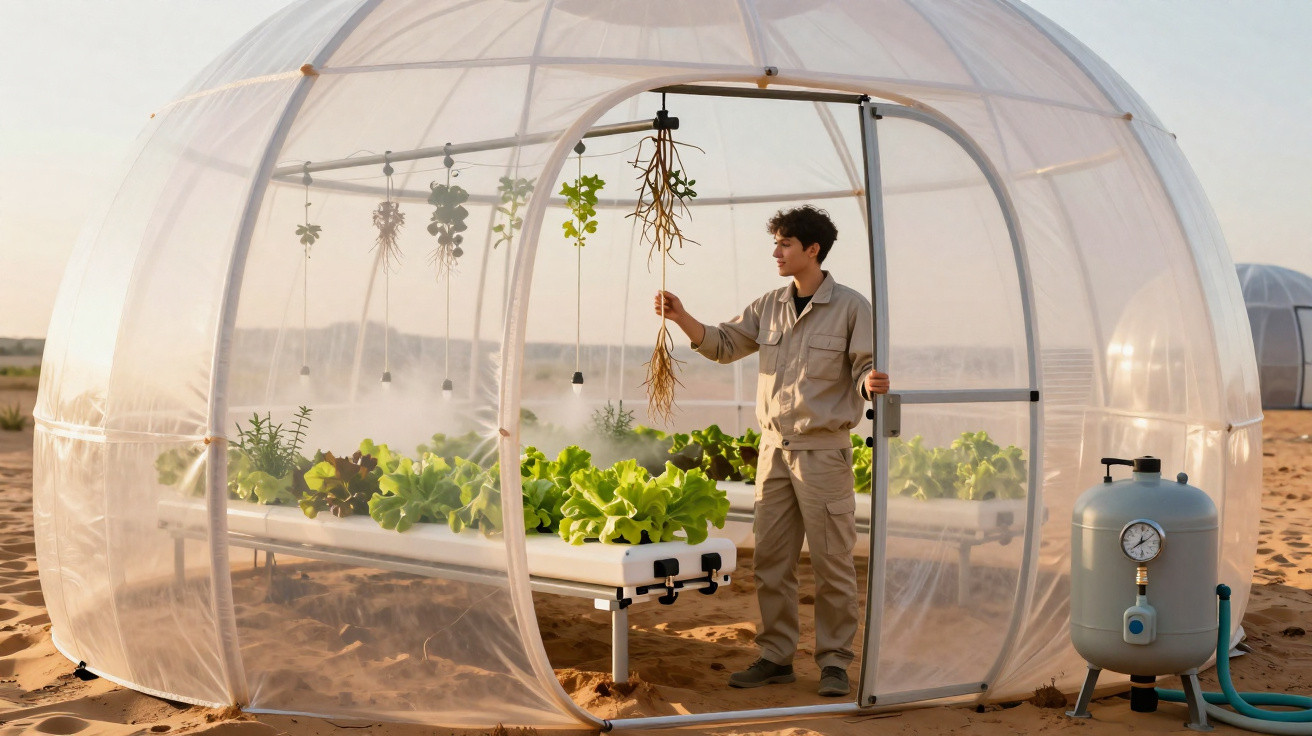
A compact team is trying to raise salad greens directly from sand.
A startup based in Jordan has introduced an inflatable farm that relies on aeroponics rather than soil. It is aimed squarely at water-stressed places where every litre counts.
From sci‑fi to sand: an inflatable farm you can tow
This winter, the company airfarm presented its portable, pressurised growing modules at a large technology event. Many people quickly likened the look to the moisture farms from a famous desert world. That similarity is mostly aesthetic; the underlying biology is proven. Inside a sealed tunnel, plant roots are left exposed and suspended, while a fine spray provides water and nutrients with tight control.
airfarm says the resource savings are significant. Against conventional irrigation, the system uses far less water. Compared with many hydroponic setups, the aeroponics method is designed to reduce consumption even more. Fertiliser use is lower, too. Because the growing space is enclosed, pests are kept out more effectively, reducing the need for chemical spraying.
Airfarm says its aeroponics cuts water use by up to 90% compared with hydroponic systems, reduces fertilizers by about 60%, and removes pesticides from the routine.
How the system works
Each unit is essentially a light, inflatable tunnel fitted with racking inside. Tiny nozzles turn the nutrient mix into a micro‑mist that coats the roots. Sensors monitor electrical conductivity (EC), pH, temperature, humidity and vapour pressure deficit (VPD). Those measurements appear live in a mobile app, which also notifies the grower when values drift beyond the desired range. The principle is straightforward: give the crop precisely what it needs at the right moment, while keeping contaminants and pests out.
Setup in half a day
Rapid deployment is central to the proposition. airfarm says a team can install a module in roughly half a day. Units are designed to pack flat, and a standard shipping container can carry up to ten modules-cutting logistics costs and avoiding the need for a dedicated trailer. That matters in isolated locations where roads are poor and budgets are tight.
Two sizes for different jobs
Two formats are available. The three‑metre module is positioned for classrooms, pilot projects or back‑garden use. The six‑metre version matches the length of a standard shipping container, helping with transport planning and making expansion more straightforward. The concept has already been trialled in the United Arab Emirates, Japan and Jordan, where heat, dust and water stress can push conventional agriculture to its limits.
- Schools and training centres can deliver year‑round lessons with consistent, predictable results.
- Hotels and resorts can grow greens on site while cutting food miles.
- Refugee camps and aid teams can establish a fresh supply quickly after an emergency.
- Mining camps and construction sites can access dependable produce far from established markets.
- Urban rooftops get a sealed option that reduces noise, odour and runoff.
A half‑day setup and a dashboard for EC, pH, temperature, humidity and VPD turn a complex grow into a repeatable routine.
Why water math matters in 2025
Agriculture already accounts for most global freshwater withdrawals. Climate stress, rising salinity and fast urban growth are tightening constraints, particularly across arid regions. The United Nations forecasts global population at about 9.7 billion by 2050, with a peak near 10.3 billion around 2080. More demand for food, higher temperatures and increasingly erratic rainfall leave little margin for waste. Methods that produce calories with less water, land and chemical input therefore carry real significance.
How it compares at a glance
| Aspect | Conventional soil | Hydroponics | Airfarm aeroponics |
|---|---|---|---|
| Water use | High, with runoff and evaporation | Lower, recirculates solution | Up to 90% less than hydro, micro‑mist to roots |
| Fertiliser input | Standard rates, soil losses | Optimised dosing | About 60% less than hydro |
| Pesticides | Frequent in many crops | Occasional, depending on setup | None in routine operation, sealed space |
| Setup time | Weeks to months | Days to weeks | Around half a day per module |
| Mobility | Low | Medium | High, flat‑pack for containers |
| Climate control | Weather‑exposed | Greenhouse‑dependent | Targeted nano‑climate in grow beds |
Early pilots and the road ahead
Looking ahead, the team wants to add vertical racking inside future modules to increase output per footprint. Engineers are also developing what they describe as nano‑climate control, aiming to manage conditions around the root zone and canopy rather than only regulating the overall tent environment. That kind of precision could stabilise yields when desert sun becomes extreme or when night-time temperatures drop sharply.
A carbon‑neutral farm is also on the roadmap. Reaching that goal depends on combining efficient pumps and sensors with solar panels and batteries sized to the local site. The enclosed format supports this direction as well, because cooling demand can be lower than in glass greenhouses during the height of summer.
Ten modules in one container, pilots in three countries, and a plan to stack vertically point to a system built for scale, not just show floors.
Risks, costs and what to watch
No agricultural technology is a silver bullet. Aeroponics introduces its own risks. Fine misting hardware can block. If power fails and cycles stop, roots can suffer quickly. Operators must follow cleaning and hygiene practices to prevent biofilms building up inside lines. Dust storms put seals and filters under pressure. UV exposure and high temperatures can also degrade materials unless suitable films and coatings are used.
- Power quality: off‑grid sites need batteries and backup generators sized for pumps and controls.
- Water source: brackish water still needs filtration; salts build up without purging.
- Spare parts: nozzles, pumps, sensors and films must be stocked locally.
- Skills: growers must read EC, pH and VPD data and act quickly.
- Economics: payback depends on crop choice, local prices and energy costs.
A quick primer: aeroponics vs hydroponics
In hydroponics, roots sit in a nutrient solution that moves through channels or beds. In aeroponics, roots are suspended in air and fed via mist. Both approaches avoid soil, which can remove many weeds and soil-borne pathogens. Aeroponics can increase oxygen availability at the roots, potentially accelerating growth when the nutrient ‘recipe’ is correct. The trade-off is that control must be tighter. That is why EC and pH need close attention throughout the day. VPD, which combines temperature and humidity into one indicator, helps predict how fast plants transpire, allowing growers to align misting cycles with real plant demand.
Where this could fit next
Coastal cities face saline intrusion into wells and shrinking peri‑urban farmland. Inflatable modules could form small production hubs on rooftops, in car parks or next to warehouses, supplying nearby kitchens. Ports might host container-length farms that can be relocated with seasonal trade patterns. Universities could also adopt standardised, lab-grade grow spaces that travel with research teams and field courses.
Hybrid models may make sense as well. A site could use an inflatable unit for leafy greens while keeping shaded soil plots for tougher fruiting crops. That combination spreads risk, reduces capital pressure and supports a more varied diet. Insurers and food buyers already monitor water use and pesticide footprints; a sealed, sensor-rich module can provide auditable data, which may help growers secure stronger contracts when they decide to try a new approach.



Comments
No comments yet. Be the first to comment!
Leave a Comment