
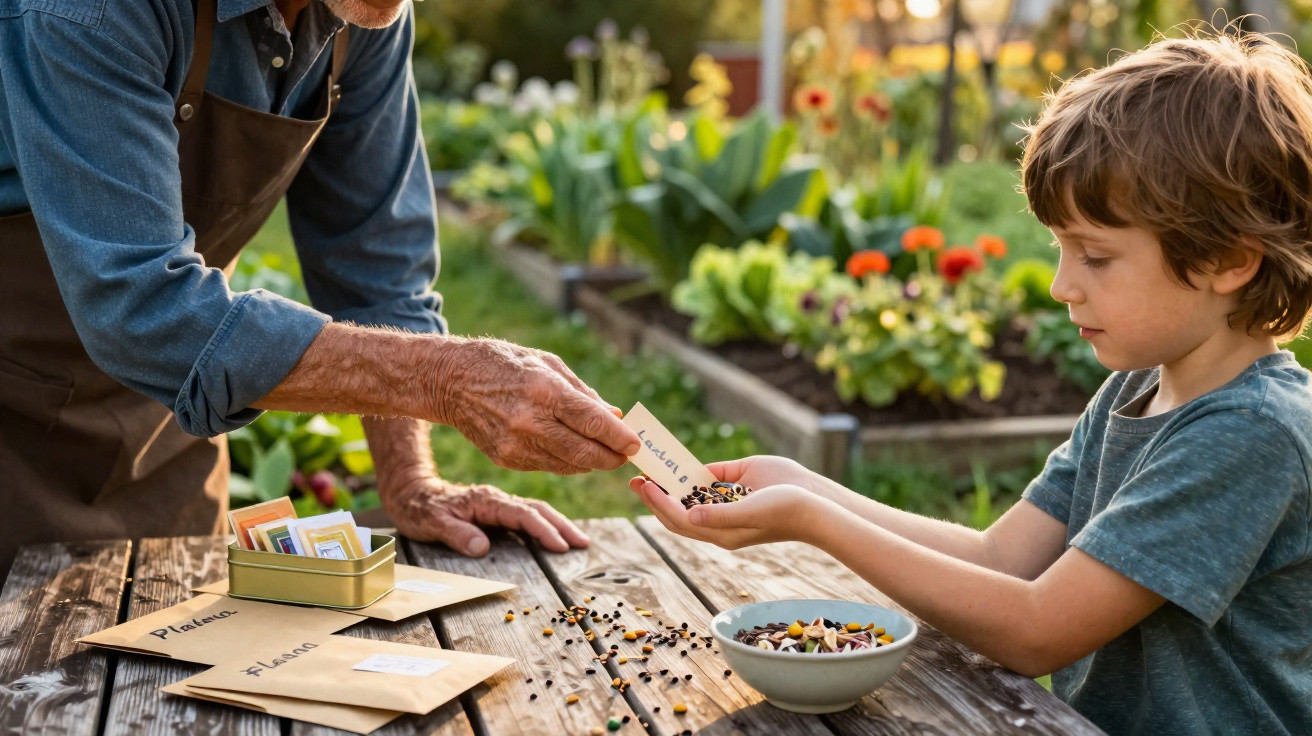
In the shed, the chatter of brittle pods sounded like rain striking a corrugated roof. She squatted between lines of peppers and beans, deciding which plants would be allowed to speak again next year. The sun was dropping, staining the foliage with a golden bruise. I watched her ease a seed loose with her thumbnail and slip it into her pocket, the way you might tuck away a phone number you can’t bear to mislay. She took her time. She read the plants through her fingertips. A blue jay barked from the maple and, for a beat, the whole plot held its breath. Without lifting her head, she smiled and said seed-saving was more than being careful with money. It was stubborn love in a world that won’t sit still. Then she closed the bag with a soft breath you could nearly hear. She was banking time.
When a seed carries a family’s backbone
Rosa-fifth-generation gardener, first-generation homeowner-says she learned seed saving by paying attention to who made it through a rough year. “The healthiest plants cast the longest shadows,” she likes to joke, tapping a pod against her palm. In her garden, resilience isn’t a catchphrase. It’s the bean that still bloomed after the August heat dome, the tomato that kept its sweetness through a month of strange rain. Keeping seed from those standouts isn’t stockpiling; it’s choosing what you want your soil to remember. In two quick lines, the point lands with the weight of a spade: seed-saving is one way a family teaches strength to travel.
Her grandfather carried a small stash of pole beans through three flats and one border, wrapped in cloth and stories. First they climbed a fire escape, then a borrowed back garden, and now they’re here-where Rosa’s children pull pods straight from the vine and crunch them with green, grassy grins. Some summers were brutal-too hot, too wet-yet the beans kept improvising. “They got tougher because we asked them to,” she says. One seed turns into a dozen, then a jar, then a bowl on the table. In this house, time is counted with forks and plates, not dates.
There’s a steady logic underneath the tenderness. When you save seeds from plants that succeeded in your particular patch-your wind, your shade, your erratic watering-you’re doing small-scale evolution in a jam jar. The traits that helped this season are more likely to show up again next season. A garden isn’t an exhibition; it’s a workshop. The process is slow, plain, and truthful: slice a dozen fruits, keep the best, label the jar, do it again. That’s how resilience stops being a vague idea and becomes something you can actually cook.
How resilience gets packed into an envelope
Rosa’s approach is refreshingly straightforward. She saves from the strongest plants, not merely the largest fruit-no leaf spotting, no sulking, no odd tastes. With tomatoes, she scoops the seeds into a jar with a splash of water, lets them fizz for two days, then rinses and dries them on a plate until they crackle like paper. Beans and peas finish drying in their pods; she waits for the rattle. Peppers are cut open, the seeds coaxed out, then dried on a coffee filter that catches every last speck. After that, each batch goes into a coin envelope marked with the date, the variety, and a tiny note: “Late but tough,” “Sweet under stress.” Science, spoken with a human accent.
She also keeps a slim notebook for the oddities-unexpected colours, late blight, that one cucumber that tasted like a raincloud. The notebook and the envelopes sit together in a shoebox on a wardrobe shelf: cool, dark, and low-tech, like a small vault. A few salt packets help keep moisture down. She avoids zip bags unless she’s absolutely certain everything is fully dry. And, honestly, nobody manages this perfectly every day. Habits come in bursts. We’ve all had the moment a frost alert pings your phone and you dash outside in pyjamas. The aim is simply to care enough to start again tomorrow.
On her potting bench, a line is taped beneath the twine: This is how you teach the future to recognise you. Rosa doesn’t say it to sound lyrical. She repeats it because it proves itself in her hands as much as in her head. Strong parents tend to yield sturdier offspring-plants and people alike-and choosing them becomes a quiet family ritual. She chuckles at the fantasy of perfection and reaches for the habit instead. The habit fits neatly inside envelopes.
“I save seeds from plants that showed up when I needed them,” Rosa says. “That’s what resilience looks like in a kitchen.”
- Pick from the top 10–20% of plants: vigour, flavour, disease resistance.
- Dry until the seeds are bone-dry; brittle beats bendy.
- Store them cool, dark, and clearly labelled, as if you’re writing to your future self.
- Swap with neighbours to diversify your gene pool and your recipes.
- Jot small notes: drought, flavour, pests. Patterns start to show.
The quiet social life of saved seed
Seed-saving puts backbone into more than a single household. In community gardens, leftover corners of envelopes become a kind of currency. A neighbour turns up with chilli seeds that didn’t flinch at last year’s heat. You pass along squash that shrugged off powdery mildew like a polite refusal. The trade is equal parts story and genetics. That’s one way local varieties come into being-through swapping small victories. As a city’s climate shifts, envelopes adjust faster than policy ever does. Resilience becomes a community habit long before it becomes a headline.
There’s comfort in the ritual, too. When life scrolls by at 145 km/h, this is one slow action you can still trust. You don’t need fields. A balcony and a handful of tomato seeds are enough to feel the thread stretching behind you and ahead. You can taste last summer in February. You can imagine next summer while you rinse the jar. The practice gives you time you can hold between finger and thumb.
Saving seed from your healthiest plants feels like practical magic. It answers a nagging question-what can I hold on to, gently, that also holds on to me? Rosa waves away the grandeur and returns to the bench, the paper plates, the soft hiss of beans dropping into a jar. Each envelope is a small wager that tomorrow will want what thrived today. And if tomorrow asks for something else, well, you’ve been paying attention. The hand that slips a seed away is the same hand that knows how to open.
Think about the moments that stitch your life into a line: a flavour you can’t shake, a plant that refused to give up, a shared meal that quietened a room. Seed saving is one way to stop those moments sliding away. You don’t have to become a pioneer. Choose one lettuce that didn’t bolt in August and keep its seed. Swap two teaspoons of squash seeds at a neighbourhood exchange; meet a new friend by the car park. Tell the story of a pepper that stayed sweet after the heat. Stories spread faster than pests. An envelope invites the handover, the way a tune asks for harmony. Maybe you’ll add a tiny note-“Held on in the wind,” “Grandma’s,” “Tastes like sun.” The future reads it. The plant reads it. You read it next spring and remember what you’re made of.
| Key point | Detail | Why it matters for the reader |
|---|---|---|
| Select the survivors | Save seeds from plants that thrived in your exact conditions | Builds local resilience you can taste and trust |
| Dry and label like a pro | Bone-dry seeds in paper, dated notes, cool and dark storage | Preserves viability and your hard-won knowledge |
| Swap to evolve | Trade with neighbours and seed libraries to broaden genetics | Adapts faster to shifting weather and enriches your plate |
FAQ
- How long do saved seeds stay viable? It varies by crop and storage. Beans and peas often sprout well for 3–5 years, tomatoes for 4–6, squash can push longer. Cool, dry, and dark conditions stretch those numbers.
- Can I save seeds from hybrid plants? You can, but the offspring may not match the parent. For reliable traits, focus on open-pollinated varieties. For curiosity and surprise, hybrids can still teach you things.
- What’s the simplest crop for beginners? Beans, peas, and peppers. They’re easy to dry, simple to clean, and forgiving. Tomatoes are next-just add a quick fermentation step.
- How do I avoid cross-pollination? Grow one variety of a crop at a time, add space between varieties, or bag blooms. For tomatoes and beans, crossing is rarer; for squash and corn, give them distance.
- Do I need special gear? Not really. Envelopes, a pen, a plate for drying, and a cool shelf. A notebook helps you remember which plant earned the envelope. The rest is attention and a little patience.
Comments
No comments yet. Be the first to comment!
Leave a Comment