
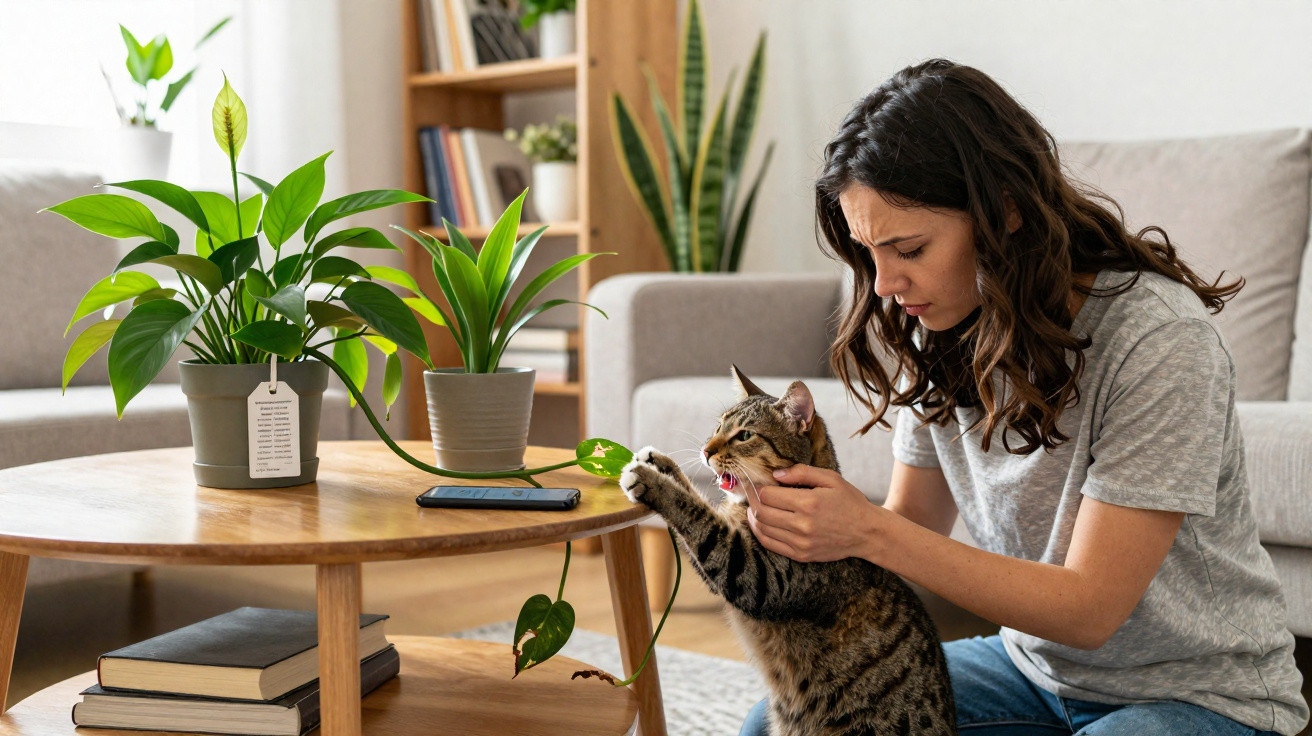
Some of the most Instagram-ready houseplants can do real harm to a curious cat. Vets say it isn’t only the headline villains like lilies: plenty of everyday, “easy-care” favourites that sit on bookcases and coffee tables can cause serious illness. The trouble often starts with a single exploratory bite.
I was at a friend’s flat when her tabby, Miso, discovered the trailing vine by the window. He investigated the way cats do-straight in with his mouth-treating it like a new toy or a piece of string that might move.
Half an hour later he was drooling, pawing at his face, and suddenly unnervingly subdued. The vine-pothos-looked completely innocent in its shiny terracotta pot, the sort you pick up without a second thought. We drove through weekend traffic to the out-of-hours vet, the pot on the passenger seat like evidence.
In the waiting room, everyone seemed to know lilies are dangerous. Hardly anyone had heard that pothos or ZZ plants can be a problem. The vet didn’t bat an eyelid; she sees cases like this constantly. The leaves were glossy. The risk wasn’t.
Tiny leaves can still mean big trouble.
The stealth hazards in everyday houseplants
Vets routinely flag a surprisingly long list of plants that many people keep in plain sight. Pothos, philodendron, peace lily, monstera and dieffenbachia can look lush, tropical and “safe”, yet their leaves contain needle-like crystals that can burn a cat’s mouth. Dracaena and snake plant contain saponins that commonly trigger vomiting.
Even plants sold with a wellness halo, such as aloe, can leave a cat feeling sick. Asparagus fern can irritate the skin. If enough is eaten, kalanchoe flowers may interfere with heart rhythm. And then there’s the dramatic one: the Sago palm (Cycas revoluta), a popular tabletop accent that can cause liver failure from a single seed.
It’s easy to overlook the common thread. Many of these plants are marketed as forgiving and low-maintenance. They cope with low light, recover after being left dry, and end up on shelves right at paw height. Cats, meanwhile, explore the world with their mouths. Once someone points it out, the logic is hard to unsee.
There’s a scenario vets describe again and again. A family arrives with a cat that “only licked” a trailing vine-often pothos or philodendron. The cat is drooling, gulping repeatedly, and trying to rub away the pain. Insoluble calcium oxalate crystals-known as raphides-act like microscopic needles, embedding in the tongue and gums and causing pain and swelling.
The ASPCA’s poison control service (APCC) takes hundreds of thousands of calls each year, and plant exposures make up a consistent portion of those emergencies. What stands out isn’t the rare exotic; it’s the ordinary houseplant. The ZZ plant (Zamioculcas zamiifolia), loved for being “unkillable” and shiny, can cause the same mouth pain and gastrointestinal upset seen with philodendron.
Then there are the surprises most people don’t clock. String of pearls (Curio rowleyanus) looks whimsical on a shelf but can lead to drooling, vomiting and lethargy. Jade plant may cause unsteady, wobbly walking. Cyclamen tubers-the knobbly roots cats often dig for-contain stronger toxins than the leaves. The packaging may look friendly; the chemistry is indifferent.
So why do cats chew leaves in the first place? Vets point to boredom, texture-seeking, and a bit of biology. Some cats seem to want roughage in the same way we crave a crunchy snack. They test, then either learn-or don’t. A few become repeat offenders, while others are put off after one unpleasant taste.
Plants evolved chemical defences, and we bring those defences indoors. Calcium oxalate crystals can cut like glass fibres. Saponins can foam and upset the gut. Cardioactive compounds in kalanchoe and some bulbs can stress the heart. Lilies-true lilies and daylilies-sit in a category of their own: even tiny exposures can risk acute kidney failure.
What catches people out is how closely this overlaps with home décor. Big-box shops display plants next to candles and photo frames, not next to medicine cabinets. A plant reads as a “vibe”, not a hazard-until you realise your living room has become a problem you need to solve quickly.
What vets say to do next-and how to plant smarter
If you spot your cat nibbling, take the plant away and pick up any fallen leaves. Wipe the mouth gently with a damp cloth or let a slow trickle of water run for them, then offer a small drink. Take a clear photo of the plant and any label, and call your vet or a poison hotline (ASPCA APCC: 888-426-4435; Pet Poison Helpline: 855-764-7661). Don’t give food, milk, charcoal or peroxide unless your vet specifically tells you to.
The two most useful details are timing and identification. Record when the bite happened and roughly how much seems to be missing. Keep an eye out for drooling, pawing at the mouth, vomiting, lethargy, hiding, or any change in breathing. With lilies and sago palm, treat it as urgent even if your cat appears fine-early treatment can be the difference between a fright and a full-blown crisis.
Prevention begins at the point of purchase. If the name includes philodendron, pothos, dieffenbachia, spathiphyllum (peace lily), Zamioculcas, dracaena, kalanchoe, ficus, or sansevieria, treat it as a risk. Consider cat-safer alternatives such as calathea, parlour palm, areca palm, pilea, African violet, haworthia, echeveria and prayer plant. Add height (vertical distance), use closed terrariums for small specimens, and rotate in fresh cat grass so your cat has a permitted, gentler chew.
Realistically, nobody manages that perfectly every day. Life gets busy, shelves get rearranged, and a trailing vine slips off its hook. What helps is putting a few habits in place that still work on a chaotic Tuesday. Label plants with their Latin names. Keep the truly toxic options behind glass, behind a door, or simply out of the house.
Don’t put your faith in bitter deterrent sprays; many cats ignore them or learn to tolerate the unpleasantness. Don’t assume “my cat never jumps up there”-they will the day a moth lands. And don’t assume succulents are automatically safe. Jade, aloe, euphorbia and desert rose all carry risks. Swap or secure those, and use safer lookalikes where you can.
One emergency vet summarised it bluntly:
“The best emergency is the one we never meet. If you love your plants and your cat, curate your jungle like a museum.”
- Quick safer swaps: philodendron → calathea; pothos → hoya; snake plant → cast-iron plant; jade → peperomia.
- Containment ideas: wall-mounted shelves with lip rails, hanging planters above non-climb zones, glass-front cabinets, and cloches for small pots.
- Enrichment for cats: grow cat grass and catnip, add puzzle feeders, and play bird videos to redirect plant-hunting energy.
- Write it down: tape the plant’s botanical name under the pot for fast ID in a pinch.
- Emergency card: vet number, poison hotline, plant list, and a ride plan ready by the door.
A greener home that still loves cats
Plants and pets can share a home without constant drama. It just takes a bit of curiosity-the same trait that gets cats into trouble-to rethink how a room is set up. Place risky showstoppers where your cat can’t launch an ambush. Create a small “safe texture” station near a bright window, and many cats will choose that option instead.
It also helps to adjust how you think about houseplants. They aren’t only decoration; they’re chemistry packaged as leaves. Once you see it that way, you start checking labels, asking for Latin names, and moving the peace lily to your office rather than the snug. Your home can stay lush, and your cat can stay confident.
Plant trends come and go. At the moment, big-leaf aroids and sculptural succulents dominate the feed. Perhaps the next wave is glass cabinets, airy shelving and intentional safe-lists-practical, a touch nerdy, and genuinely stylish. Cat-proof can still look beautiful. Pass your safe-list to a friend and you make more than one household safer.
| Key point | Detail | Why it matters to the reader |
|---|---|---|
| Hidden risks in common plants | Pothos, philodendron, ZZ, dracaena, jade, string of pearls, and more | Helps prevent surprise emergency vet visits from “easy-care” favourites |
| What to do after a nibble | Remove plant, rinse mouth, document, call vet/poison line | Clear step-by-step actions that buy time and reduce uncertainty |
| Safe-looking swaps | Calathea, parlour palm, prayer plant, peperomia, haworthia | Keeps the indoor jungle while protecting the cat |
FAQ:
- Are orchids safe for cats? Most orchids sold for the home (Phalaenopsis, Dendrobium) are considered non-toxic to cats, though nibbling can still upset the stomach.
- How much plant is “too much”? For lilies and sago palm, any amount warrants urgent care. For oxalate plants like pothos, even a small bite can hurt and swell the mouth, so call your vet to assess.
- Which succulents are risky? Jade (Crassula), aloe, euphorbia, and desert rose can cause vomiting or worse. Safer bets include haworthia and echeveria.
- What symptoms should I watch for? Drooling, pawing at the mouth, vomiting, diarrhoea, lethargy, loss of appetite, wobbliness, or changes in breathing or urination.
- How do I identify my plant fast? Keep nursery tags, label pots with botanical names, and snap clear photos. Identification apps can help, but a tag plus a photo is gold in an emergency.




Comments
No comments yet. Be the first to comment!
Leave a Comment