
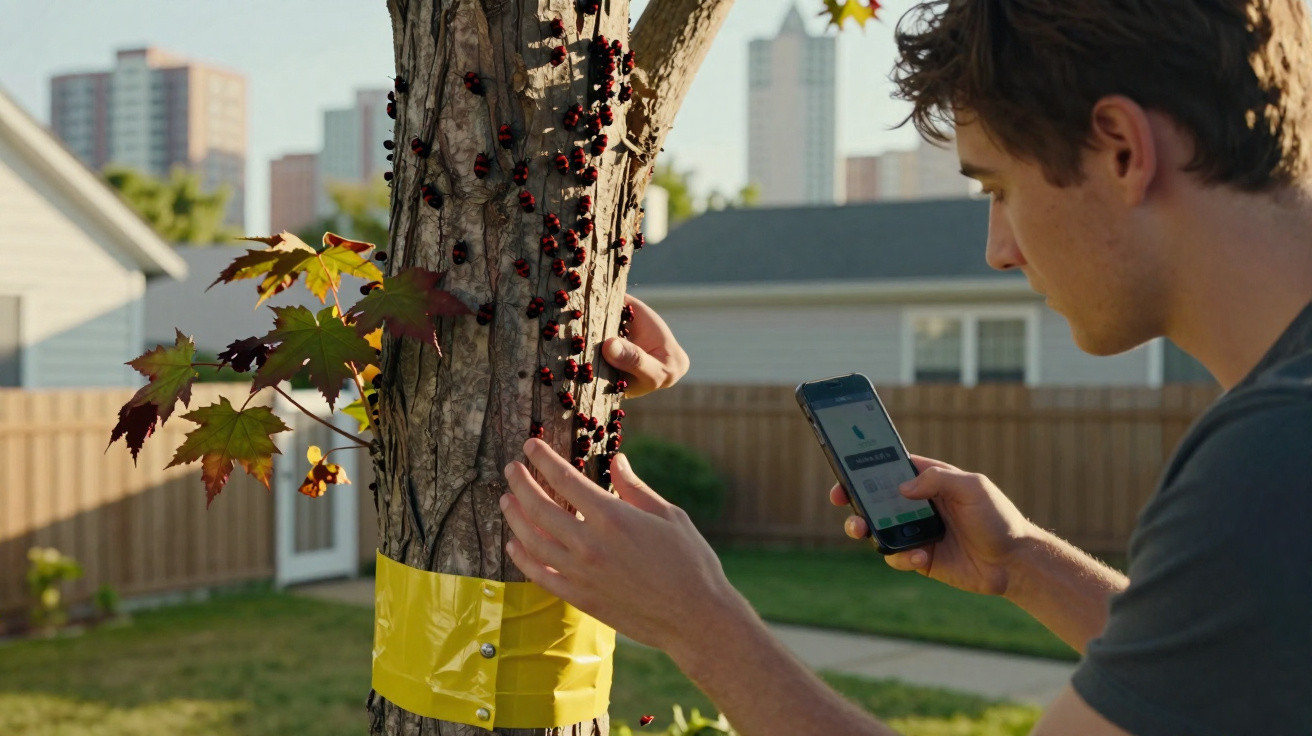
Across the eastern United States, spotted lanternflies are advancing at speed, leaving residents puzzled and putting vineyards, orchards and forests under pressure. A new study suggests their edge may come from an unexpected place: life in China’s cities, where harsh urban conditions may have shaped their genomes for modern city living - and helped set them up for rapid spread overseas.
From ornamental oddity to multistate menace
Despite its name, the spotted lanternfly (Lycorma delicatula) is not a true fly. It is a planthopper that punctures plants with a needle-like mouthpart and drinks sap. The species originates in China and has already expanded through South Korea and Japan. In the United States it was first detected in Pennsylvania in 2014, and it has since been recorded in at least 19 eastern states.
One of its preferred hosts is the tree of heaven (Ailanthus altissima) - itself an invasive plant that thrives along roadsides and in neglected urban corners. But the lanternfly is highly adaptable in what it will feed on, and it also targets grapevines, hops, maples, apples, stone fruit trees and valuable hardwoods.
That broad appetite turns a pretty insect into a serious economic threat, especially for wine, fruit and timber producers.
The damage is not limited to sap loss. While feeding, lanternflies release a sugary waste called “honeydew”, which can coat leaves as well as decks, cars and garden furniture. This residue promotes sooty mould, a black fungus that reduces the light reaching leaves and can make produce more difficult to market.
The knock-on effects can even reach beekeeping. Bees sometimes collect honeydew in place of floral nectar, producing honey with a smoky flavour and an unusual aftertaste. It remains safe to eat, but it is not what most buyers expect.
Economic modelling from a 2019 analysis indicated that, without effective control, spotted lanternflies could cost Pennsylvania alone roughly $324 million per year through crop losses, management expenses and trade-related impacts.
Clue to an invasion: urban evolution in Shanghai
To find out why lanternflies appear to be adapting so successfully in North America, scientists examined populations within the insect’s native range and compared them with samples from the United States. They analysed genomes from lanternflies collected in:
- urban Shanghai, China
- rural areas around Shanghai
- New York City
- Connecticut
- New Jersey
The study, published in Proceedings of the Royal Society B, uncovered a pronounced pattern in China: lanternflies living only 30 kilometres apart - one group in densely built Shanghai and another in the surrounding countryside - were genetically distinct.
Although lanternflies can fly, their flights are typically short. Because they rely on ready access to host trees, they tend to remain close to suitable patches of vegetation. That limited movement allows neighbouring populations to diverge genetically over relatively short timescales.
Shanghai’s city lanternflies had evolved a package of genetic tweaks that made them better at surviving heat, pollution and chemical exposure than their rural cousins.
In particular, the urban insects showed stronger capacity to withstand high temperatures and to detoxify and metabolise a variety of toxins, including pesticides. The combination of concrete, pollution and heat associated with one of China’s largest cities appears to have functioned as an evolutionary proving ground.
From Chinese streets to US backyards
When the researchers looked at US populations, the picture was different. Lanternflies sampled in New York, New Jersey and Connecticut were genetically similar, even where collection sites were more than 200 kilometres apart.
Importantly, many of the same genes that had shifted in Shanghai’s city population also displayed signals of adaptation in the US insects. In other words, traits shaped in Chinese megacities seem to have travelled abroad and then been further refined in American environments.
Using demographic modelling based on the genomic results, the team inferred three major “bottlenecks” in recent lanternfly history - moments when new populations were established by a small number of founders:
| Approximate date | Event | Significance |
|---|---|---|
| ~170+ years ago | Rapid urbanisation of Shanghai | Urban populations adapt to heat and pollutants |
| 2004 | Introduction to South Korea | Spread beyond China begins |
| 2014 | First confirmed US records in Pennsylvania | Likely arrival via international trade |
Each bottleneck involved a small founding population - but, crucially, one that seems to have already carried traits forged in urban conditions. By the time lanternflies arrived in the United States, they may have been pre-adapted to hot, polluted environments where chemical control is common.
Why US cities are such comfortable landing pads
Many US cities, unintentionally, provide an ideal launch point: warmth, disturbed habitats and abundant host plants. Urban heat islands push city temperatures above those in nearby rural areas. Air and soils can contain complex mixtures of pollutants. At the same time, tree of heaven is widespread along rail corridors, vacant lots and motorway verges.
Fast-growing tree of heaven gives lanternflies their first foothold; city-hardened genes help them hold it.
Ecologists suspect this combination makes it easier for lanternflies to establish on tree of heaven and then shift onto more economically important hosts. Genes associated with chemical detoxification may also help them handle natural plant defences when switching hosts - not only the synthetic pesticides used in control programmes.
That may help explain why lanternflies are moving so quickly through vineyards and orchards even where management is underway.
What new genetics research means for control efforts
These genetic findings have practical implications, not just academic value. They could influence how agencies, growers and landowners approach control over the coming years.
- Smarter insecticides: Identifying genes that enable lanternflies to break down toxins may help guide the selection or development of chemicals that are harder for them to resist.
- Better resistance management: Authorities can limit repeated use of products that rely on the same detoxification pathways, reducing the speed at which pesticide resistance evolves.
- Targeted strategies: Genetic markers may eventually allow teams to trace the sources of new outbreaks and determine whether they are linked to city-adapted lineages.
The wider takeaway is that urbanisation and biological invasions are closely connected. Cities are trade hubs, but they can also be arenas where invaders evolve key traits before they ever cross borders.
What homeowners and growers are facing on the ground
For people living in affected states, the research matches an everyday experience: masses of insects hopping across tree trunks, sticky honeydew coating outdoor surfaces, and public campaigns urging residents to kill lanternflies on sight.
Many state agencies encourage the public to:
- scrape egg masses from outdoor surfaces in winter and early spring
- check vehicles and firewood before travelling out of infested zones
- report sightings, especially in new counties or states
In agricultural areas, vineyard owners and orchard managers are trying out nets, traps and carefully timed sprays. For growers, even relatively small drops in lanternfly numbers during critical stages of the season can make a meaningful difference to yields.
Key terms and ideas worth unpacking
Genetic bottleneck: This occurs when a new population is founded by only a small number of individuals. Much of the original genetic diversity disappears, while traits present in the founders can become common simply by chance. When those traits include city-hardened genes, an invasive population can expand very quickly.
Detoxification genes: Many insects have groups of genes that help them process toxic substances. These can include plant-produced chemicals, pollution and synthetic pesticides. When evolution amplifies or alters these genes, insects may tolerate doses that previously would have been lethal.
Future scenarios: where this invasion could go next
Two broad possibilities emerge. If control remains inconsistent and conditions continue to warm, lanternflies could spread further into the Midwest and New England by tracking suitable host plants and major trade routes. Urban-adapted traits would probably support survival through hotter summers and intermittent pesticide pressure.
Alternatively, if regulators use the new genetic evidence to sharpen chemical control, and if inspections of traded goods and public reporting become more robust, expansion could be slowed and kept largely to the eastern seaboard. That would not eliminate lanternflies from the United States, but it could substantially reduce the financial burden on agriculture.
Either way, the spotted lanternfly is becoming a clear example of how city environments can shape an insect well before it reaches a new continent. Urban evolution, it seems, does not remain confined to the city where it starts.






Comments
No comments yet. Be the first to comment!
Leave a Comment