
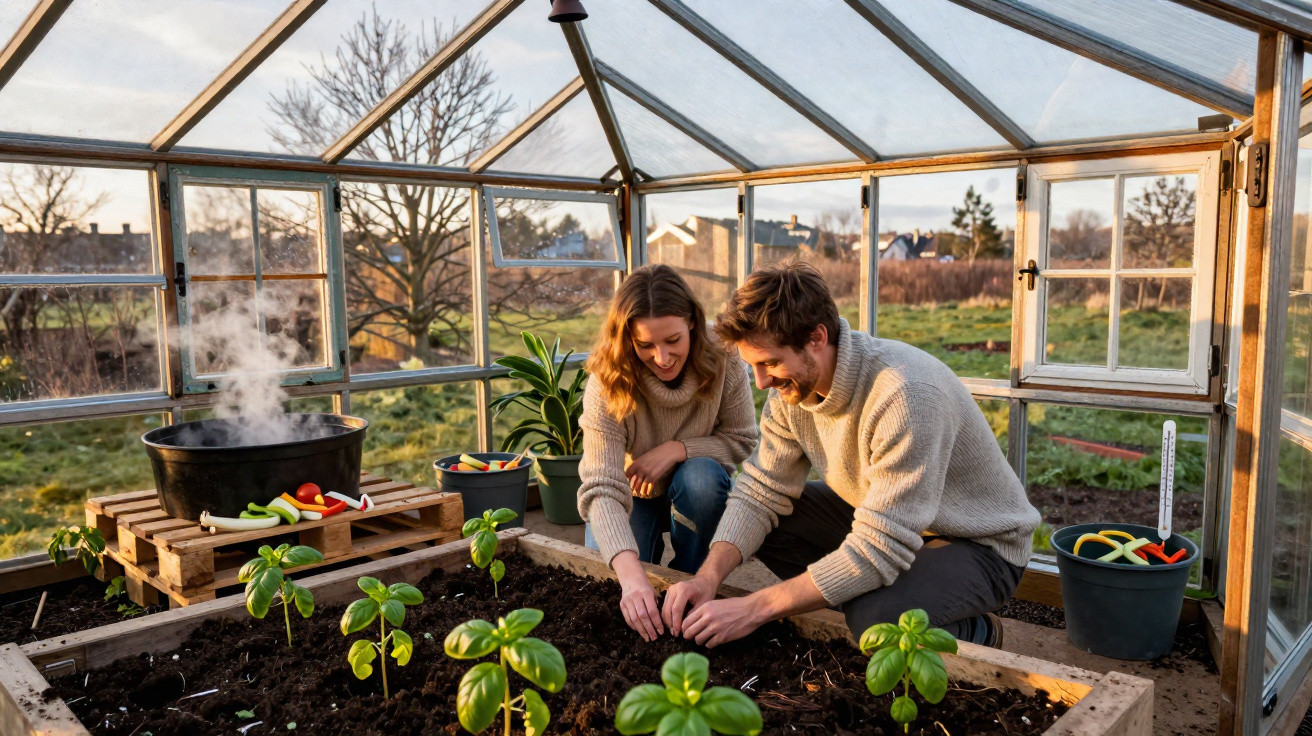
In Denmark, a couple have quietly found a way to take the edge off winter: a greenhouse that heats itself using compost, wrapped in a patchwork skin of recycled windows. It doesn’t buzz like a gadget. It feels more like a living thing.
On a leaden January morning in northern Jutland, Mikkel eases open a door made from a former stable window. A shy but constant wave of warm air spills out. Inside, daylight filters through a jumble of panes-some still faintly marked with old paint from earlier lives. In one corner, cherry tomatoes colour up. Mint grazes your sleeve, releasing that crisp, forgiving scent.
Freja reaches for a small gauge tied up with twine. The compost core is holding at around 58°C, and it’s feeding warmth into a coil hidden within a bench. You catch a soft, steady drip, drip, drip as condensation tracks down the glass and finds its way into a gutter. There’s a lemon sapling, a chair with a film of rust, and the quiet shuffle of leaves. The warmth feels alive.
A greenhouse that runs on leftovers
From the garden it looks like something half-remembered, made solid. A straightforward timber frame leans towards the low southern sun. The walls glitter with salvaged windows of every imaginable size-a quilt of glass stitched together. When the wind rises, the panels tap gently, as though the building is clearing its throat.
Cross the threshold and the atmosphere changes at once. The air is steadier and softer-typically about ten degrees warmer than the yard on winter days. There’s no heater growling away, and no cable vanishing into the soil. Instead, the heat comes from microbes working through plant offcuts and sawdust in a compost core, turning scraps into warmth. A small pump then moves that heat through a loop running behind the growing beds.
They haven’t discovered new physics; they’ve adapted old know-how-plus an idea associated with the French forester Jean Pain, who famously warmed water using enormous compost mounds. In greenhouse form, the concept becomes compact and manageable. Give the pile the right balance of carbon, nitrogen, air and moisture, and it produces a consistent, gentle heat for months. Not sauna-level. More like pulling on a jumper.
Two people, many windows, one steady glow
Their build began with a stroke of luck: a school due for renovation. The contractor was happy for them to take a stack of old windows-so long as they shifted them quickly. Over three evenings they sorted through frames, matched up latches, and laughed at panes etched with children’s names. Back at home, they cleaned, re-glazed and piled them up, turning the garden path into a skyline of second chances.
The heat source came together through neighbours and friends. A riding stable supplied horse manure and straw. A sawmill passed on bags of wood chips. They chopped kitchen scraps, added dry leaves, and formed a compact core about two metres across and one and a half metres tall. During the first week, their probe read 60°C and then stayed above 50 for most of the winter. One night the outside temperature sank to -6°C; inside, it sat at 7–10°C. The leafy greens carried on regardless.
The specifications are modest and matter-of-fact. The heat exchanger is roughly 100 metres of PEX hose, tucked behind a bench and linked to a shallow tank. The circulation pump uses less electricity than a phone charger. Thermal mass-water barrels and stone pavers-stores daytime heat and releases it overnight. Ventilation is handled by a vent at the apex and a low louvre near the floor, keeping air moving without stripping away warmth. It isn’t magic; it’s good sequencing.
What they did, and what you might replicate
First, they chose a spot where winter sun actually reaches: south-facing, with no large trees cutting off light in the cold months. The roof pitch sits at roughly 35–40 degrees to make the most of the low sun. A simple foundation using reclaimed brick supports a timber frame, sealed with tape and a bead of silicone. The windows were laid out by size-larger panes lower down, smaller ones above-like scales.
The compost core sits in a sturdy box lined with wire mesh, plus perforated pipe to keep air moving through the mix. They use a 3–4 m³ blend: approximately two parts carbon (dry leaves, chips, straw) to one part nitrogen (manure, green waste). Water is added until it feels like a wrung-out sponge. A coil loop runs along the rear of the growing bench and circulates to a small insulated tank. That moment when a project feels too big is familiar; this one becomes possible as soon as you bring home your first pane.
Did they get everything right first time? Not entirely-and they’ll tell you with a shrug. Their first pile was too wet and lost momentum. Condensation collected in pools until they fitted a basic gutter. They also discovered it’s better to overlap frames rather than butt them flush, so the wind can’t find a gap to whistle through. Let’s be honest: nobody nails that kind of detail every day.
Tips, traps, and quiet wins
Hot compost that actually produces heat has a rhythm to it. Their layers are kept thin rather than bulky: a hand’s width of carbon, a hand’s width of nitrogen, then water-repeat. Every few days, a fork is worked through to pull oxygen into the core without ripping it apart. The first fortnight is the peak; from weeks three to eight, the pile settles into a reliable, steady output that keeps the greenhouse comfortable.
They pay attention to moisture as much as temperature. If the pile smells sharp or sour, it needs more air and additional dry material. If it goes dusty and sluggish, it’s asking for water and green scraps. They steer clear of treated timber, choose exterior-grade screws, and split tasks into short sessions so the build stays manageable. On the coldest night, they listened for the pump and felt oddly comforted by its tiny pulse.
They also learned to speak to the people around them-the stable, the sawmill, the school caretaker. In the end, warmth turns out to be a community project in disguise.
“The heat is free only if the relationships are warm too,” Freja said, half-joking, brushing soil from her palm.
- Core recipe: 2:1 brown to green, by volume, layered by hand.
- Window tip: overlap the frames and add felt tape where they meet.
- Vent rule: a small adjustable top vent and a small adjustable bottom vent.
- Thermal mass: water barrels along the north wall, kept shaded.
- Maintenance: five-minute checks, not heroic overhauls.
A small experiment with big weather
This greenhouse won’t fix the climate, but it does change the feel of a back garden. It creates a place where winter seems smaller, where salads make it through the darkest months, and where household scraps return as heat. The couple now grows tough greens, herbs, early strawberries, and a rather smug Meyer lemon that behaves as if latitude is somebody else’s problem.
There’s also a quiet point about scale here. Not every answer needs a smart thermostat or a glossy app. Some solutions are built with a shovel handle and second-hand glass. The microbes don’t require subscriptions; they just need air, water and time.
Around Europe, others are trying their own versions-in allotments, in school gardens, behind cafés swapping coffee grounds for winter spinach. The forms differ, but the principle stays the same. Heat can be grown. Comfort can be cultivated. It makes you look differently at what’s already on hand, waiting to be stitched back into the weather.
| Key point | Detail | Benefit for the reader |
|---|---|---|
| Compost as heater | Microbial heat at 50–65°C feeds a simple water loop | Warmth without a gas bill or noisy machines |
| Recycled windows | Patchwork glazing from schools and homes | Lower costs, higher charm, lighter footprint |
| Thermal mass and vents | Water barrels, stone, and small adjustable vents | Smoother temperatures and less condensation |
FAQ:
- Question 1 How does the compost actually produce heat? Microbes break down carbon and nitrogen, releasing energy as warmth. With enough air and moisture, a good mix can stay at 50–65°C for weeks.
- Question 2 Does a compost-heated greenhouse smell? Not if it’s in balance. A healthy pile smells like a woodland floor. Bad odours usually mean it needs more air and more dry material.
- Question 3 What does a build like this cost? When you use reclaimed windows and local waste streams, many people keep materials within a modest budget. The bigger “cost” is labour, spread across weekends.
- Question 4 How much maintenance does it need? About five to ten minutes a few times each week. Check moisture, add some air, and top up with small amounts of material. Full rebuilds are uncommon.
- Question 5 Can it scale to a larger greenhouse? Yes-either by adding multiple compost cores or by building a larger central core with more coil. As size increases, plan for extra ventilation and sturdier framing.




Comments
No comments yet. Be the first to comment!
Leave a Comment