
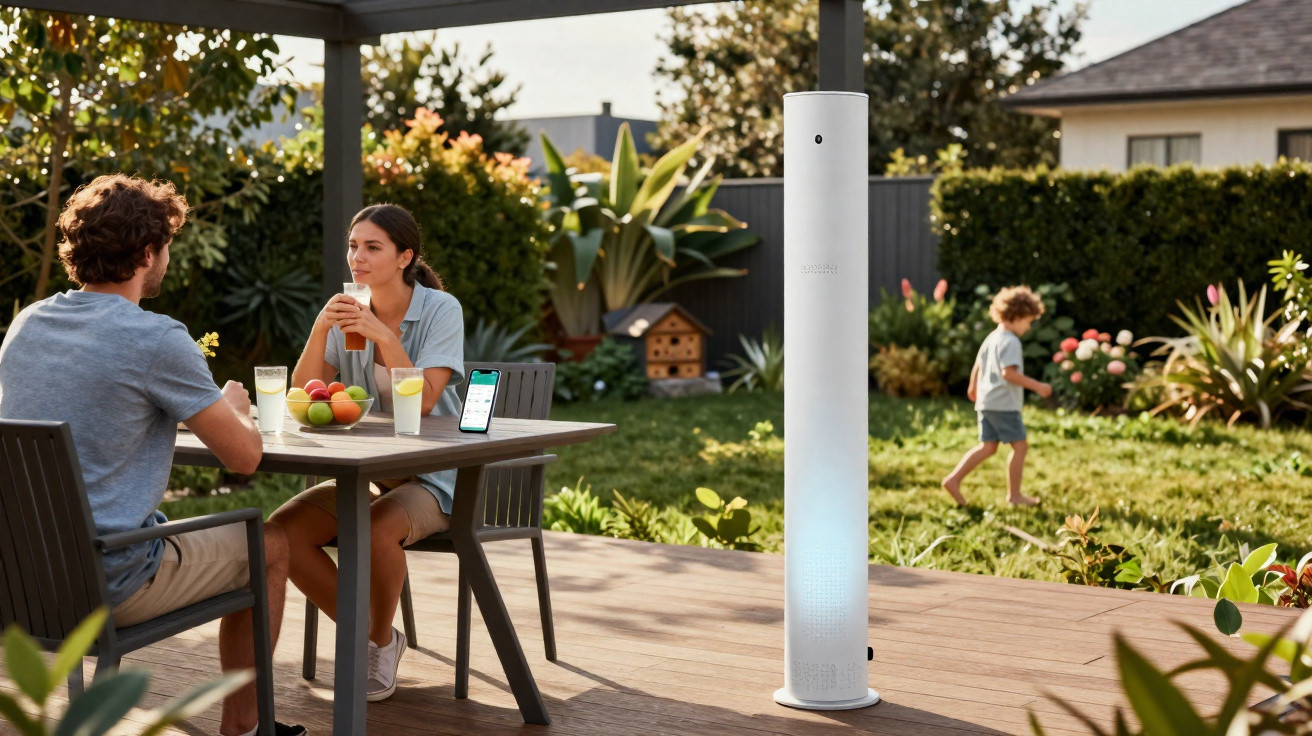
When the terrace calls, the mosquitoes usually arrive too.
A new French high-tech pillar is aiming to put a stop to the summer nuisance - no poison, no spray, just a lot of engineering.
As soon as the first warm days hit, many gardens see the return of aggressive biting mosquitoes that can quickly wreck an evening outdoors. The invasive tiger mosquito in particular is continuing to spread across Europe. A connected pillar called the I-Garden from the INYO brand claims it can clear up to 750 square metres of garden space of these pests - without using chemical insecticides.
How the high-tech pillar is meant to outsmart tiger mosquitoes
At the centre of the system is a method based on how humans attract mosquitoes. Tiger mosquitoes track targets largely via exhaled air and body odour - and that is exactly what this pillar exploits.
"The I-Garden simulates a human 'target': it imitates breathing and skin scent, drawing in mainly biting females."
According to the manufacturer, the process works in several stages:
- Release of CO₂ from bio-based cartridges to mimic human breathing
- Dispensing a specific blend of scents designed to replicate skin odour
- Luring primarily the bite-focused females, which need blood for egg-laying
- Drawing insects in through side openings using fans
- Holding the mosquitoes in integrated nets
The thinking is that, unlike many UV lamps that attract insects indiscriminately, the pillar aims specifically at tiger mosquitoes while leaving beneficial pollinators such as bees and butterflies as undisturbed as possible.
Why the effect does not happen overnight
Anyone expecting an instantly mosquito-free terrace will need a bit of patience. This pillar is intended to work more like a long-term treatment than an on/off switch.
The manufacturer describes it as a kind of "background treatment": if the unit is run early in the year, it should gradually catch enough females to disrupt the population’s breeding cycle. Each mosquito captured potentially removes several hundred eggs from the local area.
For noticeable results, experience with comparable systems suggests several weeks of continuous operation are usually required. Ideally, it should be started before mosquitoes appear in large numbers - meaning as early as spring.
Up to 750 square metres of coverage - controllable via an app
From a technical standpoint, INYO positions the I-Garden clearly as a premium device. One pillar is said to cover an area of up to 750 square metres - sufficient for many gardens, large terraces, or a small park-like space. For very large plots, multiple devices can be linked together.
Control is handled via Bluetooth and a dedicated app, which can be used to:
- adjust fan intensity depending on mosquito pressure,
- check operating status,
- keep an eye on maintenance prompts or refill levels.
The approach fits a wider move towards smart garden tech. Alongside robot mowers and automated irrigation, this could become another connected fixture outdoors.
A design piece instead of a plastic trap
Visually, INYO tries to stand apart from traditional insect traps. The I-Garden uses a steel body that also functions as a planter. Shrubs or flowers can partially conceal the technology, allowing the pillar to read more like a garden feature than a device.
"The anti-mosquito technology disappears inside the flower tub - if you didn’t know, you’d be more likely to mistake it for a design object than a defence system."
Even so, it is not without practical hurdles. The pillar needs a permanent power supply from the household mains. To place it in the best position - typically a slightly shaded spot, not right beside the seating area but offset somewhere in the garden - many people will need a weatherproof extension lead. For renters with a balcony or only a single outdoor socket, that can be a real sticking point.
Premium price and ongoing costs
The I-Garden is clearly pitched at the upper end of the market. The announced entry price is 990 € for the standard model. A "Pro" version is expected to cost 1.299 €.
| Model | Price | Target group |
|---|---|---|
| I-Garden | 990 € | Private gardens, terraces |
| I-Garden Pro | 1.299 € | Large gardens, hospitality, holiday resorts |
There are also running costs: CO₂ cartridges and scent refills must be replaced regularly. The manufacturer estimates two to three euros per day at full operation. If you run the pillar for around 120 days per season, that quickly comes to 240 to 360 euros per year in operating costs - before electricity.
What the system cannot do
The pillar will only be as effective as its surroundings allow. Standing water in rain barrels, plant saucers, gutters or buckets remains a perfect breeding site - especially if neighbours do not keep their properties consistently dry. In those situations, the surrounding area can keep replenishing the population.
It also will not solve last-minute scenarios at the press of a button, such as an impromptu barbecue after a thunderstorm and humid weather. If you only switch the device on once mosquitoes are already circling, you are unlikely to notice much at first.
Who the purchase could make sense for
Whether the investment pays off depends heavily on personal circumstances. The system seems particularly relevant for:
- homeowners with large gardens in regions where tiger mosquitoes are already a major issue,
- families with young children or people who react strongly to bites,
- hospitality venues with outdoor seating that want to improve guest comfort,
- holiday homes and campsites in affected areas.
If, on the other hand, you only have a small city balcony or live somewhere with very few mosquitoes, traditional approaches such as mosquito nets, fans, occasional spray or smoke coils will often be the better - and far cheaper - option.
What sits behind "biomimetic" mosquito control
Imitating natural cues to lure mosquitoes into traps has been one of the most interesting developments in this field in recent years. Researchers now understand fairly well how biting mosquitoes locate people: they combine CO₂ plumes, skin odours, warmth and humidity.
Technical traps often use a mix of these signals. The I-Garden focuses primarily on scent and carbon dioxide. In some regions, comparable systems are already deployed at a larger scale, for example at holiday resorts or along waterways. Effectiveness varies depending on population density, local conditions and consistent maintenance.
Environmental angle: less poison, more technology
A major advantage of devices like this is avoiding classic insecticides. Sprays and foggers distribute active substances that do not only affect mosquitoes but many other insects too - including pollinators. Residues can build up in soil and water.
The I-Garden avoids such poisons entirely. Instead, it relies on mechanical capture and bio-based CO₂. This significantly lowers the risk to pets, children and beneficial insects. On the flip side, the system needs electricity and consumes cartridges regularly - a different kind of resource use worth factoring into any decision.
Practical tips for a strong anti-mosquito package
If you want to tackle tiger mosquitoes seriously, it makes sense to combine any technical system with straightforward habits. Particularly effective measures include:
- weekly checks for standing water in the garden,
- covering rain barrels with fine mesh,
- changing water in plant saucers and bird baths,
- using fans on a terrace or balcony, as mosquitoes avoid air movement,
- wearing light-coloured, long clothing during peak season.
In places where authorities are already issuing tiger mosquito warnings, pairing these basics with a high-tech trap like the I-Garden could make outdoor summer evenings feasible again - without having to fog yourself in chemicals.






Comments
No comments yet. Be the first to comment!
Leave a Comment