
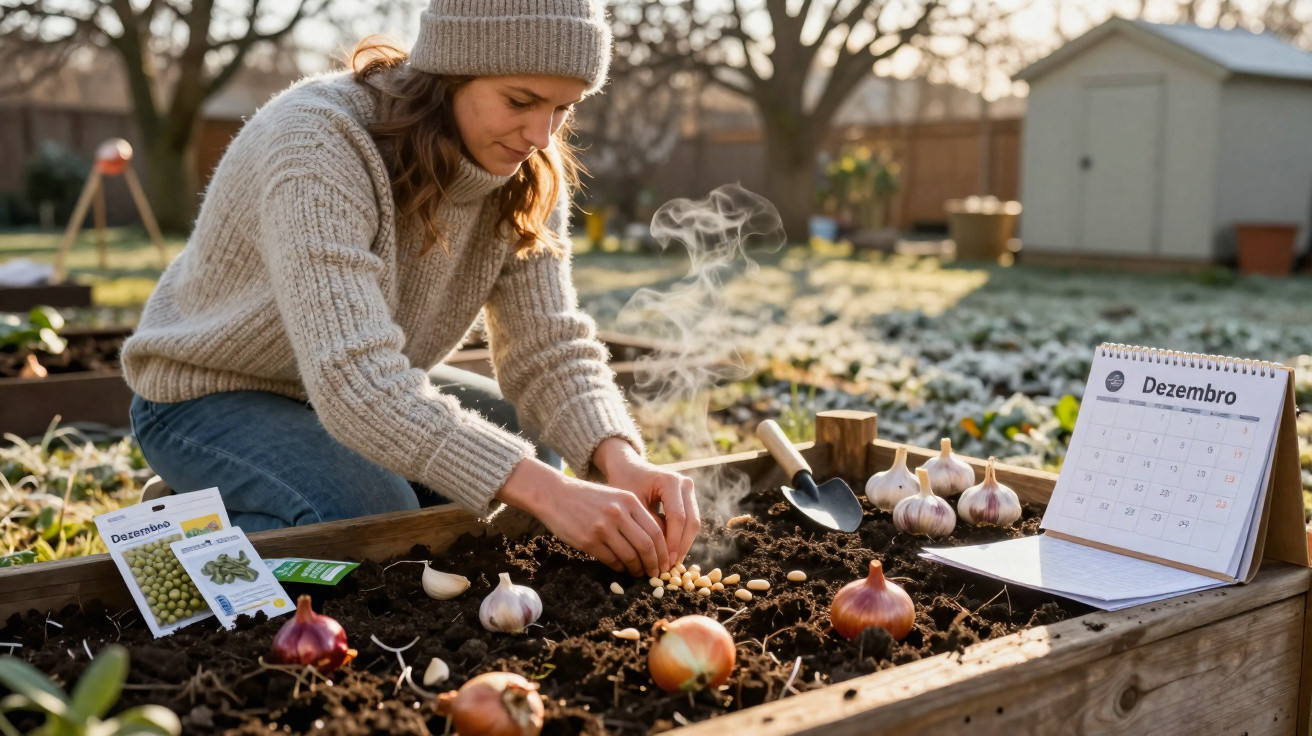
The allotment gates seem to bang that bit louder in December. People let go of the handles quickly, their breath clouds the air, and most pass the vacant beds as though the growing year has finished. At the fence, the same words are often heard: “I’ll get going again in spring.”
That is exactly how countless gardeners unknowingly give up a whole season of produce.
On a dull morning early in December, I saw an elderly pair spreading seed packets across their car bonnet: spinach, broad beans, garlic and onions. The neighbouring plot was immaculately weeded, with its tools neatly arranged, but it was entirely empty. No seeds, no young plants, nothing at all. Two very different responses to winter, right beside each other. One plot will be providing home-grown vegetables in March; the other will still be waiting.
December is not an inactive month. It is a hidden entrance.
The unseen winter race
British allotments have an unusual stillness in December. The usual question, “What are you sowing?”, becomes “See you in spring then.”
Yet, beneath the ground, the real competition has already begun.
As frost stings your fingers, seeds placed in cool, moist earth are steadily developing their roots. Broad beans demonstrate this particularly well. Sown in December, they establish strong root networks while slugs are inactive and blackfly has yet to appear. By May, those early rows can often reach chest height, whereas plants sown in April may still be finding their feet. The days are short above the soil, but below it is a full-scale building project.
Garlic and overwintering onions work in much the same way. Plant a handful of cloves or small sets, leave them alone, and allow winter to take on the hard work. It may appear that nothing is taking place, but the weather is effectively doing the work for free.
One figure regularly surprises beginner gardeners: many UK growers who sow broad beans, garlic and hardy lettuce in late autumn or December report harvesting three to six weeks ahead of neighbours who only sow in spring.
That is no minor advantage. It amounts to almost an extra month of fresh food.
Speak to experienced allotment holders and you will often hear the same understated claim: “These were in before Christmas.” A grower from Leeds once showed me two garlic beds: one planted in mid-December and the other in March. By summer, the December-planted bed had produced thicker stems and bigger bulbs. The soil and watering were identical. Only their approach to winter had changed.
A young couple on a small Bristol balcony tried a similar approach with salad crops. They sowed hardy winter lettuce and rocket in a planter beneath a basic plastic cloche. In early spring, as supermarket prices rose, they were picking bowl after bowl of their own leaves. Their friends assumed it had been complicated. They had simply started sooner.
Why, then, is December so important? The answer lies in timing and plant psychology. Plants do, after all, follow a form of rhythm.
Hardy vegetables including broad beans, garlic, onions, peas for shoots, spinach, lamb’s lettuce and certain winter lettuces are designed to cope with cold conditions.
When planted in December, they do not immediately race into leafy growth. Instead, they remain low, putting their energy into roots and small resilient stems while enduring the worst weather. Once daylight and warmth return, they already have a robust engine prepared for rapid growth. Sow identical seeds in March and they must build that engine while rushing towards flowering at the same time. There is less time and more pressure, resulting in smaller yields.
Pests are another unpredictable factor. Slugs and aphids move slowly in winter. Seeds sown now emerge into a calmer, less threatening setting. When pests become active, your plants are adolescents rather than toddlers. That distinction can determine whether you or the wildlife gets the crop.
What to sow in December and how to do it without freezing your fingers
Let us be practical. There is no need to turn your garden into a military campaign. A few sensible tasks, completed during short cold spells, are enough.
Begin with broad beans. Select a hardy variety, such as the classic Aquadulce Claudia, and sow into free-draining soil; use deep modules if the ground is waterlogged. Insert the seeds around 5–7 cm deep, space them roughly 20 cm apart, then cover them. Nothing more is required.
Garlic is simpler still. Separate bulbs into individual cloves, then plant each one pointed end upwards, 3–4 cm deep and about 10–15 cm apart. Firm the bed by walking gently over it.
For containers and compact spaces, choose deep pots or planters for winter-hardy leaves, including lamb’s lettuce, spinach, winter lettuce mixes and even peas grown only for shoots. A layer of fleece or a transparent plastic lid can transform a cold patio into a temporary mini greenhouse. Sow once, then let December, January and February handle the unexciting part.
Here is the reality that glossy gardening books rarely acknowledge: most of us are weary in December. Darkness falls at four, work parties accumulate and the sofa usually wins.
Your December sowing plan therefore needs to be achievable.
Choose one bed or perhaps two containers, rather than ten. Use one for broad beans and garlic, and perhaps another for winter salads. By doing that alone, you are already ahead of 80% of gardeners who mentally close down their plots until spring.
What commonly goes wrong? Seeds are sown into frozen, waterlogged clay, where they rot rather than establish roots. Tender varieties are used despite being unsuited to winter, and gardeners blame themselves when the plants struggle. Pots are left exposed to persistent winter rain until they become cold soup. The straightforward answer is to use raised beds or well-drained containers, with fleece or clear plastic during severe spells. If a hard frost is forecast, there is no need to stand outside heroically at midnight. Plants can tolerate plenty; they simply need a modest head start.
An older gardener in Norfolk once told me something memorable:
“I don’t sow in December because I’m clever. I sow then because I’m lazy. I want the soil to do the work while I stay indoors.”
There is something reassuring about that. This is not about pursuing perfection, but about creating a partnership with time.
Keep December sowing straightforward by following these principles:
- Select hardy crops: broad beans, garlic, onions, spinach and winter salads.
- Choose well-drained beds or deep containers, never ground with cold standing water.
- Use fleece or a low tunnel where sharp frosts or heavy rainfall are common.
- Label every sowing. By February, you will have forgotten what is planted where.
- Step back and let winter work on your behalf.
On a still, cold morning, those modest actions can feel surprisingly grounding. You are doing very little, yet your future meals are already beginning to change.
Rethinking “next year’s garden”
There is a wider change in outlook within the question of December sowing. Most people see gardening as a spring activity: seeds are bought, enthusiasm rises and ambitious plans are made when the first mild day arrives.
By that stage, winter sowers are already one chapter ahead.
Sowing in December requires something different: trust. You work during a season that appears empty for a result that cannot yet be seen. It can feel unsettling, but also strangely freeing. On a wet afternoon when nothing seems to be progressing, placing garlic cloves into cold ground is a small act of defiance. It is a quiet “not yet” to the belief that everything must wait.
In practical terms, gardeners who use winter in this way tend to speak less about “good” and “bad” seasons. They diversify their chances. A difficult spring is less damaging when deeply rooted beans and garlic are already growing strongly. This is not about becoming the perfect gardener. It is about refusing to begin from nothing every April.
| Key point | Detail | Benefit for the reader |
|---|---|---|
| December is not a pause | Broad beans, garlic, onions and salads can be sown through winter | Gain 3 to 6 weeks of harvest time in spring |
| Choose hardy varieties | Use vegetables suited to cold, damp soil | Reduce failures and lost seed |
| Let winter do the work | Roots develop while pest pressure is lower | Less effort and stronger plants when warmer weather returns |
FAQ
- Can you really sow in December in the UK? Yes, provided you choose the appropriate crops. Hardy varieties of broad beans, garlic, onions, spinach, lamb’s lettuce and winter lettuces can all be sown across much of the UK during December, particularly in mild or coastal regions.
- What if my soil is waterlogged or frozen? Use deep modules, trays or pots in a cold frame, unheated greenhouse, or simply a bright sheltered spot. Move plants outside once conditions improve.
- Do I need special winter seeds? No special seeds are needed, only suitable ones. Check packets for terms such as “hardy”, “overwintering” or named winter varieties, especially when choosing lettuce, onions and broad beans.
- Is it too late if I miss December? Many of these crops can still be sown under cover in January or February, although starting earlier within their safe sowing period gives them better root systems by spring.
- How much maintenance do December sowings need? Very little: check occasionally for waterlogging or damage, and add some fleece in severe cold if necessary. Let us be honest: nobody is outside fussing over plants every day in January.



Comments
No comments yet. Be the first to comment!
Leave a Comment