
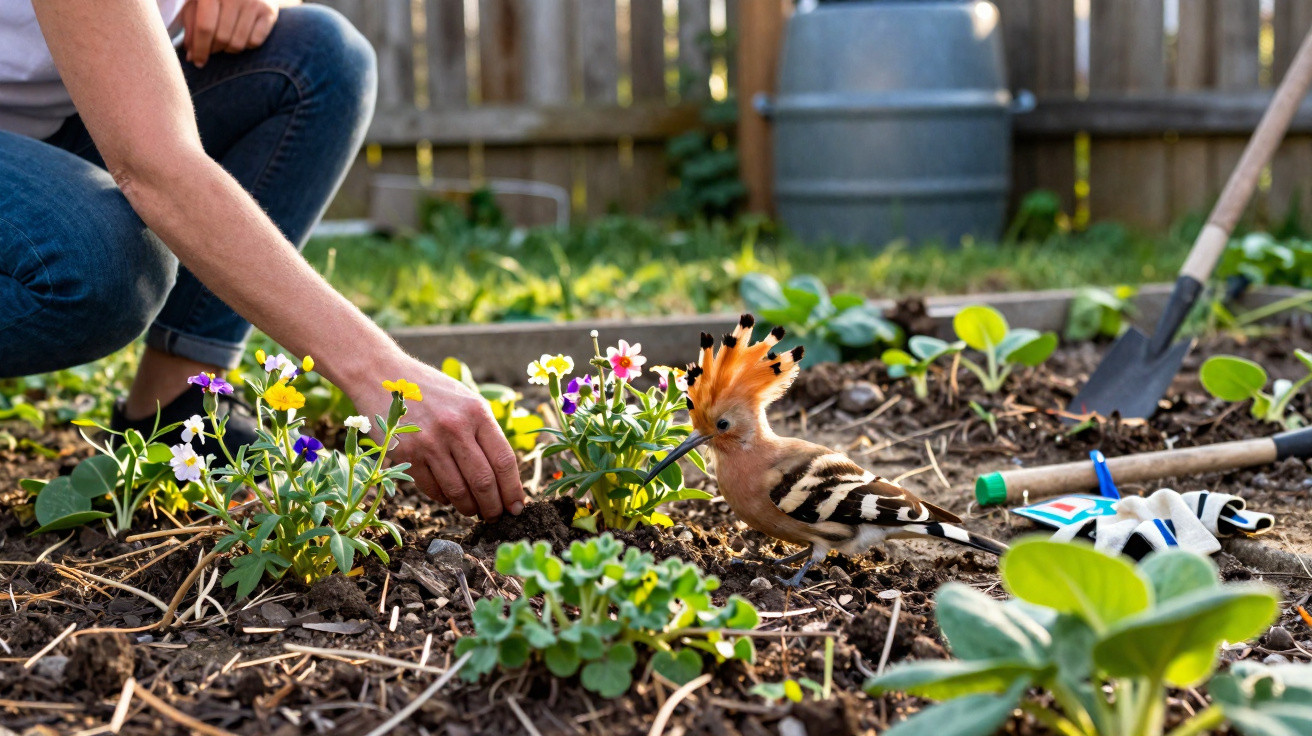
More lies behind this visit than mere chance.
Spotting a hoopoe in your own garden for the first time can feel almost unreal. This slim bird, with its fan-like crest that it can raise at will, looks as though it has stepped straight out of a Mediterranean holiday snapshot. But its presence is not only a striking spectacle - it also reveals a great deal about your soil quality and about how your garden is likely to develop over the coming years.
How the hoopoe “diagnoses” your garden
The hoopoe (Upupa epops) quite literally lives off what is happening in your soil. It feeds almost entirely on insects and other small invertebrates, which it probes and pulls from the ground using its long, curved bill.
"Where a hoopoe hunts regularly, the soil is alive, loose and largely free from toxins."
Its menu includes, among other things:
- Grubs and larvae of cockchafers
- Crickets and grasshoppers
- Mole crickets
- Beetle larvae of all kinds
- Caterpillars, including those of processionary moths
- Various soil insects that can damage gardens and fruit trees
For the bird to linger in one place, it needs plenty of prey. That only happens if:
- the soil is not contaminated with pesticides and insecticides
- there is abundant soil life
- there are open, closely cut areas where it can forage
If you see a hoopoe on several consecutive days - or even for weeks - in the same garden, that patch functions like a natural seal of approval: the ground has not been “sprayed dead”, but is full of insects and therefore appealing to other wildlife too.
Which gardens the hoopoe deliberately chooses
Hoopoes pick their habitat with real care. Typical sites are semi-open landscapes that combine short grass with patches of bare ground:
- closely mown lawns or meadows
- loosened beds with exposed soil
- traditional orchards and scattered fruit meadows
- vineyards and lightly farmed, open countryside
- quiet parks and garden grounds
It favours sunny, relatively dry areas. Gardens that are densely overgrown, persistently damp, or fully covered with gravel and membrane tend to be avoided. Places with constant noise or heavy traffic are also unattractive. If you want the bird to stay, it helps to create a small “buffer of calm”: minimal disturbance, no dogs charging about, and no continual mowing right beside its feeding area.
"A garden where a hoopoe lands usually combines three things: peace, structural diversity and a high degree of naturalness."
A migratory bird with a message: what its route says about your area
The hoopoe spends winter in Africa south of the Sahara. In spring it returns to Europe, where it is typically seen from around April to September. In Central Europe, warmer and drier regions are considered its classic breeding areas.
Records show a clear pattern: in many countries it is more common in the south and rarer further north. When the bird appears in an area where it has previously been scarce, this usually points to two things:
- Your property offers particularly suitable conditions compared with the surrounding area.
- Climate change is slowly shifting its range northwards.
Experts note that numbers have edged up again after a marked decline in the 1990s. The downturn was driven by intensive agriculture, uniform fields and widespread pesticide use. Even with this modest recovery, the hoopoe remains rare in many places and is strictly protected.
What its rarity means for garden owners
In densely populated regions, there are often only a handful of breeding pairs. If a hoopoe chooses to feed - or even nest - in your garden, your plot is one of the ecologically valuable “islands” nearby. That can be a reason to garden even more naturally and to create space for additional species, from wild bees to lizards.
Old myths, new symbolism: what the bird “signals”
People have noticed the hoopoe for thousands of years. Its distinctive crest and the characteristic call, “hup-hup-hup”, have left an impression across many cultures. In older traditions it is seen as a guide, a messenger and a sign of fresh beginnings.
In tales from the Near East, it leads other birds as a kind of “forerunner”. In Egyptian imagery, it stood for gratitude and family bonds. In some regions it has nicknames such as “king bird”, because its crest resembles a crown.
"For many people, meeting a hoopoe feels like a small omen of new starts, clarity and a more conscious relationship with nature."
Some garden owners even say the bird symbolises a turning point: fewer chemicals, more nature, and a calmer attitude towards so-called “pests”. Rather than fighting every beetle, people increasingly allow regulation to be handled by birds, hedgehogs and bats.
What you can do in practical terms so the hoopoe comes back
If you do not want the visit to be a one-off, you can adapt your garden with the hoopoe in mind. Small changes are often enough to improve conditions in a lasting way.
Create pesticide-free zones
Because the hoopoe eats insects, it can easily absorb toxins through its food. Chemical products used against “weeds” or insects quickly turn a well-laid table into an empty one.
- Avoid insecticides, especially on lawns and in beds.
- Use mechanical or biological approaches to manage pests.
- Leave some corners completely untreated as refuge areas for insects.
Add structure instead of a uniform lawn
A garden that is nothing but closely clipped grass offers limited food. A mix of zones is far more helpful:
- short grass areas for hunting
- small patches of bare soil or sand
- wildflower strips to support insects
- old trees or stacks of wood with cavities and crevices
For breeding, the hoopoe uses cavities in trees, cracks in walls, or nest boxes with a sufficiently large entrance hole. Keeping old fruit trees or installing suitable nest boxes increases the chances of the bird establishing a long-term territory.
The “smell factor”: why the hoopoe is not welcome everywhere
One trait can unsettle some people: at the nest, hoopoes can develop a very pungent odour. The chicks and the incubating female give off a strong smell intended to deter predators. In some languages, the bird even has a name that refers to this “scent”.
In gardens where seating is right next to a nesting cavity, it can occasionally be noticeable. Anyone who consciously chooses to protect the species generally accepts it - and, for most, the rare sight of fed chicks more than makes up for it.
Why the bird is fascinating even for people without a garden
Even without your own garden, you can still gain something from the hoopoe’s symbolic value and ecological role. Local councils, allotment associations and even businesses are increasingly creating nature-friendly spaces: low-intensity meadows, flower strips along car parks, and deadwood areas in parks.
In that setting, the hoopoe acts like a barometer. When it turns up in municipal green spaces, it suggests that fewer toxins are being used and that wildlife-friendly approaches are taking effect. For schools or nurseries, a sighting can be an ideal opportunity to explain to children how soil life, insects and bird populations are connected.
So, if you spot an orange-brown bird with black-and-white wings and a raised crest stepping across the lawn, do not only reach for your phone to take a photo. The visit is quietly - but clearly - saying: something is right here, in the soil, in the garden, and perhaps in how we ourselves are choosing to engage with nature.
Comments
No comments yet. Be the first to comment!
Leave a Comment