
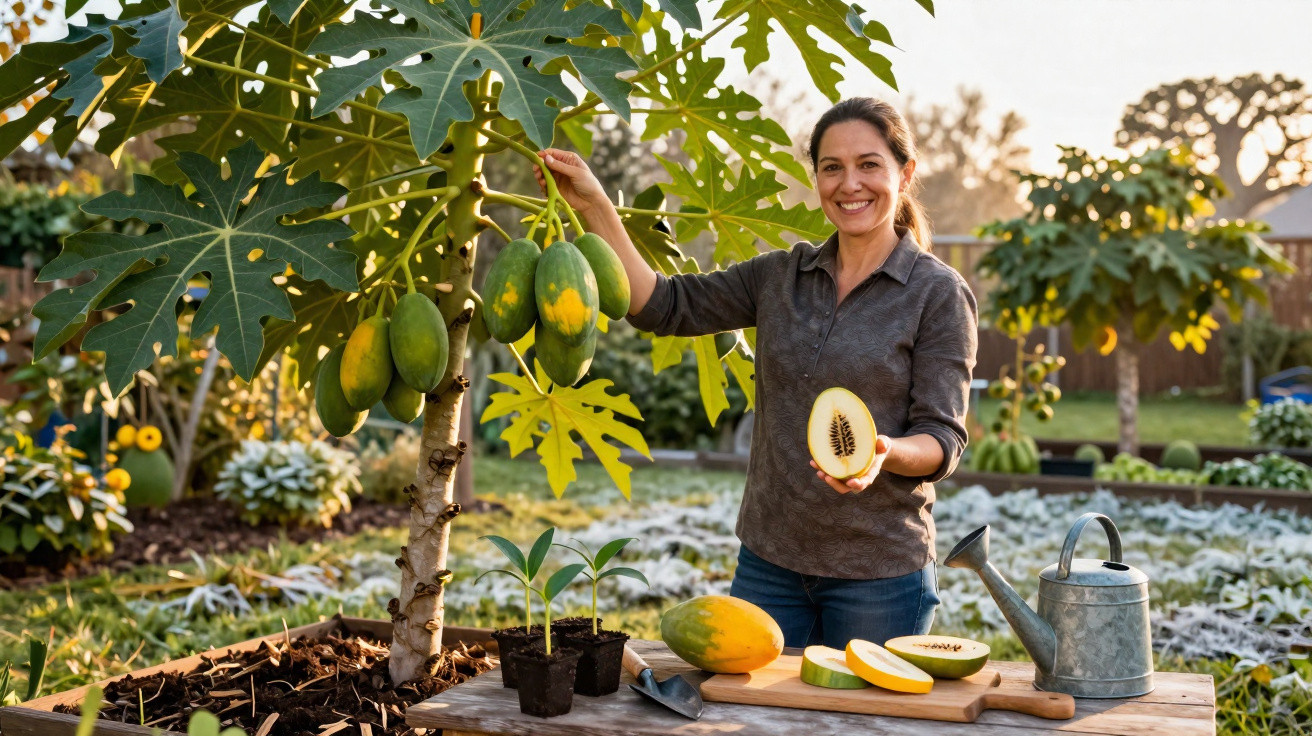
Many gardeners across Europe and much of North America assume that fruit trees with a truly exotic look belong in greenhouses or sun-baked Mediterranean courtyards. Yet there is a distinctly oddball species-complete with rainforest-style foliage and fruit that eats like pudding-that copes with hard freezes and settles perfectly well into an everyday back garden.
The tree that looks tropical but laughs at frost
At a glance, this is the sort of tree you’d expect beside a hammock rather than a hedge. Its long, drooping leaves can grow to roughly 30 cm, creating a thick, luxuriant canopy. It’s no surprise that many gardeners presume it would collapse at the first serious frost.
That visual contradiction is a major reason it remains uncommon in temperate gardens. It has the look of something that must be grown under glass or tucked into a mild coastal microclimate. In truth, its origins are much closer to cool woodland than to any palm-lined beach.
This “fake tropical” fruit tree comes from cold North American forests, not from the Caribbean or Southeast Asia.
So while its silhouette suggests “jungle”, its biology is firmly “hardy woodland”. For gardeners who want something out of the ordinary without gambling on a tender plant, that gap between appearance and resilience is exactly the attraction.
The pawpaw: a cold-hardy outsider hiding in plain sight
The tree is the pawpaw (Asimina triloba), known in the United States as the “poor man’s banana” and increasingly referred to in Europe as the asimina. It is native to North America, stretching from the Great Lakes down through the eastern and southern states, and it even reaches into southern Canada.
These are not gentle winter climates. Snow cover, late cold snaps and long spells well below freezing are normal, and the pawpaw has adapted to handle them.
The pawpaw can withstand temperatures down to roughly -25°C, putting it on par with truly hardy orchard trees.
For gardeners in colder parts of the UK, across northern Europe, or in higher-altitude locations, that figure stands out. Where figs often start to struggle at around -10 to -12°C, pawpaws usually continue with minimal fuss. In practical terms, that means they can be grown across much of Britain, Ireland, northern France, Germany, the Low Countries and many inland continental areas without elaborate winter wrapping.
Its root system also copes with frozen ground, provided the soil is not persistently waterlogged. Once the tree has settled in, it simply rides out winter and then breaks into leaf relatively late in spring-an advantage that can help it avoid the late frosts that sometimes ruin blossom on apples or peaches.
A “mango of the north” growing by the shed
Cold tolerance is only half the story. The fruit is what turns the pawpaw from a curiosity into something memorable.
From late summer into early autumn, greenish to yellow fruits-rather like slightly misshapen, chunky mangoes-ripen on the branches. Inside, the flesh is pale, smooth and creamy, with a texture closer to custard than to most fruits grown in temperate gardens.
The flavour is often described as a blend of banana, mango and a hint of vanilla, with a rich, dessert-like texture.
Because pawpaws bruise easily and do not keep for long, they are rarely sold in supermarkets. Even specialist greengrocers may never stock them. For most people, growing your own is effectively the only way to eat the fruit fully ripe.
From a nutrition point of view, pawpaw is not just a novelty. Studies and analyses indicate a solid supply of vitamins, minerals and amino acids, giving it a nutritional profile that can resemble certain tropical fruits more than apples or pears. For gardeners looking for both flavour and nutrient density, that’s a compelling combination.
How to plant it: the golden rules for success
The pawpaw is resilient, but if you want more than an attractive ornamental, there are a few requirements you cannot ignore.
Why one tree is not enough
Most pawpaw varieties commonly sold are not self-fertile. It’s entirely possible for a single tree to flower well and still produce no fruit at all.
For reliable crops, you need at least two different varieties to ensure cross-pollination.
Set the trees within a few metres of one another so insects can transfer pollen between them. Where pollinators are scarce, some growers use a small brush to hand-pollinate in order to increase yields.
Soil, site and planting tips
- Soil: It does best in deep, rich soil that stays evenly moist but still drains freely. A slightly acidic to neutral pH is ideal. Very chalky, dry or compacted ground will slow it down.
- Light: In most climates, established pawpaws are happiest in full sun, which supports better fruit quality. Young plants can scorch, however, so dappled shade or temporary shade cloth in the first few summers can prevent leaf burn.
- Roots: Pawpaw forms a sensitive taproot. When planting, keep root disturbance to an absolute minimum to reduce the chance of failure.
- Water: Consistent watering over the first two or three years makes a big difference. After that, the tree is more tolerant of short dry spells.
Planting is usually best in late autumn or late winter, when the soil is workable and not frozen solid. Container-grown trees can be planted during most of the growing season too, as long as watering is kept steady.
Low maintenance, low spraying, high interest
Hardiness and flavour aside, pawpaw has strong appeal for gardeners aiming to cut inputs. Many traditional orchard trees-apples and peaches among them-often require repeated fungicide or insecticide treatments to stay at their best.
The pawpaw shows natural resistance to many common pests and diseases, making it a strong candidate for chemical-free gardens.
Its leaves contain natural compounds that discourage several insects, so damage is often modest. That doesn’t make the tree immune to problems, but the overall pest and disease pressure tends to be lower than with apples or plums.
Size is another advantage. A mature pawpaw commonly reaches about 4–5 metres and keeps a tidy, upright shape-easy to accommodate in a typical suburban plot where a large walnut or chestnut would overwhelm the space.
How it compares with familiar fruit trees
| Fruit tree | Approx. hardiness | Typical height | Maintenance level |
|---|---|---|---|
| Apple | Good frost tolerance | 3–6 m (rootstock dependent) | Regular pruning, frequent pest monitoring |
| Fig | Often damaged below -10°C | 3–5 m | Needs shelter in colder zones |
| Pawpaw | Down to around -25°C | 4–5 m | Low spraying, light pruning |
From garden to kitchen: what you can actually do with pawpaws
When it is perfectly ripe, the fruit is usually eaten fresh-scooped straight from the skin with a spoon-thanks to its rich, creamy texture that feels like a ready-made dessert.
In cooking, pawpaw pulp can stand in for banana or mango in a wide range of recipes. It is commonly used in:
- Smoothies and milkshakes
- Ice cream and sorbet bases
- Cakes, quick breads and muffins
- Custards, panna cottas and chilled puddings
Once cut, the flesh oxidises and softens quickly, so freezing the pulp is a practical way to make it last. Many growers scoop out the flesh, remove the large seeds, and freeze portions to use later in winter puddings and desserts.
Practical scenarios for different types of gardeners
In a small urban garden, a pair of compact pawpaw trees can take the place of a more traditional apple-and-pear combination. They offer shade, seasonal structure and a conversation starter when neighbours spot unfamiliar fruits over the fence.
On a larger rural plot or in a small orchard, a line of pawpaws planted along a sheltered fence or woodland edge can add robustness. If late frosts destroy blossom on apricots or cherries, the later-flowering pawpaws may still manage a crop, helping to spread risk across different species.
They can also be combined with other low-input fruiting plants-such as serviceberries, medlars or hardy kiwis-to create a more diverse, climate-resilient planting scheme. A mix like this reduces dependence on a single fruit type and staggers harvesting from early summer through to late autumn.
Terms and small risks worth knowing
A handful of terms often appears in pawpaw discussions. “Rusticity” describes the tree’s ability to endure low temperatures without damage. “Self-fertile” means a plant can set fruit using its own pollen; most pawpaws cannot, which is why planting two different varieties matters.
There are a few modest downsides. The harvest period is brief, and anyone with latex or certain tropical fruit allergies should sample a small amount first. The seeds and leaves are not eaten and should be discarded. As with many plants in the annonaceae family, the usual advice is to eat only the ripe flesh and to do so in reasonable quantities.
Even with those caveats, the pawpaw’s mix of cold hardiness, unusual flavour and relatively low maintenance makes it one of the most intriguing options for future-proofing temperate gardens. As gardeners reassess what “exotic” can mean, this so‑called “mango of the north” quietly shows that you don’t need palm trees to bring a holiday note to the back lawn.
Comments
No comments yet. Be the first to comment!
Leave a Comment