
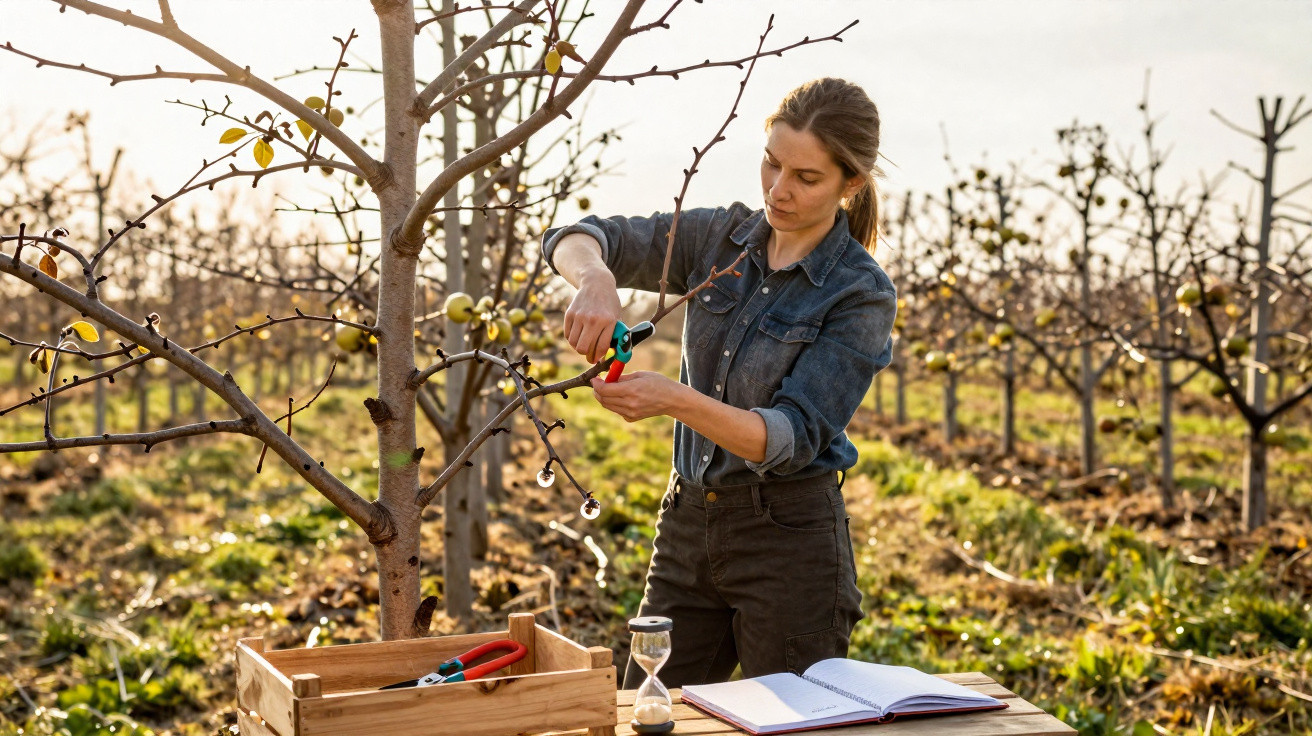
No hum of insects, no sweet hint of blossom - only boots rasping over frozen grass and the neat snap of secateurs in cold fingers. This is the month when apple and pear trees can look almost lifeless: grey bark, empty limbs, a stillness that feels like they’re pausing their breath. Most people walk straight past them now. The action, it seems, belongs to later on - when branches bow under fruit or the ground is dotted with windfalls.
But if you grow even a single tree, this hushed spell is when next season’s crop is set in motion. A handful of cuts, a couple of poor decisions, or leaving it a few days too late - that’s enough to alter a tree’s shape and behaviour for years.
January never makes a fuss. It murmurs. For apple and pear trees, though, what it’s saying matters enormously.
Why January is the tiny window that decides your harvest
On a dull January day, a leafless apple tree looks as though nothing is going on - no canopy, no colour, just branches twisting up into the sky. Yet inside, the sap is low, reserves are banked, and each bud sits quietly packed with potential. The tree is dormant, and oddly, that’s when your influence is at its greatest.
Because the tree is asleep, winter pruning lets you reshape an apple or pear with surprisingly little stress. You can thin and open the crown, decide which limbs will carry next year’s fruit, and remove what shouldn’t be there. Let the moment slide and the tree surges back into growth, responding more aggressively to cuts and spending energy on wood you never wanted. All those bare days can make it feel as if you’ve got ages - but the effective window is shorter than it looks.
A small commercial grower in Kent once walked me along two adjacent rows of apple trees. Same variety, same soil, same age. One row had been pruned during a crisp spell in mid-January. The other was left “until later” and tackled in March, with buds already beginning to swell. By autumn, the contrast was almost awkward. The trees pruned in January carried evenly spaced, well-coloured fruit on shorter, sturdier branches.
The later-pruned row was a set of trade-offs: more leafy growth, fewer apples, and fruit crowded on long, whippy shoots that sagged under the load. His records backed it up too - around 20% more marketable fruit from the trees pruned in the heart of winter. Not because he put in more effort, but because he acted sooner.
The reason is straightforward biology. Cut in deep winter and the tree hasn’t yet committed to where it will drive growth once spring arrives. Pruning at this stage redraws the plan before the sap rises, channelling energy into the buds and branches you keep. Leave it until the tree is already waking and it’s like rearranging furniture after guests have turned up - more disruption, more waste, and a whole season of balance lost.
That’s the quiet reality of January: it isn’t merely a “pruning month”. It’s the time you strike a deal with the tree about the sort of year you’re both going to have.
What you actually need to do in those few crucial weeks
Put aside the idea that winter pruning has to be dramatic or daunting. For most garden apple and pear trees, the key January job is uncomplicated: let in light and reduce chaos. Walk a slow circle around the tree and picture a bird flying through the centre. If it would have to batter through crossing wood, you’ve found your task.
Begin with three straightforward actions. First, remove anything dead, diseased, or broken. Second, take out branches that rub, cross, or head straight into the middle. Third, cut back last year’s long, upright shoots by roughly a third to a half, making the cut just above an outward-facing bud. No heroics required. The aim is a structure that could hold pockets of sunlight between its limbs.
On a suburban street in late January, once you know what you’re seeing, the contrast is obvious. One pear tree stands like a feather duster - dense, tangled, all growth and no air. Next door, another of similar age shows an open, bowl-like shape, with three or four main limbs and space between them. It’s not hard to guess which tree produces fruit you can actually reach. The tree that looks “tidy” because it’s been left alone can swing from a bumper year to almost nothing the next, pushed into biennial bearing by unmanaged vigour and uneven cropping.
A lightly pruned tree usually finds a steadier tempo. Older wood carries short, knobbly spurs, each holding neat clusters of blossom. Fewer limbs snap after a gale. Less fruit drops in frustration just before it colours and ripens. Allotment talk often lands in the same place: gardeners who give their trees one or two focused sessions in January tend to harvest smaller but more reliable crops than those who “let nature decide”. Nature, entirely unchecked, rarely produces supermarket-style fruit.
There’s a clear logic to this winter work. When you shorten a vigorous shoot in January, spring growth tends to push into the buds just below the cut. On apples and pears, that’s exactly where fruit buds can develop. By reducing length and thinning congestion now, you tilt the balance away from greedy leaf-making and towards compact, fruiting wood. Skip it and the tree keeps racing upwards - creating shade, ladders, and irritation.
That’s why orchardists talk about “pruning for light” as much as “pruning for shape”. Sun reaching ripening apples in late summer often begins with a decision made in a foggy January - a clean cut taken in cold air.
How to use this short January window without losing your mind
For home growers, the most workable approach is smaller than you might think: plan one or two brief sessions in January, and treat each tree as a manageable job rather than a life’s work. Start by looking from a distance, then move in close. Pick out three to five cuts that clearly improve light and structure, and make those first - before you get pulled into fiddly, indecisive trimming.
One rule of thumb helps: keep sturdy branches that grow outward at roughly 45–60 degrees from the trunk, and reduce or remove steep vertical shoots and anything pointing inward. Use sharp, clean secateurs or a pruning saw, and place cuts close to the branch collar without leaving stubs. Even seasoned growers don’t achieve “perfection” in a single pass. Dormant trees are forgiving.
When it’s freezing outside, it’s easy to find reasons to stay in. Fingers go numb, glasses mist over, and the living room starts to look much more sensible than the garden. That’s why so many backyard trees miss the January attention they quietly require. People promise themselves they’ll do it in March, or “when the days stretch out”. By then, buds are swelling, sap is moving, and every cut carries a sharper outcome.
So make it easy. Choose one decent-weather day, get the kettle on, and aim to finish just one tree. If you have several, the rest can wait a few days. On a human level, consistency matters more than ambition. A slightly imperfect winter prune carried out most years beats a dramatic overhaul once a decade - and years of wishing you hadn’t.
“Winter pruning gives you a rare thing: time. The tree isn’t rushing, the leaves aren’t shouting, and you can actually think before you cut,” says one veteran apple grower from Herefordshire. “Miss that, and you’re wrestling a moving target the rest of the year.”
This is where a handful of checks can spare you unpleasant surprises.
- Confirm the variety: some pear trees dislike hard pruning and respond with a thicket of water shoots.
- Check for canker or blackened wood, and cut well below the damage into clean, healthy tissue.
- Keep ladders secure, and make cuts at shoulder height whenever you can.
- If you’re tired or irritated, stop; poor moods lead to poor cuts.
- Preserve well-sited older spurs; not every “gnarly bit” is a problem.
Let’s be honest: nobody does this perfectly all the time. One careful January session - done with a clear head and a truthful eye - puts you well ahead. And the tree doesn’t forget. You notice it in August, when limbs hold their crop without snapping and the ladder stays in the shed.
January decisions that echo through the year
Once you’ve seen how strongly a few winter cuts can steer an apple or pear tree, you stop walking past bare branches without noticing. You begin to spot the forks where two limbs compete, the shaded-out centres, the trees leaning towards light as if they’re trying to escape. You realise fruit growing isn’t only about feeding or spraying. It’s design. It’s structure.
That’s the subtle pressure of this month. January hands you control, but it demands care. Each cut is a choice that will carry forward - when bees arrive, when late frosts bite, when a child stretches for a warm apple in September. Get it “wrong” and nothing collapses, but you may steer your tree towards years of awkward form and stop-start harvests. Get it mostly right and the tree works with you rather than against you.
Most of us have had that moment: biting into a home-grown apple and realising it tastes nothing like the supermarket kind. More fragrant, more imperfect, more alive. That taste began in the unseen season, when someone stepped into the cold, looked properly, and decided which branches earned their place. January won’t fill the baskets by itself, of course. There’s blossom to defend, pests to avoid, summers that scorch and summers that flood. Still, this brief, quiet window carries its own sort of promise.
Standing beneath a bare tree with secateurs in hand, you’re not only clearing dead wood. You’re drawing autumn’s outline onto the winter sky.
| Key point | Detail | Benefit for the reader |
|---|---|---|
| January window | A short dormancy period when trees respond best to structural pruning | Knowing when to act to genuinely influence the harvest |
| Pruning for light | Open the centre, reduce vertical shoots, favour branches at 45–60° | Fruit that’s easier to pick, better coloured, and more consistent |
| Fewer cuts, more often | One or two considered sessions each winter rather than a rare, heavy prune | Balanced trees with less stress and less exhausting work |
FAQ:
- How late in winter can I still prune apple and pear trees? You can prune while they remain fully dormant, but the prime period is usually early to late January. Once buds are clearly swelling, move to lighter, more cautious cuts.
- Is it okay to prune in frosty weather? A light frost is generally fine, although severe freezes can make wood brittle and tools harder to control. Choose dry days that are cold but not extreme - when you can still work safely.
- Can I prune young trees the same way as old ones? Young trees need gentler shaping, focusing on building a strong framework rather than heavy thinning. Older, overgrown trees often need gradual correction over several winters.
- Will pruning in January reduce the risk of disease? Dry winter conditions often mean fewer fungal threats, and cuts can settle more cleanly - particularly if you remove diseased wood well back into healthy tissue.
- What if I’m scared of taking too much off? Start modestly. Remove what’s plainly dead, rubbing, or growing inward, then stop. You can always come back next winter; the biggest errors usually happen when people rush or try to do everything in one go.



Comments
No comments yet. Be the first to comment!
Leave a Comment