
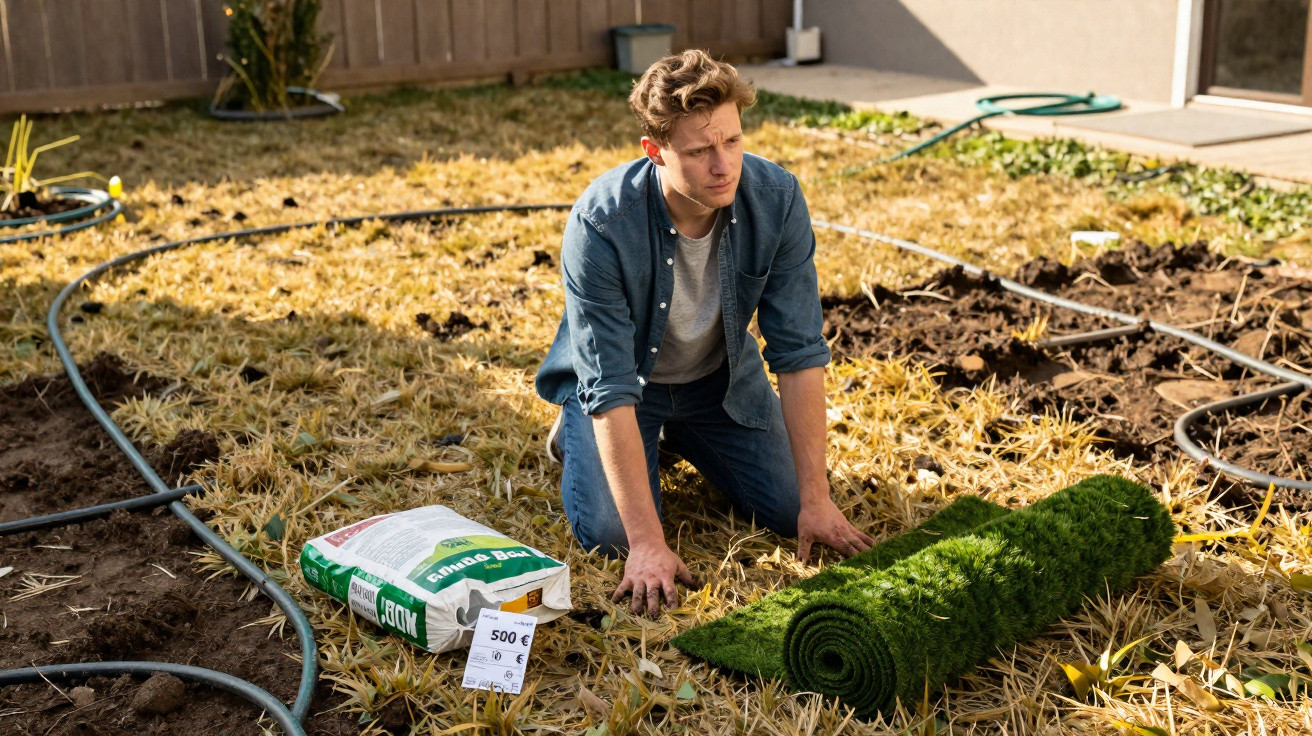
A weekend later, my lawn resembled a football pitch straight from television. Three weeks on, it had the appearance of worn-out carpet. The cash disappeared quickly. Regret arrived more gradually, like a shadow moving across the grass.
On the morning the turf was delivered, the driver gave me a wink and said, “Get it down quick or it’ll cook.” The heavy, sweet-scented rolls were still wet from the farm, piled on a wooden pallet like green cinnamon buns. My neighbour rested against the fence and gave an approving nod. We cut, staggered, tamped and watered. It was as though we were making summer with our own hands. As the sun dropped behind the birch tree, the lawn shone. It felt like a modest triumph, bought with euros and hard work. We celebrated with coffee mugs in hand and mud on our shoes.
By the following afternoon, the edges had begun to curl.
What €500 really buys you when you buy a lawn
This was the part of the small print I had missed: turf is a living promise delivered with a countdown attached. It still behaves as if it belongs on the farm. It needs deep, friable soil, reliable moisture and midday shade. My garden had compacted clay and a low-pressure hose. The first week is not about “having a lawn”; it is about caring for a transplant. That care costs both time and money. After spending the €500, I ended up paying more than I had beforehand.
During the first week, my water meter turned as fast as a bicycle wheel. In warm weather, new turf requires around 2.5 cm of water three to four times each week. That works out at roughly 15–25 litres per square metre for every session. Across my 70 m² patch, I used nearly 4,000 litres over seven days. The grass remained green, but turned yellowish in the strip the sprinkler failed to reach. I then bought another hose, an inexpensive oscillating sprinkler, a wetting agent and a hand roller that I used just once. Quietly, that €500 became about €740.
Turf is a crop with stage fright. It arrives from the farm with shallow roots and a high leaf-to-root ratio. Once laid at home, it faces wind, heat and uneven moisture. In dense soil, its roots meet a barrier and grow in circles close to the surface. Rolls left on the pallet for too long overheat and suffocate. Because the joins dry faster than the centre of each roll, the edges curl upwards. Turf does not simply “fail.” Its biology is unforgiving when preparation is poor and the weather changes. You are not buying a lawn. You are buying a process.
What I wish I’d done before unrolling those green carpets
If I could go back, I would put half the budget below ground. I would loosen the top 15 cm using a fork or tiller, then rake in 2–3 cm of compost along with sandier topsoil, until the soil held its form but crumbled when squeezed in my hand. I would carry out a quick soil test, bring the pH towards 6–6.5, and apply a starter fertiliser that was low in nitrogen but high in phosphorus and potassium. While laying the turf, I would stagger the joins as with brickwork, push the edges firmly together and use a light roller once to press the turf gently into the soil. I would water straight away until the ground glistened, rather than flooded.
I treated watering as a chore, when it is really an art. For the first 10 days, I should have watered only in the early morning, with lengthy soaks that carried moisture 10–15 cm into the soil. During heat spikes, a midday mist should only cool the leaves, not “water” them. After that, the right approach is to water less often but more deeply, encouraging the roots to follow the moisture downwards. The surface should only be crossed on boards. Mowing should wait until the blades are 7–8 cm tall, then they should be cut back to 5–6 cm with a sharp blade. Leave the clippings where they fall. And here is the “real life” part: Let’s be honest: nobody actually does that every day. Set reminders, use timers or persuade a friend to help. Your future self will be grateful.
Most of us have experienced the moment when something purchased to save time quietly takes over our weekends. I assumed turf would be a shortcut. With patience and proper preparation, it can be. If possible, ask a local groundskeeper for a 20-minute sanity check. They will identify grading problems, shade traps and sprinkler blind spots more quickly than any YouTube video. A lawn is not a colour; it is a routine.
“Turf isn’t a magic rug,” a stadium gardener told me. “It’s just grass with a head start. If the soil’s wrong, the grass pays the price.”
- Preparation target: 10–15 cm of loosened topsoil mixed with compost
- Watering plan: 2.5 cm per session, 2–3 times weekly, in the mornings
- Mowing rule: make the first cut at 7–8 cm, removing no more than one-third
- Root test: pull gently after 10–14 days; resistance means it is knitting in
- Heat tip: use a midday mist only during heatwaves to cool, not soak
The quiet lesson a €500 lawn taught me
My regret is not about paying for grass. It comes from believing I could spend my way around physics, soil and weather. The lawn forced me to prepare for the mundane details: the hose schedule, the no-shoes rule and the shaded corner that always takes on water more slowly. It also showed me that seed can sometimes be wiser than turf, even though it takes longer. Seed establishes itself within your soil rather than sitting on top of it. Turf is a houseguest; seed is family.
I would buy turf again one day, but not as I did before. I would begin with soil that crumbles rather than clods. I would measure water by depth rather than minutes. I would choose a hardier mix for my climate instead of the glossy roll displayed at the front of the shop. I would also treat the first two weeks as a part-time job, because that is exactly what they are. The green visible on the first day is not the finish line. It is the starting pistol.
| Key point | Detail | Benefit for the reader |
|---|---|---|
| Preparation beats price | Invest in soil structure, pH and grading before the turf arrives | Fewer failures, less watering and better rooting |
| Water by depth, not habit | Aim for 2.5 cm per session, mornings only, then gradually reduce | Stronger roots, lower bills and fewer yellow patches |
| Choose the right material | Turf provides instant cover; seed offers long-term suitability and cost control | Match your budget, effort and climate to the result |
FAQ:
Is turf better than seed? Different tools suit different jobs. Turf provides instant cover and suppresses weeds, while seed adapts to your soil and costs less. If you can be patient, a seed mix suited to your climate may outperform generic turf over time.
How much should I water new turf? Think in centimetres rather than minutes. Target about 2.5 cm per session, two to three times a week at dawn. During heat spikes, add a light midday mist to cool the leaves rather than soak the soil.
When can I walk or mow on new turf? For the first week, walk only on boards. Pull gently at a corner after 10–14 days; if it resists, the roots are knitting in. Mow for the first time when the blades reach 7–8 cm, cutting them to 5–6 cm with a sharp blade.
Why did my turf edges turn brown? The joins dry out more quickly and have the least contact with the soil. Fit the edges tightly during installation, roll them lightly and hand-water the joins throughout the first week. Wind exposure and gaps are usually responsible.
What’s the cheapest way to fix a patchy turf lawn? Scarify the dead thatch, top-dress with a compost-and-sand blend, overseed with a compatible mix and water by depth for two weeks. A €15 soil test can save more money than buying another roll of turf.

Comments
No comments yet. Be the first to comment!
Leave a Comment