
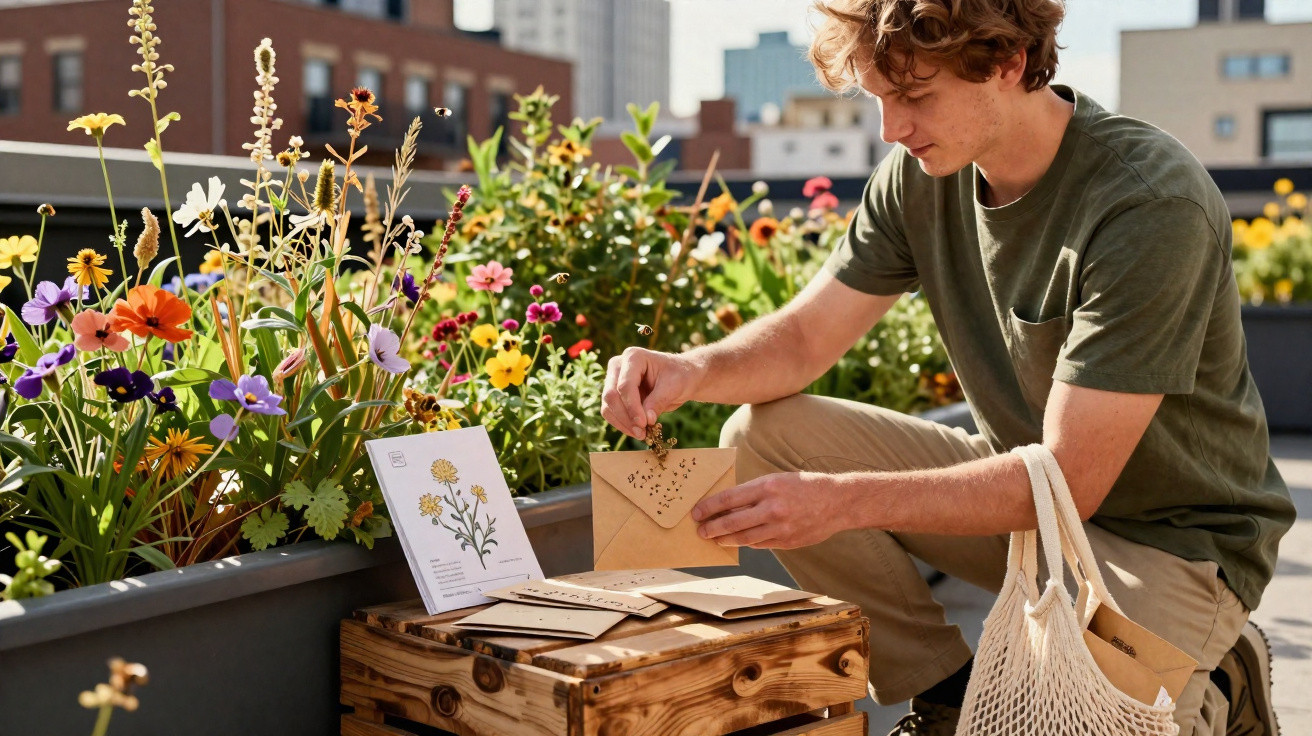
Across the UK, the National Trust is discreetly equipping volunteers with the skills to save wildflower seeds from valued meadows and urban plots. It is a straightforward activity with far-reaching benefits: more blooms, more pollinators and more wildlife. You can take part without leaving the city.
Paper bags crinkle as fingers feel for the snap of a seed head, inspect the chaff, then twist and drop the contents inside. A ranger names plants as though greeting familiar companions-knapweed, scabious and yellow rattle-while a child in red trainers raises a paper bag like a trophy. Later, in town, those hands will scatter seeds across baking trays, mark envelopes at kitchen tables and exchange them at weekend swaps, transforming flats and balconies into nurseries for a greener season ahead.
We are often told that major change requires major budgets. Yet sometimes it begins with a short walk and a small paper bag.
The key is that you do not need access to a meadow.
The quiet revolution: why seed saving is returning and matters more than you think
At its core, seed saving is about resilience rather than nostalgia. The National Trust trains volunteers because thriving meadows cannot simply be purchased in a sack. Seed adapted to local conditions, collected at the correct moment, performs more reliably, copes better with dry periods and nourishes insects that developed alongside those plants. There is another, less immediately spoken reason too: once you know how to read a seed head, you begin to look at the landscape in a new way. It becomes a lasting habit.
One autumn beside a busy A-road, a volunteer group gathered twenty bags of oxeye daisy, birdsfoot trefoil and yellow rattle from the edge of an old meadow. At home, they dried the seed on oven racks before bringing it to a scrubby former car-park area behind a community hall. By June, the site was buzzing. Children counted butterflies during their lunch breaks. A weary bus driver rested his sandwich on a rail and simply watched the bees. The context is stark: Britain has lost about 97% of its wildflower meadows since the 1930s. That figure changes the way a paper bag feels in your hand.
There is sound reasoning behind this that extends beyond sentiment. Wildflowers are not decorative wallpaper; they are a living record of a particular place. Seed from a chalk downland responds differently from seed gathered on a wet Pennine verge. By showing volunteers how to collect at “donor” sites and grow plants for nearby “recipient” patches, the Trust protects local provenance. It is basic ecological sense. A freezer-based seed bank has value, but a seed network held in people’s hands is what can expand. Distributing the knowledge also distributes the risk. Small actions form a web across cities and counties, preventing losses from slipping through unnoticed.
How to become a National Trust wildflower seed saver from your city
Keep it simple, begin modestly and work with what is around you. Register for a local event through the National Trust volunteering page, filter for nature or countryside roles, then look for seed-collecting or meadow-restoration days at properties accessible from your transport route. Pick up the essentials on site, then bring the practice back home. In the city, gather seed only from your own garden, a friend’s garden or community plots where you have permission. Select plants suited to local conditions-sun, shade and soil-and harvest when the seed heads are dry and rattle. Use paper bags rather than plastic. Mark each bag with the species, location and date. It starts with a paper bag and a quiet moment.
Leave your collection to dry on a tray for a week in a shaded, airy room. Gently rub it to free the seed from the chaff, then sieve it or use a slow breath to clean it. Keep the seed in an envelope somewhere cool and dry; the bottom of a wardrobe is suitable. Give some away at a nearby seed swap or to a community garden. Sow the remainder in autumn onto bare soil, tread it in lightly, water it once and allow winter to take over. We have all experienced a plan that seems too insignificant to count; seeing the first bee locate your patch can quickly change that impression.
Typical mistakes include harvesting too soon, using plastic bags that hold moisture and combining unlabelled species into an unknown mix. It happens. Honestly, no one does this perfectly every day. Make things easier for your future self by labelling clearly and taking a phone photograph of the parent plant. Leave at least two-thirds of the seed heads standing for wildlife and natural self-seeding. Do not collect from nature reserves or rare plant populations unless you have explicit permission. If you cannot identify a plant, leave it alone and learn another day. Perfection is not the aim. The aim is to learn through doing and pass on what has worked.
“Seed saving turns a walk into a conversation,” a National Trust ranger told me. “Once you hear the rattle in yellow rattle, you can’t un-hear it. And then you start teaching the next person.”
- Attend a city seed workshop run by a National Trust property team or a partner community garden.
- Make your balcony available as a “nursery” for plug plants raised from locally sourced seed.
- Give one Saturday each season to volunteer as a seed sorter, label maker or courier between sites.
- Organise a seed swap at your library, café or office lunchroom-three jars and a sign are sufficient.
- Identify micro-meadow possibilities, including school verges, housing estates and churchyards seeking colour and pollinators.
What grows when you share seeds
Seed saving spreads in the best possible sense. A few volunteers become a modest network, which then develops into a city-wide habit. You might start with daisies and soon find yourself learning the Latin name for scabious after a neighbour asks what to grow in a dry corner. Knowledge travels faster than seed. The National Trust understands that teaching people to gather, clean and store seed opens the door to much more-soil health, butterfly counts, hedgerow care and the politics of roadside verges. A paper bag can become a habit of paying attention, and attention becomes care.
| Key point | Detail | Why it matters to the reader |
|---|---|---|
| Local provenance matters | Seed from nearby sites performs better and supports local wildlife | Better success rates and more varied pollinator visits |
| City roles are real | Sort seed, raise nursery plants, run swaps and plan micro-meadows from your flat | Take part without a car or access to the countryside |
| Simple kit, big impact | Use paper bags, labels and trays, and sow in autumn | A low-cost way to begin, with visible summer results |
FAQ:
- How can I find a National Trust seed-saving session near me? Visit the National Trust volunteering page, filter by “nature” or “countryside”, and search for “seed collecting” or “meadow” activities. Many properties within easy reach of cities hold autumn sessions.
- May I collect wildflower seeds from parks or roadside verges? Only if you have permission and doing so is ecologically appropriate. Safer options include your own garden, friends’ gardens, community plots and Trust-led donor-site sessions.
- What should I do if I cannot identify the plant species? Collect only species you can identify with confidence. Try a field app or ask at a workshop. It is better to gather less and be accurate than distribute unknown plants that may not suit your area.
- When should I collect and sow seed? Harvest in late summer through autumn, once seed heads are dry and rattle. Sow in autumn, allowing cold and wet weather to prompt germination. Yellow rattle, for example, requires that winter chill.
- How can I contribute without a garden? Offer to raise plug plants on a balcony, label and sort seed for a local group, help with a seed swap or map potential micro-meadow sites. Urban volunteers keep the network active.
Comments
No comments yet. Be the first to comment!
Leave a Comment