
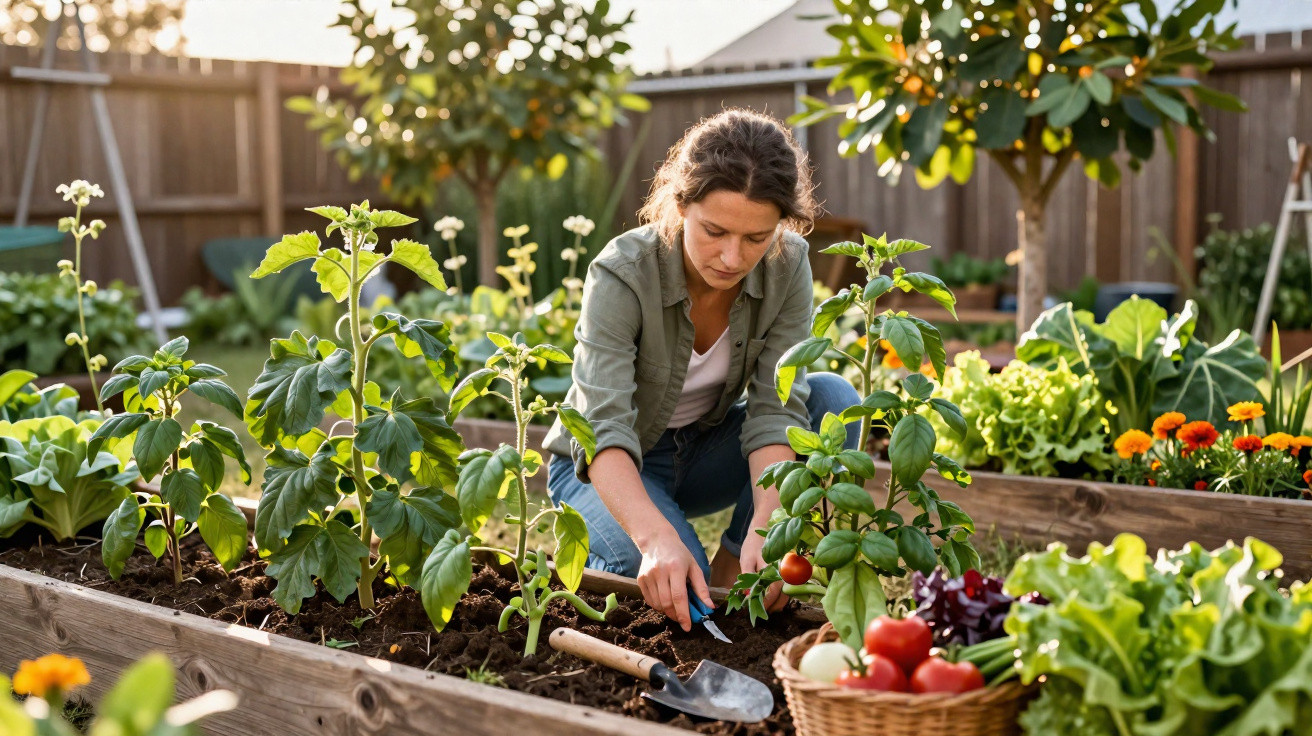
The first time I saw two tomato plants competing for light, I felt like an awful referee. One seedling, tall and overconfident, reached across its more timid neighbour and claimed every scrap of sunshine. With pruning shears in hand, I paused. Should I save the smaller plant, or leave them to settle it as siblings might on a sofa?
I left them alone.
A few weeks later, the apparent “loser” had become stocky, resilient and firmly rooted, while the taller plant broke in a summer storm. That was when I understood something. Perhaps plants do not always need us charging in with scissors and a guilty conscience. Perhaps some competition is not cruel at all.
That was the beginning of my small gardening heresy.
I allow plants to compete. Only slightly.
When plants compete gently, the garden becomes calmer
Spend ten minutes watching a packed flowerbed and the plants begin to seem like characters. There is the bold mint creeping sideways, the steadfast rosemary keeping its ground, and the rose that looks fragile while driving its roots forwards like a slow bulldozer.
When every plant is spaced as though it were furniture in a showroom, the result can feel unnatural. Bare soil remains exposed, sunlight lands on empty patches, and weeds wander in as if they belong there. There is no interaction, resistance or exchange-only isolated plants receiving too much protection.
Planting a little more closely, almost shoulder to shoulder, creates another sort of rhythm. Plants touch, bend, shade one another and compete for room. The bed feels busy and living, more like a street market than an abandoned shopping centre.
Consider my small urban vegetable patch. The official spacing guidance stated: “One lettuce every 30 cm. One kale every 45 cm.” My raised bed simply could not accommodate that, squeezed as it was between brick walls and a bike rack.
So I ignored it a little. I planted lettuce among the kale stems, placed basil at the base of the tomatoes, and fitted marigolds into every spare corner. For several weeks, it appeared overly dense-nearly claustrophobic. I was close to pulling plants out in alarm.
Then summer arrived. Beneath the canopy of leaves, the soil remained cool. Weeds could hardly find an opening. Slugs had less clear ground on which to feast. The plants were not textbook-perfect, but they developed together. Each plant produced less individually, yet the bed delivered more as a whole. The balance simply… appeared.
What happens below ground is even more intriguing. Close planting makes roots negotiate. They use fungal networks, exchange signals and can even slow one another when space becomes limited. This mild stress is not necessarily damaging. Often, it encourages plants to root more deeply, develop thicker stems and strengthen their disease defences.
The important word is the one you instinctively feel: “slightly.” Too much crowding becomes a battle. Measured closeness becomes quiet training. It should be a gym, not a battlefield.
We often assume plants either flourish peacefully or perish through struggle. The truth is less clear-cut. A little pressure, rather than too much, can help the entire system reach a living truce.
How to let plants compete without causing a riot
My approach is straightforward: I plant a little closer than the label recommends, but never dramatically closer. If a seed packet advises 30 cm, I allow 20–25 cm. It is not a revolution; it is a gentle adjustment.
I also combine different forms and heights so that plants are not all competing for precisely the same resource. Deep-rooted carrots can grow beneath shallow-rooted lettuce. Tall tomatoes can stand above creeping thyme. Woody lavender can sit beside floppy cosmos. They overlap, but they are not all pushing in the same direction.
Then I observe. The first heatwave, the first storm and the first slug invasion reveal whether the competition is constructive or harsh. When one plant is plainly being smothered, I prune it or move it. No fuss-just editing.
The main error is assuming that “a bit of competition” means cramming every square centimetre as though packing a suitcase five minutes before leaving for the airport. That is not balance; it is panic gardening.
Guilt can also take over. We plant too much, watch a few seedlings struggle and suddenly feel like the villains. We then attempt heroic rescues, only to cause further disruption. Honestly, nobody manages this every day. Most of us glance at the garden between a meeting and dinner, then act as though everything is under control.
A kinder method is to adjust gradually. Remove a seedling here, prune a stem there, or make a small opening for light above a struggling plant. Gentle, regular changes work better than large, guilt-driven interventions made too late.
Every gardener I know who discreetly welcomes competition tends to make a similar admission.
“I stopped trying to save every plant,” a neighbor told me, “and the garden finally started saving itself.”
Sometimes, I make a small survival list on scrap paper and keep it beside my tools:
- Plant slightly closer, not ridiculously closer
- Mix heights and root depths so they share, not clash
- Accept that a few plants will lose so the bed can win
- Thin and prune in tiny steps, not in one big purge
- Watch the soil: if it stays cool and covered, you’re on the right track
At first, it feels almost wrong, like failing to overprotect a child. Then one growing season becomes two, and the plants’ quiet confidence begins to influence you.
Living with a garden you cannot completely control
Late in the season, there comes a point when the garden stops looking tidy and starts looking truthful. Leaves spill across paths, roots weave together, and a self-seeded sunflower emerges among the beans. This is where the experiment with “slight competition” becomes most visible.
You notice which plants rose to the challenge and which gave up. You see shade, roots and insects renegotiate the territory without asking your permission. You realise that you are less an architect and more a mediator.
We have all experienced that moment: standing amid the disorder, hose in hand, wondering who is truly in charge. That slight unease is also a kind of freedom. You do not need to manage every centimetre. Set the scene, plant a little more closely, and allow the balance to find its own pace.
Some plants will step aside. Others will exceed your expectations. The garden learns, and so do you.
| Key point | Detail | Value for the reader |
|---|---|---|
| Let plants grow slightly closer | Reduce spacing guidelines by about 20–30% without cramming | More harvest per area, cooler soil, fewer weeds |
| Encourage mixed “neighbourhoods” | Combine heights, root depths, and plant types in the same bed | Reduces direct competition, boosts natural resilience |
| Intervene lightly and often | Small pruning, thinning, and observation instead of big overhauls | Maintains balance while letting plants adapt and strengthen |
FAQ:
Question 1: Will letting plants compete a bit reduce my total harvest?
Most of the time, no. Individual plants may be slightly smaller, but the overall yield per square metre usually rises because the space, light and soil are used more completely.
Question 2: How do I know if plants are too crowded?
When air cannot move between leaves, diseases spread quickly, stems remain weak, and plants become pale or leggy. You should still be able to spot areas of light reaching the soil for part of the day.
Question 3: Does this work in pots and on balconies?
Yes, although pots dry out more quickly. Choose deeper containers, use rich soil and water more regularly. Plants can share a pot, but avoid placing more than two or three vigorous growers together.
Question 4: Are there plants that really hate competition?
Some plants, including carrots and parsnips, dislike severe crowding when they are young. They can still tolerate neighbours, just not dense carpets of seedlings. Slow-growing trees and shrubs with delicate roots also need a respectful distance.
Question 5: Can this approach reduce my weeding time?
Yes. When foliage shades the soil and roots fill the available ground, opportunistic weeds have less room to establish themselves. You will still need to weed, but it will usually involve short, quick sessions rather than long, backbreaking battles.
Comments
No comments yet. Be the first to comment!
Leave a Comment