
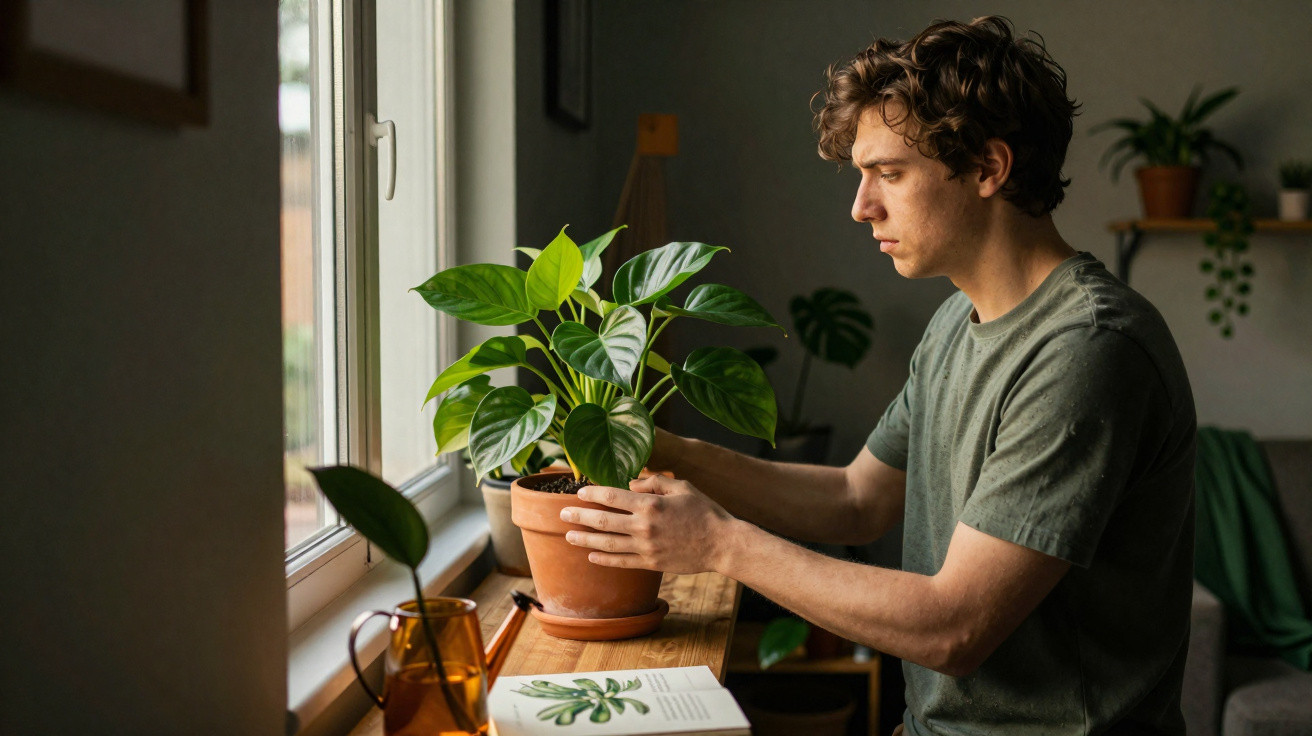
The first time I encountered it, the plant seemed almost artificial. Three tall, striped leaves reached boldly towards a window that received barely any sunshine, squeezed between a radiator and a pile of delivery boxes in a small fourth-floor flat. Beyond the glass, December pushed its grey face against the pane. Indoors, the whole room seemed weary apart from this determined flash of green.
Its owner merely shrugged. “I forget to water it for weeks and it just… doesn’t care,” she said, half-admiring, half-guilty.
That is the curious part of this type of plant. It endures conditions that make most plants wither, but people are increasingly asking whether keeping such a survivor indoors could be a subtle form of cruelty.
The plant that refuses to die… even in a cave-like flat
There is a particular kind of houseplant you discover only after living somewhere with almost no natural light: a north-facing studio, a window obscured by the building opposite, or curtains kept closed because the neighbours are too inquisitive. Bring home an ordinary plant and it may struggle on for several months before surrendering in a sad silence of yellowing leaves.
Then, perhaps, somebody gives you a low-light champion: a snake plant, a ZZ plant or possibly a pothos. You place it in a corner that scarcely qualifies as daylight, overlook it during a hectic month, and then spot fresh shoots. It is not merely surviving; it is flourishing.
A friend lives in a slim Paris flat whose hallway never receives direct sunlight. Two years ago, she put a small ZZ plant by the entrance, chiefly to draw attention away from the flaking paint.
It has since grown to twice its original size. There are no grow lights, complicated compost mixes or specialist fertilisers involved. It gets only tap water every fortnight or so, along with the muted ambient light from a hallway lamp.
Whenever visitors arrive, they ask the same question: “How is this even alive here?” She laughs before admitting, slightly sheepishly, that the plant is likely in better health than she is.
The botanical reason is fairly straightforward. Snake plants and ZZ plants developed in understoreys, shaded areas or demanding climates, where they needed to become exceptionally good at conserving energy.
They retain water in substantial leaves or fleshy rhizomes, grow at an unhurried pace, and make remarkably efficient use of the limited light available to them. For someone living in a flat, that can sound like an ideal pairing.
However, as these resilient species have become social-media sensations labelled “unkillable”, a quieter question has emerged: if a plant copes this well, are we properly looking after it, or simply taking advantage of its toughness?
Are we caring for them… or using them as green furniture?
Anyone who has shifted a hardy indoor plant nearer a window and watched its foliage become richer in colour has seen a glimpse of the answer. These so-called low-light plants do not truly love darkness; they simply withstand it better than many others.
The practical solution is straightforward. Put the plant in the brightest indirect-light position your home can sensibly provide, then allow it to demonstrate how undemanding it can be. Turn the pot a quarter-turn every few weeks, water only after the compost has dried, and recognise that slow growth is not a sign of failure. It is simply the plant setting its own pace.
Many owners make the same mistake: they hear “low light” and understand it as “no light”. The plant is then placed on a windowless bathroom shelf or in a corner untouched by sunshine since the 1990s.
Initially, its leaves remain firm and green. After several months, however, growth slows almost to nothing, stems become lanky and pale, and new leaves arrive smaller and less robust. The plant is not protesting; it is staying alive through energy-saving mode, like a phone trapped at 1% battery.
Most of us know that moment: you look at a plant which is technically alive but plainly not doing well, and feel an unexpected pang of responsibility for something unable to speak.
There is a psychological aspect that receives little attention, too. We choose hardy plants because they accommodate our disorganised lives, rather than expecting us to adapt to theirs. They endure delayed watering, stale air and dust left on their foliage for weeks.
Let’s be honest: nobody really does this every single day.
Yet some botanists and ethically minded gardeners are beginning to challenge this attitude. They argue that marketing a plant as “indestructible” can lead people to see it as decoration, rather than a living organism with preferences, rhythms and limits of its own. A plant that can endure anything is still allowed to want something. Light. Fresh air. Space to grow, even if slowly.
How to care for a hardy indoor plant without betraying its wild side
You can keep these tough species indoors while respecting their natural requirements, without converting your flat into a greenhouse. Think of it as a gentle improvement, rather than a total lifestyle change.
Begin by assessing the light in your home. Stand where you intend to keep the plant and look at your phone screen: if reading a book there during the day would be difficult without switching on a lamp, the place is too dark even for a hardy plant. Move it nearer a window, while protecting it from fierce midday sun with a sheer curtain.
Wipe the leaves with a soft cloth once a month so that dust does not obstruct the limited light they already receive. It takes only two minutes, but can make a quiet difference.
One of the most common errors with resilient plants is treating their toughness as permission to neglect them. People say, “It’s fine, it’s a snake plant, it doesn’t care,” while watering it just once every three months and never repotting it.
A kinder method is to regard the plant as a low-maintenance friend rather than an invulnerable object. Test the compost with your finger instead of following a fixed timetable. When roots circle the base of the pot, move it up by one pot size rather than three, helping to prevent waterlogged compost.
If you feel uneasy about keeping a species that grows naturally outdoors inside, you are not alone. That discomfort can be helpful when it encourages manageable, regular actions instead of dramatic resolutions that cannot be sustained.
A plant scientist I interviewed last year told me, “The problem isn’t that we’re bringing hardy plants indoors. The problem is when we stop seeing them as wild beings and start seeing them as plastic objects that happen to be green.”
She recommended thinking of an indoor plant as a distant cousin of its wild relations, one that still retains the same instincts. It needs light, even if softened. It needs air movement, even if that only comes from opening a window slightly once each day. It needs a resting season and a season of growth, however modest that growth may be.
In everyday terms, this means adopting small habits you can repeat:
- Keep your hardy plant in the brightest indirect light available, rather than in the darkest corner.
- Water according to dry compost, not a fixed date marked in your diary.
- Occasionally refresh the air by ventilating the room, even if only for ten minutes.
- Repot every 1–2 years so that roots do not remain permanently restricted and gasping for space.
- Observe the leaves: their colour, texture and position form the plant’s quiet language.
These five adjustments can take a plant out of survival mode and bring it closer to a modest urban version of flourishing.
Living with a plant that could survive you
Once you begin noticing these details, hardy houseplants bring up an awkward question: do we select them because they suit our way of life, or because they pardon our neglect?
There is no simple reply, and that may be exactly the point. A tough plant in a dim flat represents a compromise between human needs and botanical reality. It will not encounter the wind of its evolution, the insects it once lived alongside, or the full sunshine of its ancestral environment. In return, though, it is protected from frost, drought and being trodden underfoot.
What you can provide is not a flawless wild habitat, but a relationship that recognises what the plant is designed for: brighter positions when they are possible, patience with gradual growth, and enough curiosity about its origins not to treat it as background wallpaper.
If you look towards a corner of your room now and see a strip of green stoically persisting, perhaps the real question is not “Is it wrong to keep it indoors?” but “What small thing could I alter so that it is not merely enduring my home, but quietly, stubbornly, enjoying it?”
| Key point | Detail | Value for the reader |
|---|---|---|
| Hardy plants tolerate low light, not zero light | They evolved to endure shade, but still require bright indirect light to genuinely flourish | Helps you position your plant in the best available place in a dim home |
| Resilience is not a free pass for neglect | Snake plants, ZZ plants and others can survive poor care, but will grow more fully with minimal additional attention | Demonstrates how small habits can turn a struggling plant into a flourishing one |
| Ethical care is about small, consistent gestures | Cleaning leaves, repotting occasionally and improving airflow honour the plant’s wild origins | Allows you to enjoy indoor greenery without feeling that you are compromising its wellbeing |
FAQ:
Question 1: Is it really bad for a hardy plant’s wellbeing to live indoors all its life?
Not necessarily. Many hardy species adjust well to indoor living when they receive reasonable light, suitable watering and sufficient root room. The issue begins when they are regarded as ornaments instead of living organisms.Question 2: Can a “low-light” plant live in a room with no window at all?
Not in the long term. It may remain alive for months under artificial lighting, but its health will eventually deteriorate without either a grow light or some natural light.Question 3: How do I know if my hardy plant is stressed by low light?
Watch for elongated, leggy growth, pale or yellow leaves, and extremely slow growth or no new leaves over many months. These indicate that the plant is relying on its reserves.Question 4: Is moving my plant outdoors for summer better for its wellbeing?
For many species, yes, provided you acclimatise them gradually to prevent sun scorch. A shaded balcony or patio with fresh air will often give them a genuine boost.Question 5: What’s one simple change I can make today for a hardy plant in a dim flat?
Move it to your brightest indirect-light position, then clean its leaves using a damp cloth. That small combination of increased light and cleaner foliage can visibly improve its health over time.
Comments
No comments yet. Be the first to comment!
Leave a Comment