
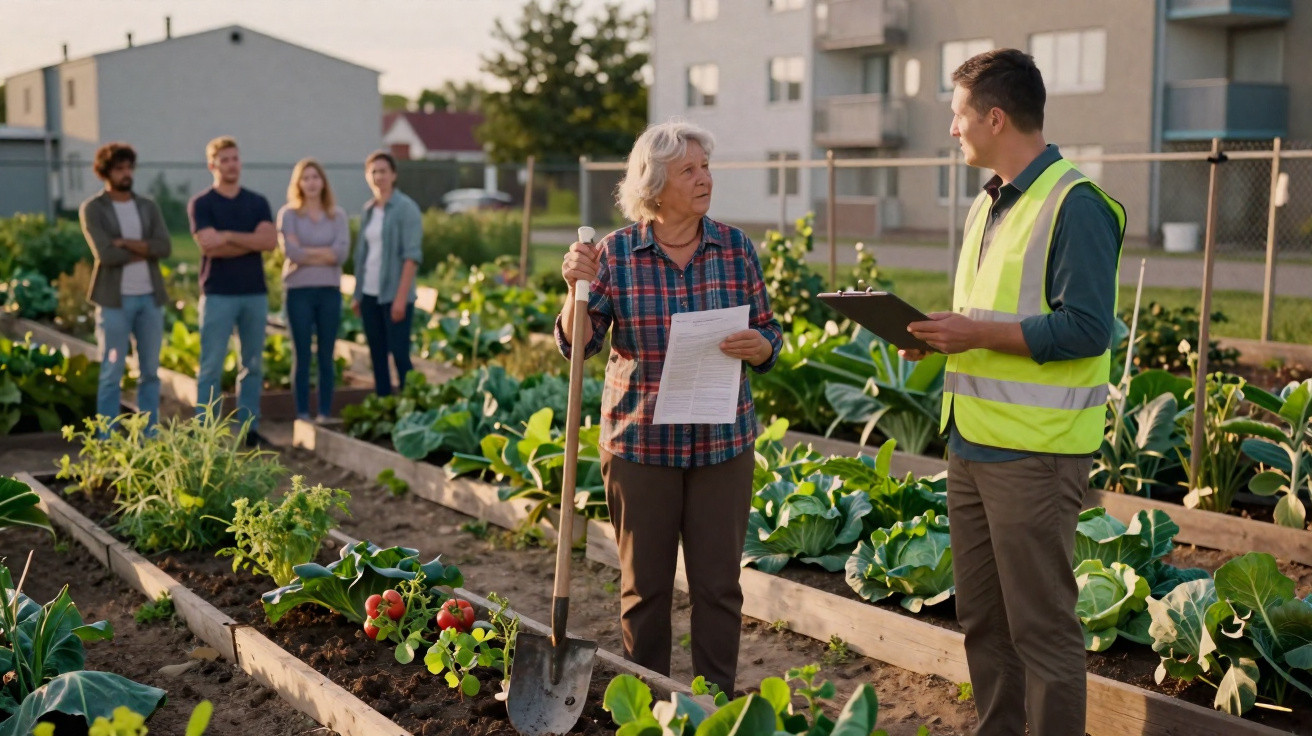
On a quiet grass verge between two blocks of flats – the sort of overlooked council land that usually escapes attention – a man in scuffed gardening gloves is crouched beside a line of cabbages. Karl*, 73, has worked this soil for longer than some neighbours have lived here. On this cold morning, he is not planting or picking crops. Watched by a council officer in a high-visibility vest, he is lifting wooden edging and taking down bean poles.
The council has instructed him to clear away his cherished vegetable beds, describing them as an “unauthorized occupation of public space.”
For 20 years, this small stretch of ground supplied his household and, at times, much of the block.
Now it has become a battleground.
A vegetable garden becomes a problem overnight
Seen from the road, Karl’s garden hardly appeared scandalous. There were several raised beds, an ageing watering can and a tangle of tomato canes familiar to any gardener. Residents say the plot gave the area more “alive” character than the neat yet lifeless grass the council had maintained there previously. In late summer, children walking past would point at the pumpkins as though they had found a hidden farm in the city.
Then a single letter upended everything.
A recorded-delivery envelope from the council referred to regulations and plot reference numbers. It labelled the beds a “non-compliant installation on municipal land” and allowed him 30 days to dismantle two decades of routine.
For Karl, the worst part is the timing. He says he never concealed the garden: it could be seen from the pavement and from every flat overlooking the courtyard. Council workers cutting the grass would stop to chat and take bunches of parsley before leaving. Nobody had ever objected.
Then a new resident moved into the block opposite the garden and began raising complaints about “mess” and “nuisances”. A photograph reached the head of a council department, a case file followed, and then came the letter.
One neighbour says softly, “We thought they’d send someone to talk, to find a middle ground… Not this.”
The dispute strikes a nerve because it pits two competing ideas of urban life against one another. On one side is public space that is orderly, controlled and standardised, administered through spreadsheets and legal notices. On the other are informal, human-scale places that people make for themselves with their hands and spare timber.
Urban planners refer to “temporary uses” and “citizen initiatives”. Pensioners such as Karl call it “growing some beans where there was just mud.” The law rarely catches up with the divide between those views.
The case has therefore become symbolic: who really owns the neglected corners of a city – the authorities or the people living beside them every day?
Neighbours divided by law, jealousy and solidarity
In the stairwell, the tale spreads faster than rumours about rent. One resident is angry: “It’s public land, he knew it.” Another accepts that the council is right, arguing that permitting one person to grow courgettes could lead to someone else parking an old caravan there. A third admits that she relied on Karl’s tomatoes near the end of the month when her wages arrived late.
These small alliances unfold by the post boxes, near the lift and in the building’s WhatsApp chats. One resident circulates a photograph of Karl beside his almost-cleared plot and asks who will sign a petition. Another responds with a screenshot from the municipal code, drawing attention to the phrase “unauthorized encroachment”.
The lawn no longer contains the garden, but it now occupies everyone’s thoughts.
Karl’s experience is not unusual. Across many cities, comparable disputes arise over compost corners, chicken runs and unofficial flower beds on council verges. In another district, a retired teacher was required to remove raspberry bushes beside a cycle route after a cyclist complained that they restricted visibility. A group of young parents were ordered to take away homemade benches from a playground because they were not “certified equipment.”
Such stories seldom reach national news, but they flare up on local Facebook groups. Beneath photographs of uprooted courgette plants, comments accumulate: “We can’t do anything anymore,” “Rules gone mad,” alongside more measured questions such as, “What if it was next to your window, with noise at 6 a.m.?”
These seemingly ordinary disputes reveal how precarious everyday compromises can be in shared places.
The council justifies its decision with reasoning that appears watertight on paper. If officers allow unregulated gardens on municipal land, where should the line be drawn? Who would be liable if a child were injured by a rusty stake, or if contaminated ground caused health problems? Rules are not drafted for Karl, the kindly older man sharing parsley; they are designed around the imagined worst-case outcome, the one that ends in court.
Council lawyers say they are not “against gardens,” but oppose informal plots with no documentation. They highlight existing community-garden programmes run by associations, with insurance and formal charters. Like many pensioners, Karl never joined one because he simply did not know the schemes existed.
Let’s be honest: hardly anyone reads an entire council website about “urban gardening procedures” before planting a tomato.
How vegetable garden conflicts could be handled differently
Beneath the anger, residents keep returning to one straightforward question: why did the council begin with a threat rather than a discussion? It could have knocked on Karl’s door, visited on a sunny morning or sent someone to step into the garden. Officers might have tested the soil, marked out a modest boundary and recommended safety improvements.
Some cities already take this approach. When informal uses of land emerge, they send mediators or “public space stewards” to speak to local people. Rather than issuing a top-down demand, they offer a simple arrangement: low fences, height limits for structures and unobstructed access for firefighters. The plot becomes semi-official while retaining its character.
That kind of action will not resolve every difficulty, but it can ease tensions for everyone nearby.
For residents, a frequent error is believing that “nobody complained so it must be fine.” A lengthy period without conflict can end suddenly when a new neighbour arrives, an official changes or an existing rule is enforced more strictly. Another risk is allowing a garden to expand beyond its original area. Three orderly beds can gradually turn into a cluttered collection of pallets, buckets and discarded furniture. That is often the point at which complaints begin.
If you are considering using an unused strip near your building, taking a few photographs and emailing the council’s green spaces department could make all the difference. It need not be a plea, merely: “this is what I’d like to do, is there a framework?” It may sound bureaucratic, but that small record on a server can be what protects your beans three years later.
We have all had that moment of realising that something made with care has never officially existed on paper.
Karl does not use the language of policy. Looking at his bare earth, he says quietly: “For 20 years this has been my reason to get out of bed. I gave half of what I grew away. Now they tell me I was disturbing public order.” Then he adds, almost apologizing, “It was just a few potatoes.”
For neighbours
Speak early, rather than waiting for the letter. A brief conversation in the corridor – “Is the garden bothering you? Anything that worries you?” – can often prevent the frustrated email to the council.For council officials
Send a person before sending a legal notice. Make one visit and spend ten minutes there. See the site, hear the individual and consider the symbolic human cost of the decision, rather than regulations alone.For would-be gardeners
Start modestly and make the project easy to reverse. Use light structures, avoid concrete and do not build permanent sheds. If one day someone says “this has to go,” it hurts less to dismantle a handful of beds than a whole invented world.
When a few square metres of soil show what a city values
Karl’s strip of council land is now a rough rectangle of turned earth, almost the same as it was before he ever worked it. The council intends to sow grass “for uniformity.” Looking down from their windows, neighbours see something else: a clear before and after. One version of events calls it “restored public space.” The other calls it “erased life.”
These minor disagreements over vegetable beds and flower borders will not determine an election. Even so, they quietly influence how people feel about their area. When a city rejects homemade solutions, some residents hear: “Your initiative isn’t welcome here.” When a neighbour contacts the authorities instead of knocking on a door, another unseen boundary is drawn between “us” and “them.”
Some of Karl’s backers are now discussing an official community garden nearby, this time with permissions, fencing and rules. Others believe that formalising it would remove the charm, since its appeal came precisely from having grown in the gaps of the system.
Between those positions, most people simply pause at their windows with a coffee, wondering what they would have done. Sent the email? Signed the petition? Knocked on Karl’s door to help him carry the final crate of onions upstairs?
The questions remain long after the beds have disappeared. They cling to the shoes of anyone crossing that lifeless stretch of grass and dimly recalling that tomatoes once grew there, tended by an old man who knew every neighbour’s favourite herb.
| Key point | Detail | Value for the reader |
|---|---|---|
| Informal gardens are fragile | One complaint or a stricter official can trigger a removal order even after years of tolerance | Helps readers gauge the real risk before investing time and emotion in a similar project |
| Dialogue can change outcomes | Early conversations with neighbours and a quick email to the council often defuse conflicts | Gives concrete steps to avoid abrupt confrontations and legal threats |
| Small plots reveal big issues | Vegetable beds on municipal land crystallise debates about ownership, regulation and solidarity | Invites readers to reflect on their own role in shared urban spaces |
FAQ:
Can a city really force someone to remove a vegetable garden on public land?
Yes. Municipal land belongs to the city, and most regulations treat any private use without permission as an encroachment, even if it’s just a few beds.Does long-term tolerance create a “right” to keep the garden?
In many places, no. Years of silence from authorities don’t automatically grant legal rights, although they can be used as an argument during mediation.How can residents safely start a shared garden near their building?
The safest path is to contact the municipality, join or form an association, and request an official plot or a temporary use agreement for a specific area.What if a neighbour’s garden on public space really bothers me?
The first step is almost always a direct, calm conversation. If that fails or you feel unsafe, you can contact the city, but that choice often escalates the situation.Are cities becoming stricter with these informal uses?
Many are tightening rules around liability and safety, while at the same time creating official community garden programs. The gray zone in between is where cases like Karl’s appear.




Comments
No comments yet. Be the first to comment!
Leave a Comment