
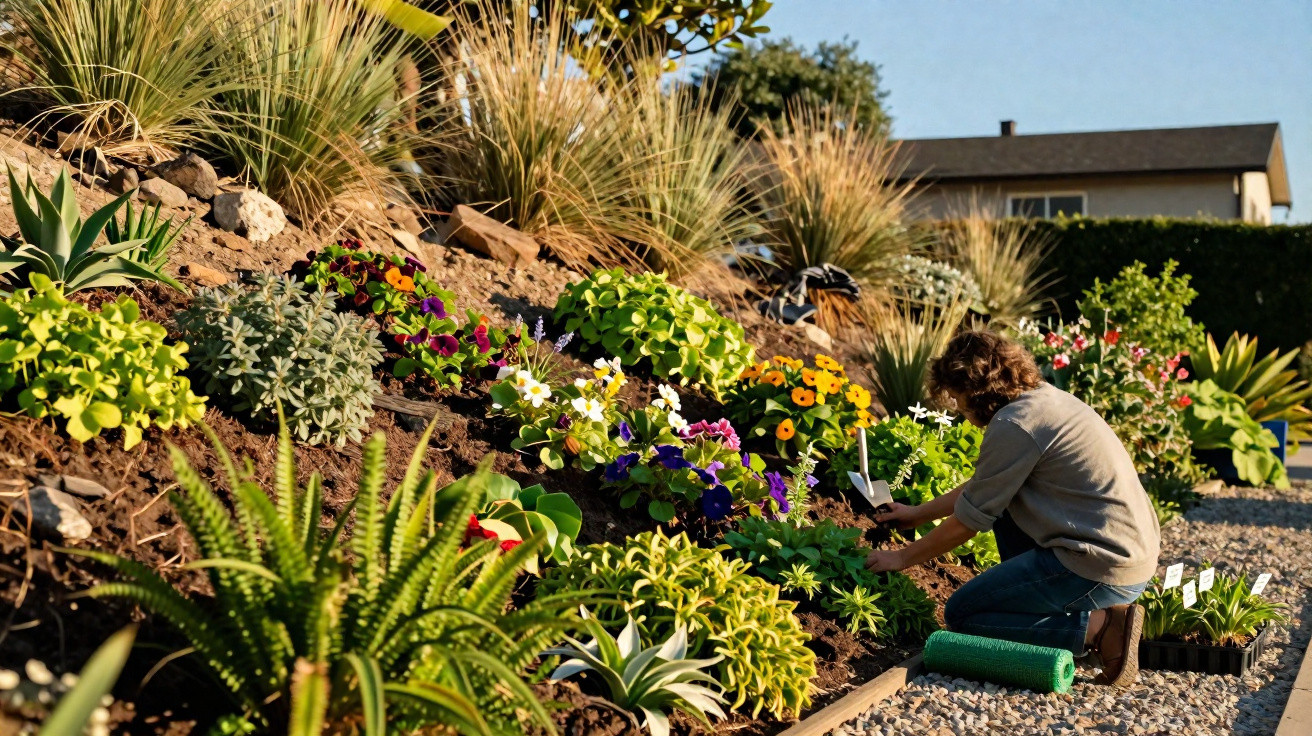
Many homeowners are frustrated by steep slopes around their property: they look bare, wash away during heavy rain and, when supported by a conventional retaining wall, can leave a huge hole in the budget. Landscape gardeners are therefore increasingly adopting a different approach: rather than concrete, roots stabilise the soil – for less than €20 per square metre.
Why a planted slope can outperform any wall
A stabilised slope has to do two jobs: remain secure while also allowing water to drain away effectively. Rainwater hits a solid concrete wall, collects at its base and may create issues elsewhere. A greened slope functions in an entirely different way.
Plants anchor soil like an invisible net, slow down rainfall, retain moisture and turn a problem area into a living habitat.
Garden and landscape specialists refer to this as an engineering-biological solution: roots take on the role of steel and stone, while foliage replaces costly drainage systems. On private plots with moderately sloping ground, this natural method is entirely sufficient in many cases.
Phytostabilisation: how roots hold a slope in place
The key term is phytostabilisation. It means carefully choosing plants with root systems that spread through loose soil in three dimensions and reinforce it. Tough ground-covering perennials and shrubs are particularly suitable.
Plants with numerous fine lateral roots are typical choices. They grip the earth like a tightly woven mesh. Their dense foliage also softens the impact of raindrops. Instead of striking exposed soil, water falls onto leaves and flowers, runs off more gently and can soak in without carving channels into the ground.
How to plant a slope correctly
Anyone wishing to green a slope themselves does not need specialist equipment, but they do need a clear plan:
- Thoroughly remove perennial root weeds from the slope.
- Position plants in a staggered pattern, rather than in straight rows.
- Allow for 4–5 plants per square metre.
- Plant the same species in groups of 6–7 for a calm, cohesive overall appearance.
- Mulch immediately after planting, ideally with coarse woodchip (for example, BRF).
On steeper ground from around 15 per cent, mulch alone is often insufficient. This is where a straightforward additional material helps: a biodegradable jute or coir mat. Lay it loosely over the soil, secure it with wooden pegs and cut cross-shaped openings at each planting point. The young container-grown plants are placed into these cuts. After one to two years, the root network has taken over the stabilising work and the mat gradually decomposes.
Suitable planting periods are autumn, from mid-September to the end of November, and spring, in March and April. The soil is generally moist enough at these times, allowing plants to establish roots without extreme heat or frost.
Three planting zones: creating a true cascade of flowers
A successful slope should be planned in layers. Each area has different conditions and requires suitable plants. Making use of these variations delivers both stability and visual appeal.
Upper slope: dry, windy and exposed to sun
At the top, soil is often poorest and most exposed to wind. Drought-tolerant species that cope with heat and changeable weather are well suited here:
- Ornamental grasses such as feather grass or fountain grass.
- Hardy small shrubs, including broom or rock shrubs.
- Resilient subshrubs such as germander or low-growing spindle shrubs.
- Small flowering shrubs with deep-reaching roots.
These plants define the slope and introduce vertical structure. They require little maintenance: only occasional pruning and some water during the first few weeks while they establish.
Middle of the slope: where erosion bites hardest
Rainfall and gravity have their strongest effect in the central section. This is the place for vigorous, deeply rooting ground-covering perennials and small woody plants. Together, they form a continuous cover that keeps the soil intact:
- Heuchera varieties with colourful foliage to add visual depth.
- Stonecrops and other Sedum varieties for dry spots.
- Small mat-forming perennials such as baby's breath and fleabane.
- Reliable slope plants, including creeping St John's wort or carpeting shrub varieties.
This zone acts as a living protective shield: it slows surface water, spreads it over a wider area and fills gaps before channels can form.
Lower slope: wetter, more nutrient-rich and often shadier
Water and nutrients accumulate at the foot of a slope. Soil here is usually heavier and cooler. Many flowering perennials thrive in these conditions:
- Sweet alyssum, which creates genuine carpets of flowers.
- Various bellflower species.
- Violets and other spring-flowering plants.
- Further Sedum and fleabane varieties for transition areas.
Large stones or boulders can be used to form small terraces. They interrupt water flow, retain soil and create pockets for additional plants.
What slope planting really costs
Compared with a built retaining wall costing €150 to €300 per square metre, a planted slope can seem remarkably modest. Many projects remain well below €20 per square metre when expensive specimen shrubs are avoided.
| Item | Typical cost per m² |
|---|---|
| Perennials and small shrubs (4–5 plants) | €10–15 |
| Jute or coir matting (for steep slopes) | €2–3 |
| Mulch material (for example, woodchip) | €1–2 |
| Doing the work yourself rather than hiring a contractor | €0 |
By consistently selecting smaller container plants, the price per square metre stays comfortably below the €20 mark. Over several seasons, the slope develops into a dense, flowering carpet.
When this method reaches its limits
There are circumstances in which plants alone are not enough. For extremely steep slopes, very large areas or ground immediately next to buildings, specialists often recommend a combination of measures: low terraces, dry natural-stone walls, gabions or lightweight support structures that can be covered by plants.
Loose sandy soil or heavily compacted ground almost always needs firm jute or coir matting at the outset, preventing the soil from slipping before roots take hold. Where cracks or settlement around buildings are already visible, a structural engineer or experienced garden and landscape professional should inspect the slope before work begins.
Practical example: from problem slope to flowering rain brake
A typical situation is a slope at roughly 30 degrees, exposed to driving rain, with soil regularly being washed onto a garden path. Rather than installing a substantial retaining wall, the owner chooses a scheme of robust perennials. Ground cover such as periwinkle and creeping plants with dense foliage secures the critical areas, while a jute mat initially keeps the soil in shape and a layer of coarse woodchip is spread over it.
Planting takes place in autumn, before the first night frosts. During the following two years, the vegetation closes over, the slope flowers in stages throughout the season, and heavy rain drains away considerably better. The budget remains well below €20 per square metre, yet the visual effect looks like a project that cost many times more.
Useful extra information for planning at home
Many terms may sound technical, but they are easy to explain. Mulch simply means a protective layer of organic material that reduces evaporation, suppresses weeds and shields soil from driving rain. BRF, often mentioned in this context, refers to coarse, fresh chipped wood from branches and twigs – ideal for slopes because it interlocks and does not slide away as quickly.
When compiling a planting list, it is worth considering insects and birds. Nectar-rich perennials, berry-bearing shrubs and evergreen plants provide food and shelter. The result is not only a stable slope, but also a small, low-maintenance haven for biodiversity in the garden.
It becomes particularly interesting when slope planting is combined with other features: a narrow winding path, several natural-stone steps or a small seating area at the lower edge can make the space accessible. What was once an unwanted slope then becomes a designed garden area that adds considerable value to the property – without heavy construction machinery or an expensive concrete retaining wall.





Comments
No comments yet. Be the first to comment!
Leave a Comment