
Do thorny blackberries turn the garden into a no-go area?
A remarkably simple cardboard trick clears them thoroughly while improving the soil at the same time.
Anyone who has ever found themselves in a thicket of blackberries will know that these plants do not surrender willingly. They scratch, cling to clothes and stubbornly return after being cut back. Yet a growing number of amateur gardeners swear by a method that sounds almost lazy: simply cover the area with cardboard and wait. There is more method behind it than might first appear.
Why blackberries return so persistently
Blackberries are among the classic problem plants in gardens. Their thorny canes may look manageable, but below ground they have an exceptionally vigorous root system. Cutting back only the growth above ground can even help the plants, as they regrow with renewed vigour.
Gardeners should be aware of the following:
- Blackberries produce long, branching root runners.
- Every piece of root left behind can generate new shoots.
- One summer is enough for them to overrun an entire corner.
- Using herbicides damages soil life, insects and groundwater.
Many people still resort to chemicals because repeatedly digging and cutting them back becomes too laborious. The cardboard method tackles exactly this frustration by exploiting the plants’ weak point: their need for light.
Blackberries: a nuisance in beds, a helper in nature
As irritating as they can be in a home garden, blackberries have a certain ecological appeal. They are typical pioneer plants, rapidly colonising and stabilising bare ground.
They are vital to many animals:
- Protective hedge: Dense, thorny canes provide birds and small mammals with secure shelter.
- Food: Their berries supply vitamins and energy for birds, insects and small mammals.
- Soil formation: Their roots hold soil together and prepare it for other plants.
Blackberries are useful to nature – but in the productive garden, they need clear boundaries.
This is precisely why many people look for effective solutions without using poison. Cardboard is particularly effective here.
The cardboard method: simply “starve” blackberries
The principle is strikingly simple: if sunlight cannot reach the leaves, the plant cannot produce energy. It gradually uses up its stored reserves until the root system collapses.
Step 1: Cut blackberries back close to ground level
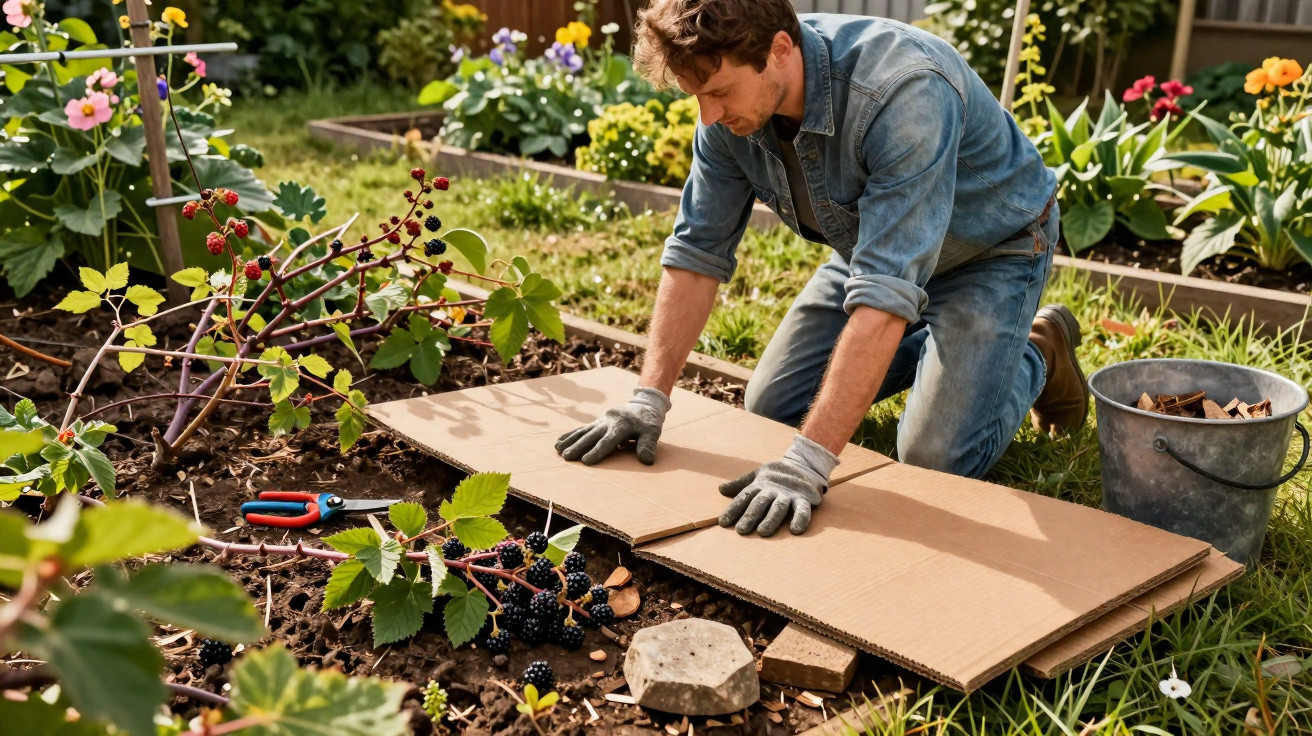
Start with secateurs or loppers. Cut all canes down as low as possible. Gloves and sturdy clothing are essential, as the thorns show no mercy.
- Cut every shoot back to just above ground level.
- Remove or shred the cut material.
- Use a saw to cut through particularly thick, old canes if necessary.
Importantly, the roots remain in the ground. At first this can seem like only half the job, but it is part of the strategy: the cardboard takes care of the rest.
Step 2: Cover the area completely with cardboard
Next, cover the entire blackberry patch with cardboard. The tighter the coverage, the better. Every tiny gap in the light gives the plants an opportunity.
- Use only sturdy, untreated cardboard without a glossy coating.
- Remove tape, metal staples and plastic film beforehand.
- Lay the cardboard with generous overlaps of at least 10–20 cm.
The crucial point is that no sunlight at all reaches the soil – otherwise the blackberries will launch a counterattack.
Step 3: Weigh down and disguise the cardboard
The cardboard needs weight to stop the wind carrying it away. At the same time, the area can be made more attractive.
- Secure the cardboard with stones, old bricks or timber lengths.
- Spread a thick layer of mulch, leaves, grass clippings or compost over it.
- The layer can comfortably be 5–10 cm deep.
This mulch layer has several benefits at once: it protects the cardboard from breaking down too quickly, retains moisture in the soil and feeds earthworms and microorganisms.
What happens in the soil while the cardboard works
A whole transformation process takes place beneath the unassuming cardboard layer. The blackberries rapidly lose strength while soil life becomes increasingly active.
| Process | Effect |
|---|---|
| No light for the shoots | The plant can no longer produce energy |
| Use of root reserves | Roots gradually die back |
| Breakdown of the cardboard | Humus formation and food for soil organisms |
| Mulch layer on top | Soil remains loose, moist and fertile |
Depending on the site and how dense the growth is, the process takes several months. Many gardeners leave the cardboard in place for a full growing season, from spring to autumn.
The benefits of the cardboard method at a glance
Anyone who has dug out a blackberry root with a garden fork will appreciate the alternative. The cardboard approach offers several advantages.
- Easier physically: No hours of digging or pulling at metres of root mass.
- Low cost: Delivery boxes are already common in many households.
- Ecologically sound: No herbicides and no harm to soil organisms.
- Improves the soil: As it decomposes, cardboard adds extra organic matter.
- Flexible: It can also be used for other troublesome weeds, such as ground elder or couch grass.
Rather than fighting the soil, the cardboard method works with it – turning a problem into fertile ground.
What comes after the cardboard
After a few months, the mulch layer can be carefully moved aside. By then, the cardboard will usually have largely rotted away or remain only in fragments. The ground beneath it will look dark, loose and surprisingly free of roots.
There are then several options:
- Create a vegetable bed straight away.
- Plant berry bushes in orderly rows.
- Sow a wildflower meadow for insects.
- Create a seating or practical area with woodchips.
An occasional blackberry shoot may still emerge, particularly around the edge of the covered area. Cut or dig out these shoots immediately. Anyone who keeps an eye on the area will soon have the situation under permanent control.
Common mistakes – and how to avoid them
To make the cardboard trick work, a few pitfalls need to be avoided:
- Layer too thin: One thin sheet of cardboard is rarely enough. Use several layers instead.
- Coated cardboard: Glossy or heavily printed packaging may contain harmful substances.
- Gaps around the edges: Blackberries exploit every opening. Edge areas need particular attention.
- Impatience: Uncovering the ground too soon risks fresh growth.
Planning generously from the start prevents later remedial work. Overlapping edges and a secure weight on top are especially important.
Cardboard as part of sustainable gardening
This method is an ideal fit for a nature-friendly, resource-conscious gardening style. Instead of buying new materials repeatedly, it makes practical use of leftover resources already available. Together, cardboard, leaves, grass clippings and compost form a kind of “lasagne” that improves the soil over the long term.
It is also interesting to combine the method with other strategies: planting densely growing ground cover after the cardboard phase prevents new problem plants from taking hold. Even tough species such as wild strawberries or stonecrop can help keep the area stable.
For anyone gardening with children, the cardboard project also makes an illustrative experiment: over several months, it is possible to watch an overgrown thorn thicket gradually become a new bed – entirely without poison, using a simple everyday material that would otherwise have ended up in the bin.
Comments
No comments yet. Be the first to comment!
Leave a Comment