
Taiwanese orchids produced 63 samples of disease-causing fungi, including one fungal group found across seven different orchid groups.
The findings demonstrate that root mould is not simply the result of watering errors. Growing conditions are crucial, as wet pots can harbour pathogens responsible for rot.
Investigating the origin of rot
In commercial orchid nurseries and flower markets throughout Taiwan, infected plants showed rot affecting their roots, stems, pseudobulbs and leaves.
After examining diseased orchid material, Wen-Hsin Chung, a plant pathologist at National Chung Hsing University (NCHU), linked the damage to a single fungal group.
At NCHU’s Taichung campus, Chung’s researchers observed disease developing within seven to 14 days of exposing wounds on healthy orchids.
The results illustrate how a waterlogged pot can become a serious problem for orchid owners.
The concealed identity of the fungi
The organism responsible is part of the Fusarium oxysporum species complex, a closely related group of soil-borne fungi that infects plants.
These fungi send thread-like cells through compromised tissue, interrupting water transport and changing solid root or stem tissue into soft material.
Genetic analysis divided the samples into six separate species, rather than one broadly defined mould type.
This distinction is important, since individual species can spread in different ways, prefer different hosts and respond differently to control methods.
How orchid types were affected
Terrestrial orchids had the greatest number of infections, accounting for 41 of the 63 confirmed fungal samples.
Cymbidium plants, a widely cultivated orchid group, frequently had rotting pseudobulbs: enlarged storage stems that retain water and nutrients.
Vanilla planifolia, the orchid used to produce commercial vanilla beans, developed root and stem rot that could remain unnoticed until the plant had weakened beyond recovery.
These subtle infections make early care essential, as mould may only become noticeable when it is already too late.
Six separate pathogens found
Of the six species, Fusarium curvatum – the most frequent – was identified in 34 survey samples.
A second species, Fusarium nirenbergiae – a fungus with a wide host range – made up 22 samples and was present in every vanilla sample.
Less common members also contributed, with two species recorded in only one or two samples.
Identifying the species gives growers a more precise treatment target. In the past, every case of root mould was managed using the same approaches.
Wet pots encourage disease
Root mould commonly starts when ageing bark decomposes, because its fine particles retain water and force air out of the pot.
Fresh growing media allow water to drain while retaining sufficient moisture for live roots between watering sessions.
If the material in a pot remains cold, dark and wet, oxygen levels fall and injured roots are more vulnerable to fungal invasion.
This is why an orchid may appear healthy for weeks before suddenly collapsing after heavy watering.
Conditions that favour fungi
Careful cleaning can be useful when mould is confined to the surface and the orchid has been removed from its pot.
Lukewarm water washes away loose spores and rotting bark, while cutting off soft roots removes the tissue on which fungi are still feeding.
An experiment using cinnamon oil against a related Fusarium pathogen showed that it prevented spore germination, helping to explain cinnamon’s cautious use on cut surfaces.
However, cinnamon, chamomile tea and diluted apple cider vinegar are not cures for deep Fusarium disease.
Why fresh media are essential
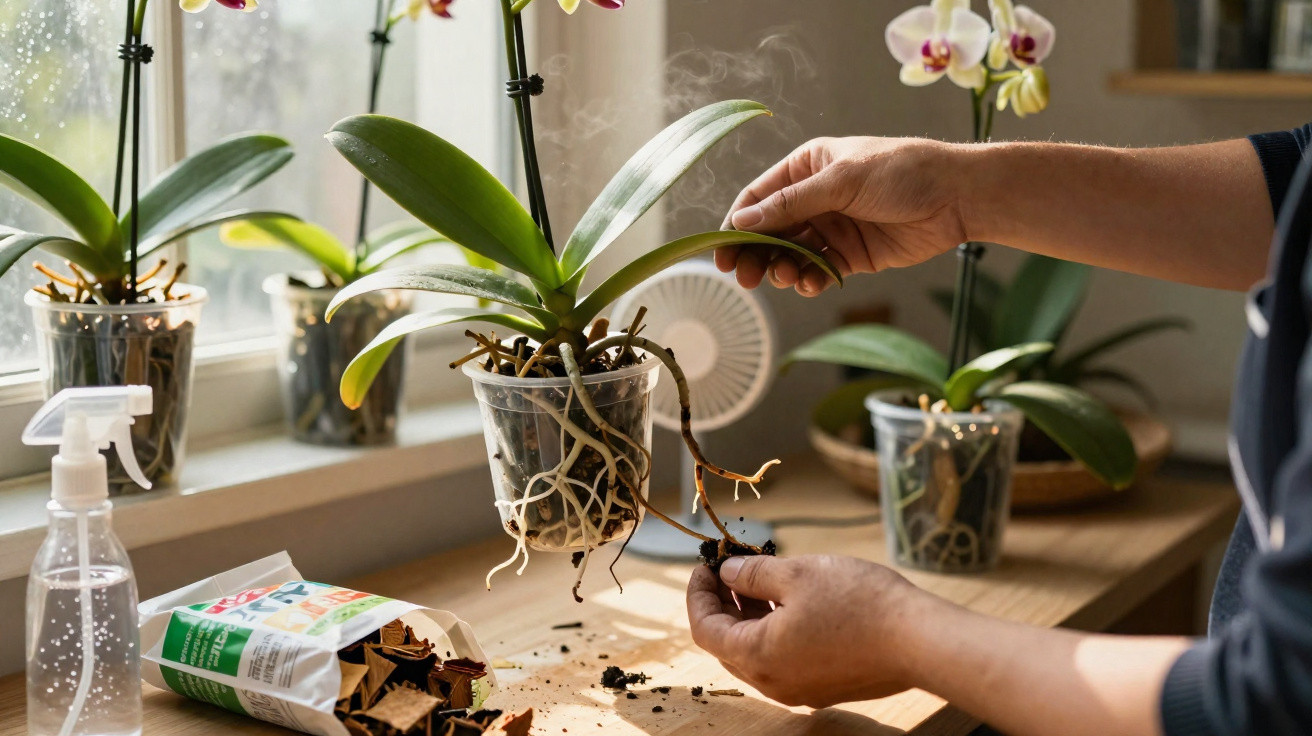
Removal is most effective when the orchid is replanted in a clean pot with unobstructed drainage and new bark.
Water must flow freely through drainage holes, as retained water leaves roots wet and concentrates salts around injured tissue.
Transparent pots allow owners to spot green, firm roots before damage reaches the main stem.
Attempts to rescue a plant have limits: soft, mushy tissue, a bad smell or expanding black patches often indicate that it is too severely affected to save.
Why orchids require airflow
Orchid roots require air just as much as water, which distinguishes them from typical houseplants.
Many orchids naturally grow on tree bark, meaning their exposed roots need wet-and-dry cycles rather than enclosed, saturated soil.
Adequate airflow dries the pot surface, reduces fungal growth and supplies root cells with oxygen.
Yet strong draughts may stress foliage, so consistent room air movement is preferable to directing a fan straight at the plant.
Replacing guesswork with diagnosis
The survey benefits commercial growers because rapid identification can distinguish a care-related issue from a disease outbreak.
DNA-based tests on samples give plant specialists a clearer explanation for the fungus, without relying on appearance alone.
Chung and his colleagues cautioned that Fusarium curvatum has also been associated with human infection in Taiwan.
“The potential threats to field managers cannot be ignored,” they wrote.
Healthy orchid roots rely on plant care and biology working together: open media, measured watering, clean cuts, steady airflow and disease identification.
For home growers, the safest response is not a more powerful household remedy, but prompt repotting, improved airflow and more frequent root inspections.






Comments
No comments yet. Be the first to comment!
Leave a Comment