
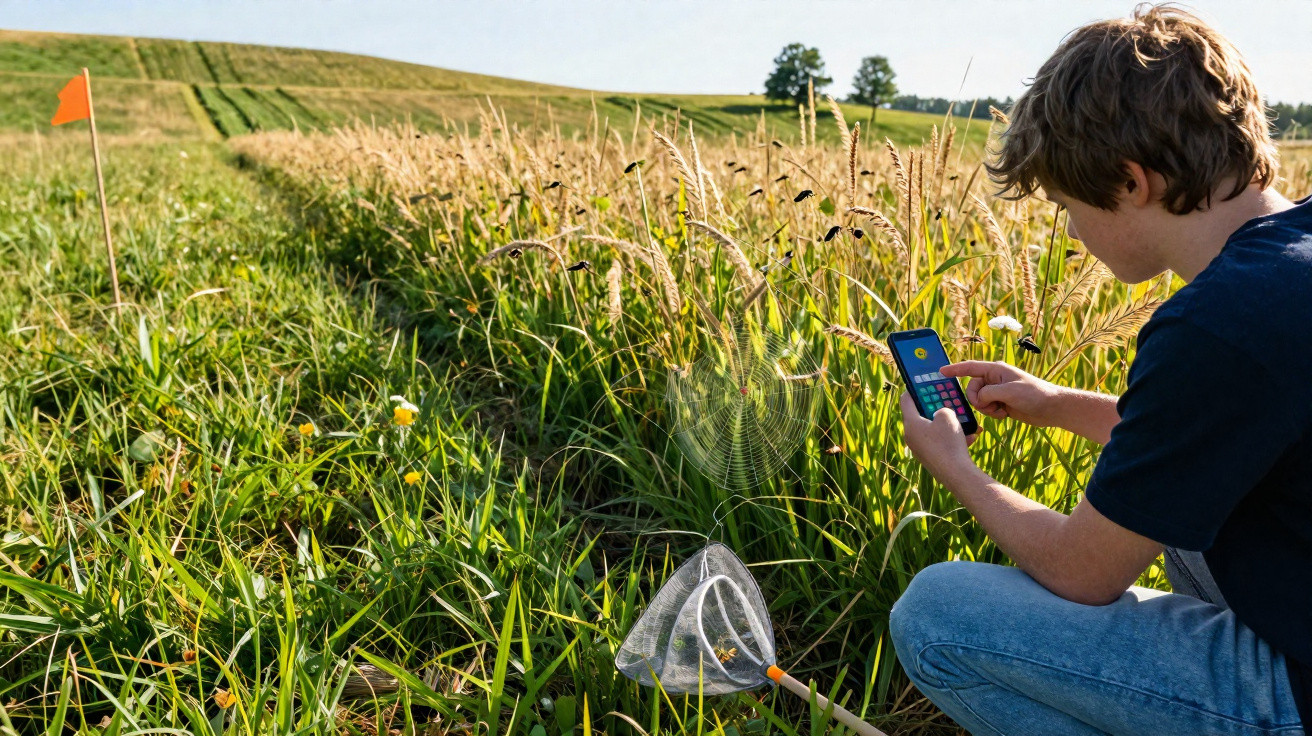
Beneath flowers and grass stems, thousands of insects and spiders make their homes, feed, breed and contribute to healthy ecosystems.
Many of these creatures pollinate plants, while others decompose organic material or become prey for birds and small mammals. Yet few people witness what occurs after a meadow is cut.
A new online tool makes this hidden world easier to understand by presenting scientific research in an accessible form.
Rather than depending on assumptions, it calculates the likely number of insects and spiders in a meadow and illustrates how alternative mowing approaches may affect them.
Its purpose is to support better green-space management decisions and help the public recognise wildlife that generally goes unseen.
From research to practical use
The web-based Insect Calculator estimates both the abundance and diversity of insects and spiders in grassland habitats.
Users can also compare mowing methods and see straight away how their decisions may alter local biodiversity.
Researchers developed a formula incorporating twelve separate variables to estimate the insect population within each square metre of meadow.
This formula is based on standardised field data gathered across several areas of Germany and Switzerland; the same dataset underpins the online calculator.
The calculator was created as part of BioDivKultur, an interdisciplinary project bringing together researchers at TU Darmstadt and field-based partners.
What the figures show
The results underline the substantial effect mowing has on meadow life. A single mowing event can cut insect and spider numbers by up to 73 percent, the researchers found.
This trend was observed among a range of groups, including cicadas, bugs and grasshoppers, though its scale differs from one group to another.
Grasslands in less isolated rural settings also tend to sustain denser insect and spider populations than green spaces enclosed by intensely built-up urban surroundings.
The type of machinery used is important too. Mulchers were associated with steeper reductions in insect numbers than bar mowers.
Mowing frequency, cutting height and various other management decisions likewise affect how many insects inhabit a meadow.
Uncut grass makes a difference
One measure emerged as particularly important in the research: keeping portions of a meadow uncut.
“One key finding is that whilst changes to mowing practices can have an effect – such as using mowers that are less harmful for insects or reducing the frequency of mowing – mowing itself has the greatest impact,” said study lead author Johanna Berger from the Technical University of Darmstadt.
“This highlights the importance of areas left unmown – so-called refuges. They are an effective measure for protecting insects and spiders, as they preserve resources and provide places for them to take refuge during or after mowing,”
Creating an insect refuge
Rotational mowing offers one way to establish such refuges. Rather than cutting a whole meadow in one go, managers mow only one section and leave another standing until a later date.
This approach gives insects and spiders somewhere to remain while the rest of their habitat regenerates.
The calculator provides an example for a meadow of roughly 100 square metres. When the full site is mown, about 13,000 insects and spiders are left.
Keeping 10 percent of the meadow uncut raises this figure to 14,350. Leaving 20 percent uncut brings it to 15,700, and retaining 30 percent increases it to 17,050.
A meadow left entirely unmown supports approximately 26,500 insects and spiders.
An Insect Calculator for everyone
The Insect Calculator features a Walking Mode for the public as well as an Expert Mode for those responsible for grassland management.
“For the Insect Calculator, we have compiled a comprehensive dataset from standardized one-square-meter samples of insects and spiders from Germany and Switzerland,” said Nico Blüthgen, project spokesperson for BioDivKultur.
“On this basis, it is possible to clearly demonstrate how various mowing parameters and the sealed area surrounding green spaces affect the number and diversity of insects and spiders.”
Tackling the biodiversity crisis
Co-author Margarita Hartlieb said the tool also offers further material, including links to records from the iNaturalist citizen-science project.
“Our understanding of the biodiversity crisis is growing, but there is still a lack of effective measures and action,” Berger said.
“A key solution for us in the scientific community is to link our findings to practical applications and communicate them more effectively, for example through digital and data-driven tools such as our Insect Calculator.”
The complete study appeared in the journal Ecological Solutions and Evidence.




Comments
No comments yet. Be the first to comment!
Leave a Comment