
A young boy stands in a supermarket aisle, gripping a crumpled £10 note.
His gaze flicks from a plastic dinosaur to a bag of sweets and then to a Lego set he absolutely “needs”. His father crouches beside him and tries to explain that, once the note has been spent, it has gone. The boy agrees, yet his hand is already moving towards the sweets.
When you are six, money seems like a magic trick. It turns up in your hand, vanishes in moments, and somehow reappears the following week. Tap a card, press a button, get a new toy. There is no physical weight, no real feeling of loss and no time to reflect.
Later that evening, the father washes out an empty jam jar and sets it on the kitchen worktop. “This,” he says, “is where the magic changes.”
When children can really see their money
Most children now grow up with money they cannot see. It exists behind screens and contactless beeps rather than in their palms. While that is practical for adults, it makes learning about saving incredibly difficult for a child.
Transparent jars cut through that illusion. Coins make a sound as they fall in, notes are folded up, and the amount steadily builds where everyone can see it. A £1 coin can suddenly seem tiny beside a large glass jar. A few lots of pocket money begin to represent potential instead of immediate spending. It is visual, tangible and surprisingly rewarding.
When a child can genuinely watch their money level rise, millimetre by millimetre, something changes. Saving is no longer an abstract talk from an adult; it becomes a quiet daily prompt sitting on the shelf.
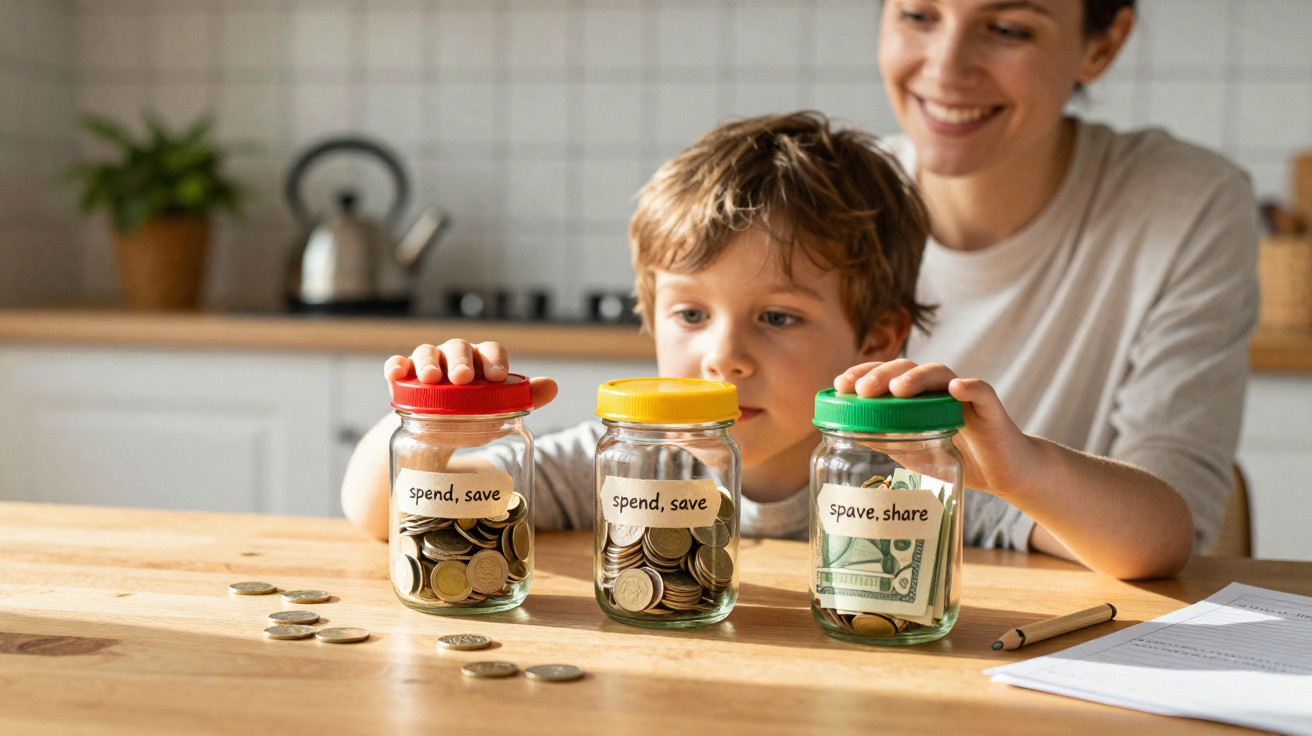
A mother in Manchester tried this after becoming fed up with weekly rows over Roblox credits. She gave her seven-year-old three clear jars, labelled by hand: “Spend”, “Save”, “Share”. The arrangement was straightforward: every amount of pocket money had to be divided between all three.
At first, he complained. The “Spend” jar was smaller while the “Save” jar was larger, which seemed unfair to him. After several weeks, though, the “Save” jar began to catch his attention because he could see its contents growing. She recalls the evening when he held it to the window and said quietly, “I think I can buy my own headphones soon.”
He continued to ask for Roblox, because children do not become saints overnight. However, the discussion shifted. Rather than asking, “Can you buy it?”, he began asking, “Do I have enough in my jar?” That one question can be the beginning of financial independence.
Jars are so effective for a simple reason: our brains respond to what we can see. We are naturally drawn to volume and movement. A figure showing a balance in an app does not change in a way a child can physically sense, whereas coins falling into a jar do.
Psychologists describe “delayed gratification” as an important life skill, including through the well-known marshmallow test. Jars offer a gentler, slower version of that test. Each coin presents a small decision: spend now or wait until later. The jar rewards patience with an increasingly large, gleaming collection. There are no graphs and no speeches, only glass and gravity.
Clear jars can slow children down too. A physical step between “I want” and “I buy” creates room for a brief pause. During that pause, useful questions can emerge: “Is this toy worth emptying my jar?”, “Do I want this more than the thing I’m saving for?” That pause is invaluable.
Setting up the three-jar method at home
Begin with three transparent jars. There is no need for expensive kits or clever technology: glass or strong see-through plastic will do. Give every jar its own purpose: Spend, Save and Share. Put the names on masking tape, allow your child to add small drawings, and make the system feel like theirs.
Then settle on an easy rule. For example, half of all money could go into “Save”, with a quarter going into “Spend” and another quarter into “Share”. You can alter the proportions according to their age. Younger children may need a slightly larger “Spend” share initially so they do not feel deprived. Participation matters more than getting everything exactly right.
This is where it becomes enjoyable. Whenever pocket money arrives, do not simply pass it over. Spend three minutes together and let your child choose where every coin should go. That short ritual is the lesson itself.
In theory, this may sound like the sort of routine we all expect to maintain forever. Let’s be honest: nobody really manages it every day. Life gets in the way. You are running late, they are exhausted, and the jar gathers dust on a shelf.
That is absolutely fine. Daily perfection is unnecessary. The important thing is keeping the jars visible and ensuring that money goes through them most of the time. Even irregular use creates a narrative in your child’s mind: “Money comes in, some of it stays, some of it helps, some of it goes.”
There are a few pitfalls to avoid. One is turning the jars into a punishment: “You didn’t tidy your room, so I’m taking a pound from your Save jar.” That makes saving feel like a loss. Another is borrowing from their jars yourself “just this once” and failing to replace it. Children notice. Trust around money begins early, and it works both ways.
Parents who maintain the jar method often notice an unusual, quiet pride developing in their children. It is not only about the cash; it is also about being trusted to manage it.
“The jars changed our arguments,” says Ben, a dad of two in Leeds. “We still say no to things, of course. But now I can point to the ‘Save’ jar and say, ‘That’s how you get to yes.’ It feels like we’re on the same team.”
Small rituals around the jars can help the habit last. They do not need to be elaborate, just simple anchors that keep the idea present:
- A weekly “money night” when your child empties, counts and refills every jar.
- A photograph of the item they are saving for, taped to the “Save” jar.
- A brief conversation every payday that connects your work - “I got paid today” - with their jars.
During a difficult week, the jars may not be touched at all. In a good week, they may become a small family occasion. The value is not in doing it flawlessly, but in returning to it repeatedly until it becomes a normal part of growing up.
The lasting lessons beyond the coins
As time passes, the real worth of these jars is not the money they contain. It lies in the stories your child begins to tell themselves about their relationship with money: “I’m someone who can wait.” “I’m someone who gives a bit away.” “I’m someone who can buy my own stuff.”
This is why jars can work especially well for children who find impulse control difficult. The glass acts rather like a mirror. They see more than coins: they see decisions they have made and kept to. For some children, it is the first time they feel in charge of anything involving money. That is significant.
Many parents introduce the jar method to reduce nagging in shops. They continue because they witness something special: their child counting out their own coins to buy a toy, standing a little taller and almost daring you not to feel proud. These are the moments that quietly reshape a family’s relationship with money.
| Key point | Detail | Benefit for the reader |
|---|---|---|
| Make money visible | Use clear jars so the child can watch their savings grow | Helps the child understand in practical terms what “saving” means |
| Give every jar a role | “Spend”, “Save”, “Share”, with an uncomplicated division of coins | Establishes the foundations of budgeting and giving early on |
| Create a small ritual | Take regular short periods to fill and count the jars | Turns financial theory into a shared lifelong habit |
FAQ
- At what age can I start using money jars with my child? Most children around 4–5 years old can grasp the idea that coins “stay” in a jar and grow over time. They won’t fully understand value yet, but they’ll get the idea of saving and waiting.
- How much pocket money should go into each jar? A simple starting point is 50% to “Save”, 30% to “Spend” and 20% to “Share”. You can adjust depending on age and personality. The exact percentages matter less than sticking to a clear rule.
- What if my child just empties the “Spend” jar immediately? That’s normal at first. Let them. The experience of watching an empty jar after a quick splurge is part of the lesson. Over time, they often start to hold back a little on their own.
- Can I replace physical jars with a banking app? Apps with “pots” or “spaces” can work for older kids, but younger ones need something they can touch and see. Many families start with jars, then move to digital versions around age 10–12.
- How do I handle gifts or money from grandparents? Use the same split. Let your child physically put birthday money into the jars, while you talk through the choices. It keeps the system consistent and shows that all money follows the same pattern.






Comments
No comments yet. Be the first to comment!
Leave a Comment